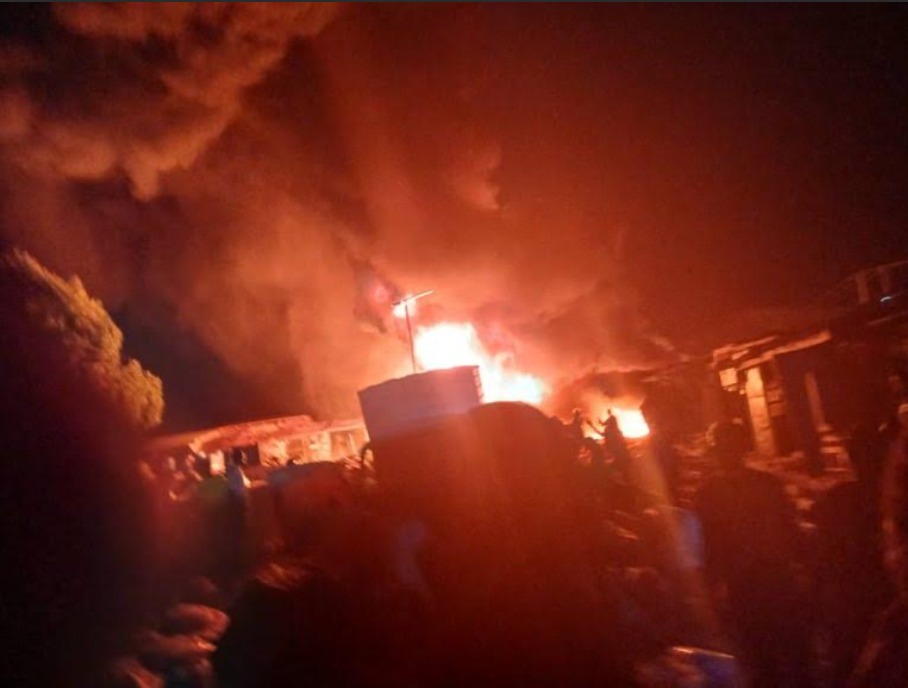
In the opening weeks of 2026, Nigeria has been plagued by a series of devastating fire outbreaks, exposing critical lapses in safety infrastructure and emergency response.
The most prominent incident involved the 25-storey Great Nigeria Insurance (GNI) House on Martins Street, Lagos Island, which caught fire on December 24, 2025, claiming lives and leaving families in mourning, as confirmed in public statements.
Similar tragedies were recorded across the country, including fires at Kure Market in Minna, Niger State; Terminus Market in Plateau State; Sabuwar Lale Furniture Market in Kano; Buzaye Garage in Sokoto; Haiba Plaza in Malumfashi; and a warehouse in Gusau, Zamfara State.
These incidents, often linked to negligence, energy poverty, and inadequate fire services, underscore a growing national crisis.
The question is, can Nigeria continue to ignore the systemic vulnerabilities that turn routine hazards into national catastrophes? In a resource-rich nation, such fires threaten economic stability and human security, calling for reforms that go far beyond official condolences.
The epidemic of fire outbreaks reveals a disturbing pattern of preventable destruction. In Lagos, the GNI fire raged for several days, hampering rescue efforts due to the building’s height and structural instability. Bodies were recovered amid fears that more victims remained trapped beneath the rubble. Traders reported losses running into millions of naira, as the inferno spread to adjoining structures, including a mosque.
In Minna, the Kure Market fire destroyed numerous shops and goods, displacing traders who depend on daily sales for survival. Terminus Market in Plateau and other affected locations followed a similar pattern, often triggered by electrical faults or the careless handling of flammable materials in overcrowded spaces.
Public outrage has been amplified on social media, where commentators highlight energy poverty marked by dependence on generators and faulty wiring as a significant risk factor.
Pointedly, the consequences extend beyond immediate destruction. Disrupted commerce in key markets destabilises local economies, while uninsured losses trap victims in cycles of poverty. The GNI incident, involving a central commercial hub, illustrates how urban density and weak enforcement of building standards transform structures into death traps.
Conditions across affected areas paint a harrowing picture of vulnerability. In Lagos, emergency responders battled the GNI fire for more than a week, with smoke persisting well into 2026, endangering rescue workers and nearby residents.
In the North, markets such as Kure and Terminus, critical for food and goods distribution, were reduced to ashes overnight, deepening food insecurity at a time when millions already face hunger.
The rural-urban divide further worsens outcomes. While Lagos can deploy agencies like LASEMA, many northern states lack comparable resources and rely heavily on volunteer firefighters. Energy poverty remains a central driver of the crisis, as erratic power supply forces households and traders to resort to unsafe alternatives such as candles and generators in highly flammable environments.
Corruption compounds the problem, diverting funds meant for safety upgrades, leaving fire hydrants unmaintained and equipment obsolete. These failures strain healthcare systems, overwhelm burn units, and erode community resilience, breeding fear in densely populated areas.
Official responses, though sometimes prompt, fall short in prevention. Lagos State Governor Babajide Sanwo-Olu visited the GNI site and ordered evacuations and structural audits. Yet, critics question why high-rise buildings continue to operate without functional sprinkler systems despite existing regulations. NEMA’s intervention reflects federal support, but delays in demolition expose coordination gaps among agencies.
Authorities frequently attribute fires to “negligence,” but this narrative oversimplifies the problem and deflects attention from systemic neglect. Outdated building codes, weak enforcement mechanisms, and compromised inspection regimes allow violations to flourish.
Regrettably, this reactive posture perpetuates a vicious cycle. Previous incidents, including market fires recorded in 2024, produced little meaningful reform. Political interference further undermines accountability, as inspections are often influenced by connections rather than compliance. Government assurances of “swift containment” ring hollow amid recurring tragedies, underscoring the failure to invest in preventive measures, such as public education and modern fire services.
The implications for national prosperity and cohesion are profound. Economic losses from incidents like the GNI fire and market infernos run into billions of naira, disrupting supply chains and driving up prices amid inflation exceeding 34 per cent. Human costs are equally severe: lives lost, families shattered, and survivors displaced into already congested urban slums.
Addressing this crisis requires urgent and coordinated intervention. The Federal Ministry responsible for works and housing must enforce updated building codes that mandate functional sprinklers, regular audits, and compliance certifications for high-rise buildings. State governments should invest in modern fire stations, equipment, and training, while partnering with the private sector to expand capacity.
Nigeria’s escalating fire epidemic from the GNI House in Lagos to markets across the northern states is a stark warning that the cost of inaction is no longer bearable.
The time for ritual condolences has passed. What Nigeria needs now is real, enforceable, and immediate action. Buildings must be made safe. Markets must be protected. Emergency services must be equipped. And those who cut corners, ignore standards, or profit from unsafe practices must be held accountable, without exception.
A country that cannot protect its people from preventable fires cannot claim progress. Until safety becomes a non-negotiable national priority, Nigeria will continue to count its losses in ashes and graves. Reform is no longer a policy choice; it is a moral obligation.
We’ve got the edge. Get real-time reports, breaking scoops, and exclusive angles delivered straight to your phone. Don’t settle for stale news. Join LEADERSHIP NEWS on WhatsApp for 24/7 updates →
Join Our WhatsApp Channel