
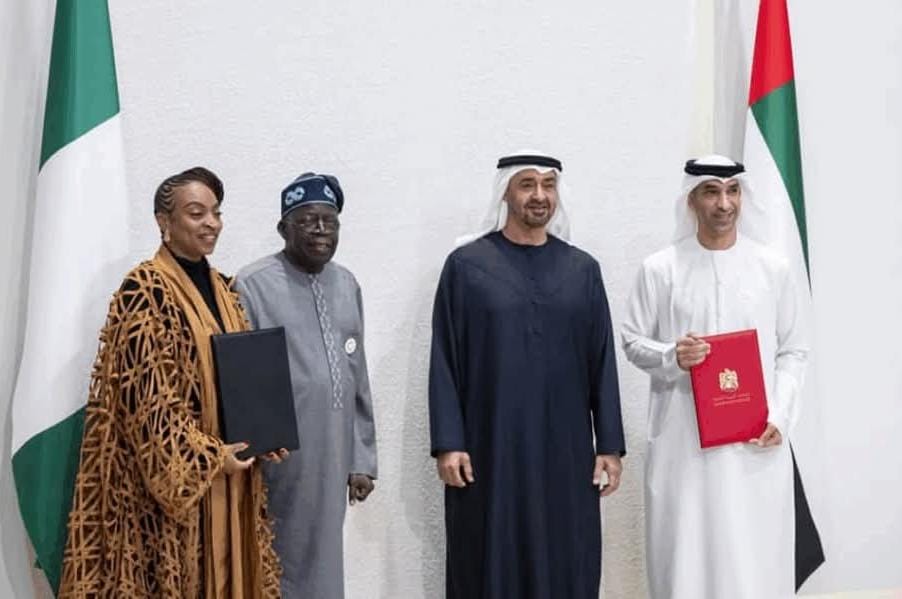
Nigeria and the United Arab Emirates (UAE) have signed a landmark Comprehensive Economic Partnership Agreement (CEPA) that will eliminate tariffs on thousands of products traded between both countries, a move expected to significantly boost bilateral trade and investment.
A member of the Governing Board of the North-East Development Commission, Rep. Sam Onuigbo, disclosed this in an interview with the News Agency of Nigeria (NAN) on Tuesday in Abuja.
According to Onuigbo, the CEPA, signed during the Abu Dhabi Sustainability Week held from January 11 to 15, 2026, marks a major milestone in Nigeria’s trade and economic diplomacy efforts.
“The CEPA was signed in January 2026, and the UAE will eliminate tariffs on 7,315 Nigerian products. This includes immediate duty-free access for 2,805 products, representing 38.3 per cent, with the remainder phased out over three to five years, covering agricultural and industrial goods,” Onuigbo said.
He added that under the reciprocal arrangement, Nigeria will also remove tariffs on 6,243 products imported from the UAE.
“That agreement creates wonderful opportunities between Nigerians and the Emirates,” he noted.
Onuigbo, who previously represented Ikwuano/Umuahia North and South Federal Constituency in the House of Representatives and chaired the Committee on Climate Change during the 8th Assembly, described the trade pact as a “game changer” for Nigerian entrepreneurs.
“The agreement is massive and would facilitate an environment for business persons in Nigeria, those with verifiable and identifiable businesses to go over there, open offices, work there for three months, and come back,” he explained.
He commended President Bola Tinubu for spearheading the agreement, saying it aligns with the administration’s vision of repositioning Nigeria’s economy, creating jobs, and strengthening the enabling environment for investors.
“Nigeria is ready for business. Nigeria’s carbon market framework policy was unveiled again in Abu Dhabi,” he said.
Highlighting the broader context of Nigeria’s development agenda, Onuigbo said the country is taking deliberate steps to close its energy and industrialisation gap.
“Nigeria is a nation of nearly 250 million people and has had, over the years, the challenge of not having enough energy or power to attain its economic and industrialisation targets. That is why Nigeria has been engaging in initiatives such as the Energy Transition Plan, the Climate Change Act, and the Electricity Act, which President Tinubu signed barely eight days after assuming office in 2023,” he explained.
He emphasised that Nigeria’s participation at the Abu Dhabi Sustainability Summit would further unlock global economic opportunities and partnerships in trade, climate action, and energy development.
“The President’s collaboration will address the challenges and devastating effects of climate change while building up Nigeria’s economy in 2026,” Onuigbo concluded.UAEU
We’ve got the edge. Get real-time reports, breaking scoops, and exclusive angles delivered straight to your phone. Don’t settle for stale news. Join LEADERSHIP NEWS on WhatsApp for 24/7 updates →
Join Our WhatsApp Channel