
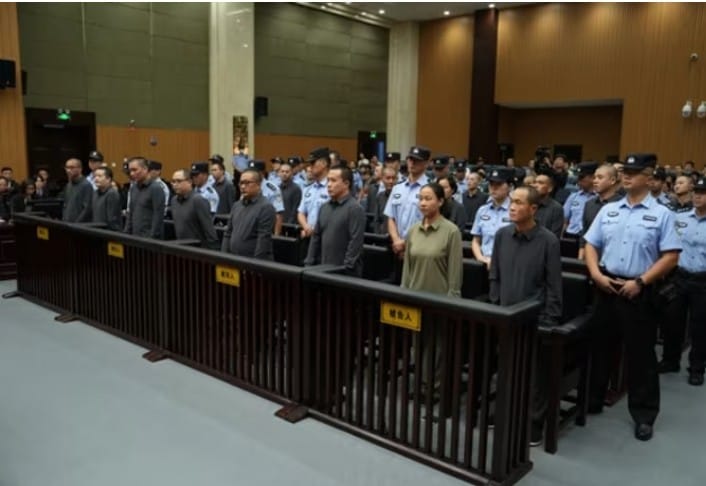
China has executed 11 members of the notorious Ming family criminal syndicate, accused of operating mafia-style scam centres in northern Myanmar and killing workers who attempted to escape, Chinese state media reported on Thursday.
According to Xinhua News Agency, the convicts were sentenced to death in September after being found guilty of crimes, including homicide, illegal detention and large-scale fraud. Two of the defendants appealed their convictions, but China’s Supreme People’s Court upheld the initial judgements.
The Ming family was one of the so-called “four families” of northern Myanmar powerful crime syndicates allegedly responsible for running hundreds of compounds involved in cyber fraud, prostitution and drug production. Members of the syndicate were also reported to have held influential positions within local government structures and militias aligned with Myanmar’s ruling military junta.
The criminal empire was led by Ming Xuechang and was closely linked to Crouching Tiger Villa, a notorious scam compound in Kokang, an autonomous region bordering China. At its peak, Chinese state broadcaster CCTV reported that the syndicate employed up to 10,000 people to carry out online scams and other illicit activities.
Kokang’s capital, Laukkaing, had become a hub of a multibillion-dollar scam industry thriving in lawless parts of Myanmar, where trafficked workers were forced to defraud victims through sophisticated online schemes.
Following mounting complaints from families of trafficked victims and increased international media scrutiny, Beijing intensified its crackdown on the scam compounds in 2023. In November of that year, Chinese authorities issued arrest warrants for key members of the Ming family, accusing them of fraud, murder and human trafficking, and announced cash rewards for their capture.
Xinhua reported that Ming Xuechang, who had previously served as a member of a Myanmar state parliament, later died by suicide while in custody.
Among those executed were Ming Guoping, the syndicate leader’s son and a senior figure in the junta-aligned Kokang Border Guard Force, as well as Ming Zhenzhen, his granddaughter. The report stated that the condemned individuals were allowed to meet with close relatives before their execution.
The syndicate was also said to have collaborated with another criminal leader, Wu Hongming, who was likewise executed. Chinese authorities accused them of conspiring to kill, injure and unlawfully detain scam workers, leading to the deaths of at least 14 Chinese citizens.
In one incident in October 2023, four people were killed when members of the group allegedly opened fire at a scam compound while transferring workers under armed guard, after being alerted to an impending police raid.
Scam networks in Southeast Asia are estimated to steal more than $43 billion annually, according to the United States Institute of Peace, a body founded by the US Congress.
In Myanmar, the proliferation of scam compounds has been enabled by entrenched corruption and weak governance in border regions, conditions further exacerbated by nearly five years of ongoing civil conflict.
We’ve got the edge. Get real-time reports, breaking scoops, and exclusive angles delivered straight to your phone. Don’t settle for stale news. Join LEADERSHIP NEWS on WhatsApp for 24/7 updates →
Join Our WhatsApp Channel