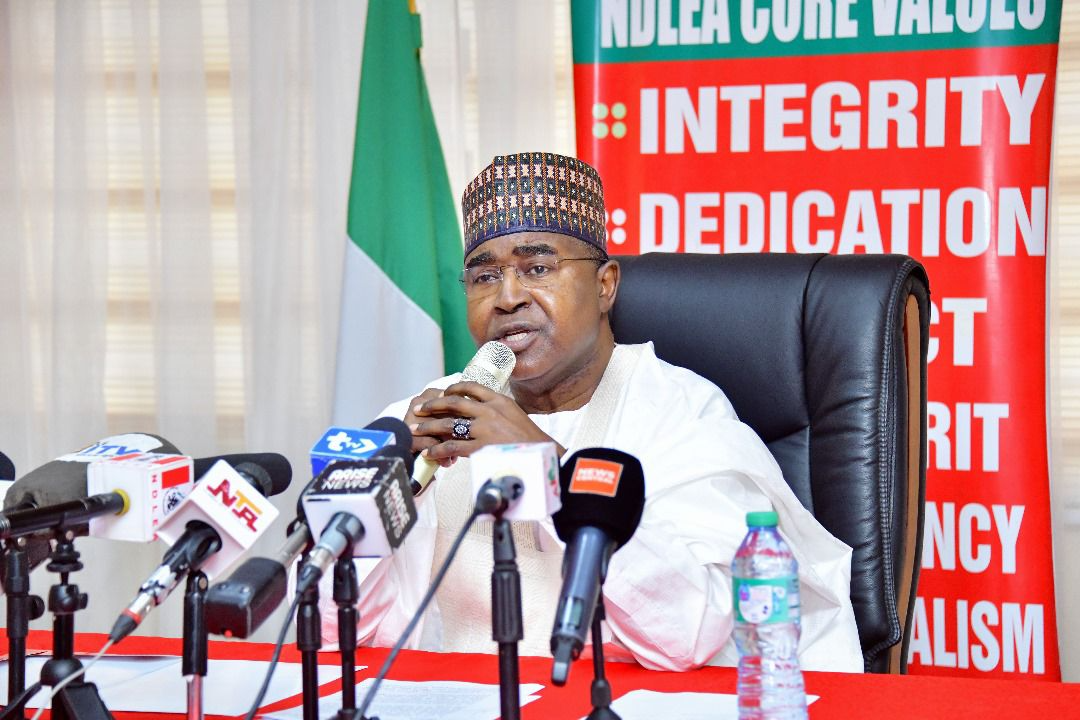
Recently, the National Drug Law Enforcement Agency (NDLEA), revealed that over 15 million Nigerians between age 15 and 64 years are confirmed to be using illicit drugs.
Citing the 2018 United Nations drug use survey, the Chairman and Chief Executive Officer of the NDLEA, Brigadier-General Mohammed Buba Marwa, said that one in every seven Nigerians in that age bracket consumes drugs and the figure was nearly three times the global average.
Meanwhile, official data presented by the agency showed that 77,792 drug-related arrests were made nationwide between 2021 and 2026, a figure that includes 128 individuals identified as major drug barons operating within expansive criminal networks.
Alongside the arrests, the NDLEA disclosed that 14,225 convictions were secured during the same period, reflecting what officials described as stronger case-building and improved collaboration with the judiciary.
As a newspaper, we are alarmed at the high incidences of illicit drug use in the country, especially among the youth despite efforts to arrest the trend.
Nigeria’s demographic structure is characterised by a very young population and because of the precarious stage of their physical and mental development, young people are more vulnerable to the harmful effects of drugs than the older segment of the population.
According to findings, the South West geopolitical zone, especially Lagos, Oyo, Ogun, and Ondo, has the highest drug prevalence at 24.4per cent, followed by the South-South at 18 per cent.
While the South has higher overall rates, the North (particularly North West) faces severe issues with specific substances, including high consumption of codeine syrup.
Lagos, Oyo, Ogun, and Ondo in the South West and Gombe, Yobe, Adamawa, and Bauchi in the North East east, are identified as major hotspots.
But drug use is a global problem. According to the United Nations Office on Drugs and Crime (UNODC), a stunning 284 million people used drugs in the world as of 2020.
It noted that the most commonly consumed drugs in the world include alcohol and cannabis/marijuana.
Outside of alcoholic beverages, cannabis is the most widely cultivated illicit drug in the world.
According to the United Nations 2022 World Drug Report, cannabis is cultivated in 154 of the world’s countries and territories, with opium, the next-most-prolifically cultivated drug, in 57 countries.
Similarly , the NDLEA said of the 15,000 tonnes of illicit substances that were seized in the last five years, over 75 per cent is cannabis and that 70 to 75 per cent of those who use drugs actually consume cannabis.
The country has in recent years gone from being a transit point for illegal drugs to a full-blown producer, consumer and distributor
The World Population Review said although these substances are legal to a certain degree in the vast majority of countries, they can still lead to a number of negative outcomes and health problems if abused.
As a newspaper, we recognise that drugs and crime are closely related, as research found that Illicit drug use and addiction, such as cocaine, also encourages people to commit crimes.
It also promotes criminalities.The Boko Haram, the terrorists and kidnappers are emboldened through drug use to carry out their nefarious activities.
This is due to the fact that these illegal substances provide the addicts with the Dutch bravery they need to perpetuate their bad behaviour.
Indeed, drug use has devastating consequences on most families and communities. But the country needs more than rhetorics to combat this menace.
We recall that the Nigerian Senate in 2024 proposed toughening penalties for drug trafficking, making the death penalty the new maximum sentence through a law amendment.
And it has a very severe penalty for drugs, cannabis included, 15 to 25 years with no option of fine.
Addressing Nigeria’s illicit drug use requires a multifaceted approach:
But Nigeria celebrates wrong things. We see our celebrities even in their music videos openly using drugs but the law enforcement agency has never called anyone to question.
And many of the country’s teeming youth see these celebrities as role models.
Even worse, in our opinion, weak maritime governance and corruption in ports offer opportunities to drug trafficking groups to move large volumes of drugs via maritime routes.
Though the NDLEA said it was engaging cannabis-growing communities to switch from illicit cultivation to legal crops, individuals at the lower levels of the drug supply chain, including farmers must be offered socio-economic alternatives.
UNODC said such alternatives should go beyond merely replacing crops or income and address root structural causes, such as deep-rooted poverty, under-development, insecurity and inequality.
Funding for such schemes could be sought from the private sector, or it could be derived from the social use of confiscated assets.
In our view, a holistic strategy that combines education, treatment, law enforcement, and community support is essential for reducing drug use and its impact in Nigeria.
We’ve got the edge. Get real-time reports, breaking scoops, and exclusive angles delivered straight to your phone. Don’t settle for stale news. Join LEADERSHIP NEWS on WhatsApp for 24/7 updates →
Join Our WhatsApp Channel