By Abhishek Singh
India is set to make history as it hosts the India–AI Impact Summit 2026, the first-ever global Artificial Intelligence Summit to be held in the Global South, from February 19–20 2026 in New Delhi. Announced by Hon’ble Prime Minister Narendra Modi at the France AI Action Summit, this landmark event signals a pivotal shift in how developing nations shape global AI discourse and policy a shift with profound implications for Nigeria and the African continent. Hon’ble Prime Minister Modi’s mantra—”Sarvajana Hitaya, Sarvajana Sukhaya” (welfare for all, happiness for all) which is the core theme of the Summit, echoes aspirations shared across Africa.
The Summit represents far more than a gathering of technology leaders and policy makers. It reflects a commitment to amplify the positive impact of AI while addressing urgent challenges posed by its rapid proliferation, including employment disruption, data sovereignty, widening digital divide. As India charts a path towards democratizing AI technology and ensuring its benefits reach beyond wealthy nations, Nigerian stakeholders from government officials to entrepreneurs can gain from this breakthrough.
At the heart of the India–AI Impact Summit lies an inclusive philosophy anchored in three foundational pillars, known as the Three Sutras—a Sanskrit term meaning guiding principles.
The People Sutra envisions AI as a force for human progress that respects cultural diversity, preserves human dignity, and ensures inclusion in both design and deployment.
The Planet Sutra emphasizes sustainable AI development that protects environmental health and promotes responsible innovation critical for African nations vulnerable to climate change.
The Progress Sutra focuses on accelerating economic growth and social good through democratized AI access, creating employment opportunities, and fostering innovation ecosystems. Together, these Sutras translate into seven interconnected Chakras—spheres of multilateral engagement—encompassing human capital development, social inclusion, safe and trusted AI, resilience, scientific advancement, democratization of AI resources, and economic growth.
The Summit propounds a simple yet far-reaching idea that AI resources must be treated as shared development enablers, not monopolies controlled by a handful. The IndiaAI Mission, which underpins the event, explicitly aims to create large-scale public AI infrastructure and make it accessible to partners, mirroring India’s earlier sharing of its digital public goods such as biometric ID (Aadhaar) and its real-time payment systems like the Unified Payments Interface. This would give opportunities for more collaborative platforms where Nigerian developers, startups, and public agencies can build and deploy AI solutions without bearing the prohibitive costs of licensing proprietary systems or renting expensive foreign computing resources.
Beyond the global governance and regulation issues, the Summit promises to highlight concrete development usecases in sectors like agriculture, healthcare, education, energy, and climate resilience. Simply put AI should translate into better crop yields for small farmers, faster disease detection in underresourced clinics, personalised learning tools for students, smarter power grid management, and improved disaster early warning systems. These themes dovetail with Nigeria’s own policy ambitions, from using satellite data and analytics for climate-smart agriculture to deploying AI-assisted diagnostics in primary healthcare centres and strengthening the digital backbone of social services.
Unlike traditional conferences, this Summit is designed as an action-generating platform. A Summit that will not only be a forum where people come and talk, but a forum where an action plan for the future will be laid down. This commitment to concrete outcomes—including a Leaders’ Declaration and multilateral cooperation frameworks—distinguishes it from previous AI gatherings.
Hosting the Summit is India’s effort and commitment to voice the interests of the Global South in the emerging technology governance. India believes that countries with similar development challenges should have a greater say in how global AI norms are set, rather than simply reacting to regulatory choices made by the more AI-advanced nations. This resonates with Nigeria’s position on reforming global institutions and pushing for fairer representation of African voices in international decision-making.
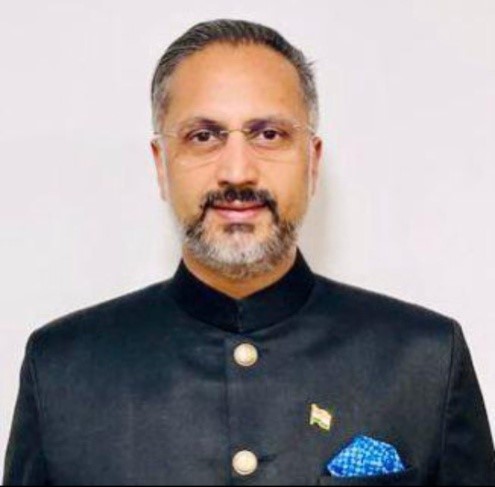
Ambassador Abhishek Singh is serving as High Commissioner of India to Nigeria concurrently accredited as Ambassador of India to Benin and Permanent Representative to the ECOWAS
We’ve got the edge. Get real-time reports, breaking scoops, and exclusive angles delivered straight to your phone. Don’t settle for stale news. Join LEADERSHIP NEWS on WhatsApp for 24/7 updates →
Join Our WhatsApp Channel