Whether positive or negative, residents of Makoko in Lagos are people of remarkable existential strength. Despite been homeless, environmental pollution and repeated demolitions of their homes, they have continued to endure in ways that defy pity and stereotypes. In many cases, when communities are pulled down by bulldozers, ordinary victims are forced into the streets, stripped of livelihood and dignity, often left with no option but to beg for survival. But Makoko’s story is different. SAMUEL ABULUDE and KINGSLEY OKOH write.
Makoko is a riverside community located on parts of the Lagos Lagoon in the Yaba suburban area of Lagos. Perched on stilts above the water and linked by narrow wooden walkways and canoes, the settlement has grown over time into one of the most distinctive waterfront communities in the state.
Historically, Makoko’s population is largely made up of the Egun people from Badagry, the Ilajes of Ondo State, as well as a significant number of settlers from the Republic of Benin and Togo who migrated in the 19th century. Over the decades, these groups have blended cultures and livelihoods, with fishing emerging as the dominant occupation that sustains families and shapes daily life along the lagoon.
Predominantly fishermen, the residents have thrived along the riverside for decades, drawing sustenance from waters others dismiss as uninhabitable. Even in the face of impoverished conditions and the trauma of seeing their homes reduced to rubble, they return to rebuild, to fish, and to live. Their resilience is not loud or dramatic, it is quiet, stubborn and deeply human. Here, survival is not handed out in alms, it is earned daily with calloused hands and unbroken spirit.
Although tales emanating from Makoko have often been steeped in anger, sorrow and, at times, blood, the latest chapter in its troubled history has left thousands in despair. Squatters at the Makoko/Iwaya waterfront, many of whom settled on the lagoon decades ago to pursue their fishing trade, suddenly found themselves in a hopeless situation when they were sent packing by the Lagos State Government.
For families whose lives are built around the water, eviction was not merely a loss of shelter but a severing of livelihood, heritage and identity. Nets were abandoned, wooden homes dismantled, and entire households displaced in a sweep that once again underscored the fragile existence of a people who have long lived at the mercy of policy decisions and urban expansion.
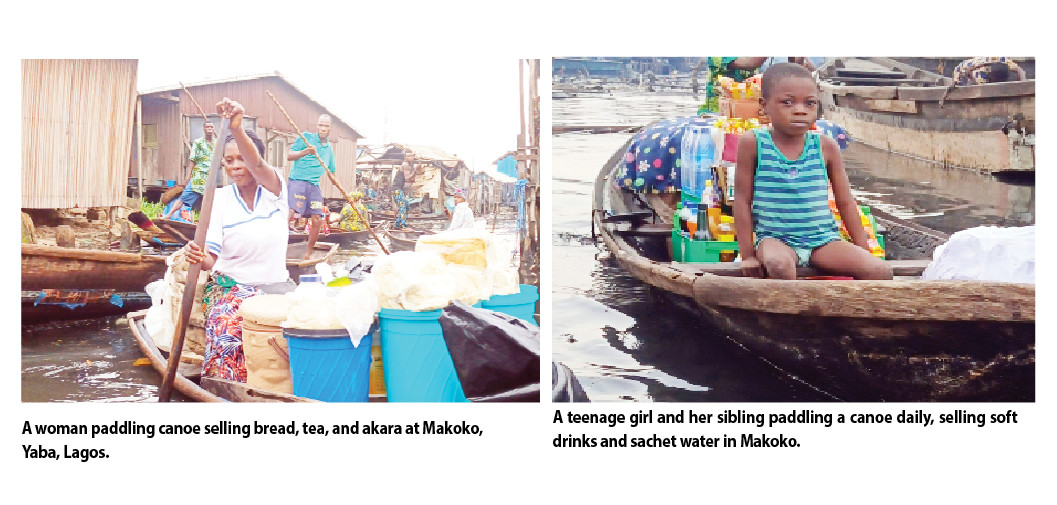
The practicality of the saying, when the going gets tough, the tough get going, came vividly to the fore when LEADERSHIP Sunday undertook visits to the community in search of one of the displaced settlers who had carved out an unusual means of survival. Amid the uncertainty that followed the demolition, she was said to be making a living selling akara (bean cakes), paddling from one corner of the waterways to another, balancing her tray and hope on the same fragile canoe.
The bravery and deeply inspirational story of the woman, Esther Zogbe, is one that demands reflection. A victim of the Makoko demolition, she refused to surrender to despair or become another statistic of displacement. Instead, she turned the very waters that once threatened to swallow her home into a marketplace, redefining survival with courage and quiet determination.
According to one of the community executives, Chief Tobi Aidee, who took responsibility for guiding our correspondents around the settlement, the challenges confronting residents are enormous. As we sailed through the murky, refuse-laden waters of Makoko in search of the akara-selling widow, he spoke of displacement, hunger, failing wooden structures and the constant fear of another demolition. Each paddle stroke revealed not just the physical hardship of life on water, but the emotional weight carried by families struggling to hold on.
As we combed the riverside community trying to locate the woman whose photograph, frying and selling akara from a boat had gone viral, other sordid realities surfaced. Children played barefoot on fragile planks suspended above polluted water; mothers nursed infants in homes patched together with tarpaulin and scrap wood; fishermen mended torn nets beside houses marked for removal. It became painfully clear that Esther Zogbe’s story, inspiring as it is, represents only one thread in a wider tapestry of resilience woven through adversity.
Our host in the Makoko community, Chief Tobi Aidee, runs a foundation that includes a nursery and primary school where a large number of children are tutored free of charge. In a place where poverty and displacement often cut short the dreams of the young, the school stands as a quiet sanctuary. It’s wooden walls sheltering hope as much as learning.
Upon learning that the akara-selling woman was being sought out for support, he quickly relayed the information to members of his group, noting that she was to be empowered. For a community accustomed to broken promises and sudden demolitions, the possibility that one of their own could receive meaningful assistance sparked cautious optimism, a reminder that even in the harshest conditions, solidarity and small acts of intervention can make a difference.
While waiting to be led further through the narrow waterways, the community leader, a son of the Baale, Chief Jeje, spoke with visible pain about his personal losses. He lamented that two of his houses were pulled down during the demolition exercise carried out by the Lagos State Government task force, despite his insistence that the structures were located beyond the stipulated boundary.
According to him, the directive had stated that all settlements within one hundred metres of the power line corridor were to be demolished. Yet, he claimed his properties stood outside that limit.
For a man born into leadership within Makoko, the experience was not only financially devastating but emotionally bruising, proof that even those entrusted with guiding the community are not spared when bulldozers arrive.
“I was not around when the demolition commenced last December. My houses were among those pulled down, and I lost a huge amount of money in the process. When I was summoned by my people and returned, I confronted the officials because, as an educated person, I could see they were going beyond the stipulated 100-metre boundary from the power line. Instead of listening to us, some of us were arrested.”
He explained that what began as an attempt to seek clarification quickly escalated into intimidation. For many residents of Makoko, the experience reinforced a painful pattern, demolitions carried out with little dialogue, leaving affected families not only dispossessed but feeling voiceless in the face of authority.
“This is our existence,” says Chief Tobi Aidee, gesturing around the school. “Some of the students you are seeing lost their homes too and are now living here at the school, and we cater for them. You can even see the jollof rice being shared to them right now. I’ve received support from some organisations that help pay for the teachers and provide school uniforms for these children.”
We’ve got the edge. Get real-time reports, breaking scoops, and exclusive angles delivered straight to your phone. Don’t settle for stale news. Join LEADERSHIP NEWS on WhatsApp for 24/7 updates →
Join Our WhatsApp Channel