
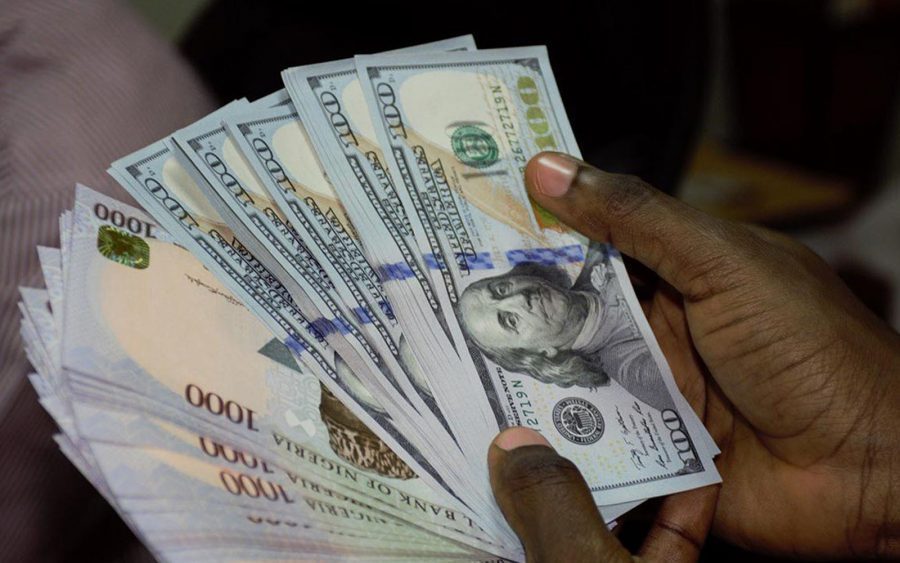
Nigeria’s foreign exchange market opened the year on a resilient footing, as total inflows into the Nigerian Foreign Exchange Market eased to $3.00 billion in January 2026.
This is even as Foreign Portfolio Investors (FPI) stepped up participation and strengthened liquidity conditions.
Data from the FMDQ Securities Exchange showed that while total inflows declined by 10.8 per cent month on month from $3.37 billion in December to $3.00 billion in January, inflows from offshore sources surged by 111. 5per cent.
It was gathered that moderation was largely driven by a sharp contraction in domestic inflows, which accounted for 40.4 per cent of total flows during the month.
Inflows from local sources fell by 51.9 per cent to $1.22 billion, down from $2.52 billion in December. The decline was attributed to reduced accretions from the Central Bank of Nigeria, individuals, exporters and importers, and non-bank corporates. In particular, inflows from the apex bank fell by 95.1 per cent, while individuals, exporters, and importers recorded declines of 59.1 per cent, 28.5 per cent, and 28.5 per cent, respectively.
However, foreign inflows provided a strong counterbalance. Accretions from offshore sources surged by 111.5 per cent month on month to $1.79 billion, compared with $847.40 million in December.
The uptick was driven largely by a 135.1 per cent increase in foreign portfolio investment and a 74.8 per cent rise in other corporate inflows, which more than offset a 40 per cent decline in foreign direct investment.
The naira mirrored the improved liquidity conditions. At the official window, the currency appreciated to N1,391 per dollar in January from N1,429 per dollar in December, extending the 7.4 per cent year-on-year gain recorded in 2025.
The average exchange rate strengthened to N1,416.5 per dollar from N1,452 per dollar in the preceding month, reflecting reduced volatility and better price discovery.
Market watchers attributed the firm performance to sustained reforms by the CBN, improved trade receipts amid elevated global oil prices, and relatively subdued demand for foreign exchange at the start of the year, when corporates typically delay large import-related requests.
External reserves also strengthened, rising by $778 million month on month to $46.3 billion in January. The upward trend persisted into February, with reserves climbing by $505.70 million week on week to $47.53 billion as of February 10.
In the forwards market, the naira appreciated across contracts, with gains recorded in the one-month, three-month, and one-year tenors, signalling improved investor sentiment and expectations of continued stability.
The CBN last week moved to enhance liquidity at the retail end of the market by approving the weekly sale of $150,000 by authorised dealers to licensed bureau de change operators, a step analysts say could ease pressure in the parallel segment.
Despite gains at the official window, the naira weakened marginally by 0.5 per cent in the parallel market to N1,475 per dollar, widening the spread between the segments. Analysts cautioned that the divergence reflects lingering structural distortions that could create arbitrage opportunities if not addressed.
Looking ahead, analysts at Cordros Research said they expect inflows from both domestic and foreign sources to remain firm, supported by sustained market confidence and attractive yields. They also projected that the naira would remain broadly stable in the near term, buoyed by a weaker US dollar, strong reserves position and continued capital inflows.
Similarly, analysts at Quest Merchant Bank expressed optimism that the currency would trade within a narrow band in the coming months, underpinned by stronger offshore participation and higher oil-related foreign exchange receipts.
We’ve got the edge. Get real-time reports, breaking scoops, and exclusive angles delivered straight to your phone. Don’t settle for stale news. Join LEADERSHIP NEWS on WhatsApp for 24/7 updates →
Join Our WhatsApp Channel