
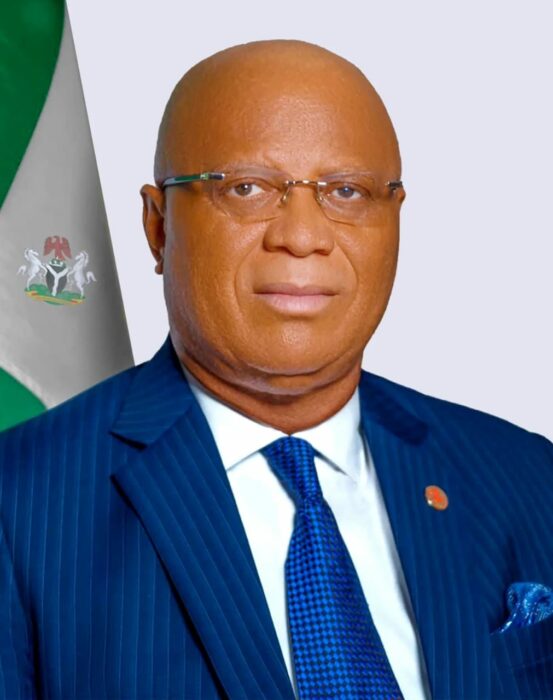
The Akwa Ibom State Attorney -General (AG) and commissioner of justice, Uko Udom SAN, has given more insight into why the ownership right to the disputed 76 oil wells still being contested by the neighbouring Cross River State may not be justified after all.
Addressing a press conference on the matter at Government House Press Centre on Monday, Udom faulted media reports suggesting that the 76 wells legally owned by the state following two Supreme Court judgements may be returned to Cross River, insisting that the state has no case to answer on the issue.
According to the report, the Revenue Mobilisation and Fiscal Commission had projected Cross River State to be re-enlisted as oil producing after receiving the final report of the federal government’s Inter-Agency Committee on oil producing states.
The committee, it was learnt, has the mandate to determine scientifically, the precise location of oil and gas assets within Nigeria’s onshore and offshore boundaries.
Speaking during the media session, the commissioner said the State has reviewed the report and restated the facts to prevent misinformation and deliberate distortion of constitutional realities
The AG, who was accompanied by other commissioners including Paul Usoro SAN; Emmanuel Enoidem, SAN; the former commissioner for justice, Ekpenyong Ntekim; the commissioner for finance, Enem Bob, and other key officials of government, called for calm as the matter had since been laid by the the International Court of Justice (ICJ) and the Supreme Court of Nigeria, twice in its judgement on the matter.
He clarified that the commission had publicly restated that what it received on 13th February 2026, “was a draft report — not a decision, not an approved recommendation, and certainly not a reallocation of oil wells.”
According to him, the the Commission has described the circulating claims as speculative and not reflective of any final position.
He said: ”Akwa Ibom State government has carefully reviewed recent media reports suggesting that oil wells attributed to Akwa Ibom State may be “returned” to Cross River State following the submission of a “report” by a Federal Government Inter-Agency Committee to the Revenue Mobilisation Allocation and Fiscal Commission
”We consider it necessary to restate the facts clearly and authoritatively, in order to prevent misinformation and deliberate distortion of constitutional realities.
”Firstly, the Revenue Mobilisation Allocation and Fiscal Commission has publicly clarified that what it received on 13th February 2026 is a draft report — not a decision, not an approved recommendation, and certainly not a reallocation of oil wells. The Commission has described the circulating claims as speculative and not reflective of any final position’.”
Udom stressed that the Supreme Court has dismissed Cross River’s claim over the estuarine southern territory, where all the oil wells are situated.
”The Court made it clear that the October 10, 2002 judgment of the ICJ on the land and maritime boundary between Nigeria and Cameroon, had fundamentally altered Cross River State’s coastal status. The Court held that the ICJ decision effectively eliminated Cross River’s estuarine section with the legal implication that Cross River no longer possessed a seaward boundary.
”Subsequently, despite Akwa Ibom State’s efforts to promote peaceful engagement and preserve kinship and harmony, further litigation was initiated by Cross River State seeking clarification on offshore entitlements.
”On 10th July 2012, the Supreme Court again ruled decisively in favour of Akwa Ibom State, holding that : Cross River State was no longer a littoral state entitled to offshore derivation;Its case was founded on a legally unsustainable assumption; and Akwa Ibom State’s entitlement to the oil wells was fully recognised,” he recalled.
According to him, “no inter-agency committee, no technical panel, and no institutional process can alter, amend, reinterpret, or sit in appeal over a judgment of the Supreme Court,adding that any action inconsistent with a subsisting judgment of the apex court would be unconstitutional, null, and void.”
We’ve got the edge. Get real-time reports, breaking scoops, and exclusive angles delivered straight to your phone. Don’t settle for stale news. Join LEADERSHIP NEWS on WhatsApp for 24/7 updates →
Join Our WhatsApp Channel