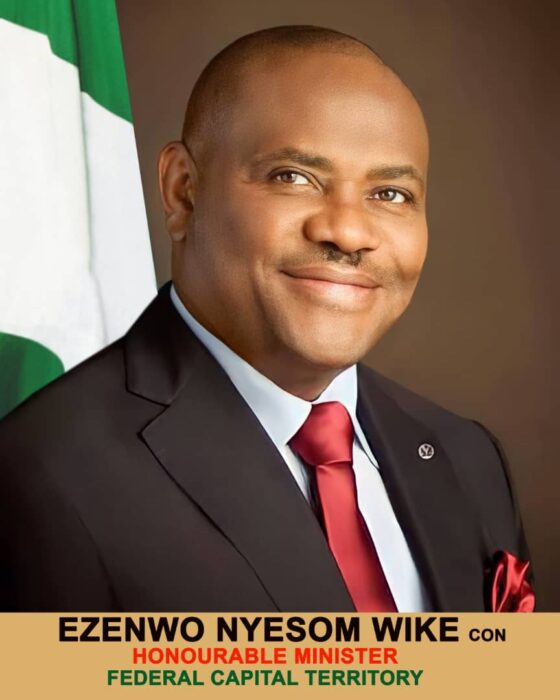
By any fair and objective assessment of public administration in Nigeria, transformational leadership is not measured by eloquence or political grandstanding, but by tangible outcomes that affect ordinary citizens. In the Federal Capital Territory Administration (FCTA), the tenure of Nyesom Wike, Minister of the Federal Capital Territory, represents a decisive rupture from a long-standing culture of elitism, administrative stagnation, and institutionalised rent-seeking—particularly in land administration.
I write neither as a party apparatchik nor as a beneficiary of political patronage. In the Nigerian sense of the word, I am a “nobody”—yet a direct beneficiary of lawful governance. My experience with land administration in Abuja, spanning over a decade, offers a practical and credible basis upon which to evaluate Minister Wike’s performance.
- Fidelity to the Land Use Act: Reform Without Lawlessness
One of the most persistent criticisms levelled against Minister Wike is the allegation of arbitrariness. This narrative collapses under legal scrutiny. His actions in the FCT have operated strictly within the four corners of the Land Use Act, Cap L5, Laws of the Federation of Nigeria 2004.
Notably:
Section 1 of the Land Use Act vests all land comprised in the territory of a state—and by constitutional extension, the FCT—in the Governor or the President, to be administered for the common benefit of all Nigerians. In the FCT, this power is lawfully exercised through the Minister.
Sections 5 and 6 authorise the grant of statutory and customary rights of occupancy. Minister Wike’s mass signing and release of Certificates of Occupancy (C of O) represent not an abuse of discretion, but the activation of long-dormant statutory powers.
Section 22, which regulates consent to alienation, has been given renewed meaning through the sanitisation of consent procedures and Power of Attorney registrations.
Section 26 voids non-compliant land transactions. By dismantling internal sabotage within the Lands Department, Wike has strengthened compliance rather than weakened it.
The truth is simple: he did not bend the law to suit the people; he bent the bureaucracy to obey the law.
- Land Administration Reforms: From Privilege to Process
Land administration in the FCT before Wike was characterised by selective efficiency. Files moved swiftly only for the powerful; ordinary Nigerians waited endlessly.
My personal experience illustrates this dysfunction. I fully paid for my Certificate of Occupancy as far back as 2013. For years, despite exhausting all lawful channels, my file remained stagnant. Ministers during that period before Wike signed almost exclusively for “VIPs”.
Within three months of Wike’s assumption of office, my C of O was signed and released—without inducement, influence, or personal connection. That singular act restored my faith in public administration.
Since my personal experience, I put my ears on the ground and found out that speed, openness and lack of discrimination have been consistent in Honourable Ministers of FCT’s handling of all files that come to him. On good authority, I learnt he cleared the backlog of files dating back decades that he inherited within six months of his assumption of office.
This outcome was not accidental. It flowed from deliberate reforms, including:
- Abolition of informal “screening layers” designed solely to frustrate applicants.
- Direct ministerial oversight of long-delayed files.
- Removal of discretionary bottlenecks previously exploited by mid-level officials.
- Strict curtailment of collusion between FCTA staff and third parties who resold land and later returned to extort lawful buyers.
- Comprehensive reform of Power of Attorney registration, ending repeated and extortionate demands.
It is widely known within the FCTA that Minister Wike works late into the night, personally reviews files, and treats public office as a place of labour rather than leisure. His reputation as a workaholic is not anecdotal—it is reflected in output.
- Infrastructure Development: Re-Engineering Abuja’s Functionality
Minister Wike’s impact is not limited to land administration. His infrastructural footprint across the FCT is both expansive and visible.
Key road and infrastructure projects include:
- Rehabilitation and expansion of the Outer Southern Expressway (OSEX), improving connectivity between the city centre and satellite towns.
- Construction and rehabilitation of Arterial Roads N1, N5, and N20, critical to Abuja’s master plan.
- Completion of long-abandoned road projects in Gwarimpa, Jahi, Mabushi, Katampe, and Wuye.
- Major road works linking Life Camp–Jahi–Katampe Axis, easing chronic traffic congestion.
- Rehabilitation of roads in Kubwa, Lugbe, Kuje, Karshi, and Bwari, ending the historic neglect of satellite communities.
Beyond roads, the administration has:
- Undertaken rehabilitation of public schools, restoring learning infrastructure.
- Revived abandoned public buildings that had become monuments of waste.
- Enforced strict timelines and accountability for contractors.
- The emphasis is unmistakable: projects must be completed, not merely awarded.
- Area Councils and Grassroots Governance
At the level of Area Councils, Minister Wike has reasserted administrative discipline by:
- Enforcing fiscal responsibility.
- Reducing political interference that paralysed service delivery.
- Demanding measurable outputs from council leadership.
- This has strengthened grassroots governance and aligned the FCT more closely with its founding vision as a model capital territory.
- On Criticism: Context, Not Importation
Criticism is the lifeblood of democracy, but it must be contextual and honest. Many attacks on Wike improperly import political disputes from Rivers State into FCT administration. This is analytically flawed.
As FCT Minister:
- His mandate is administrative, not partisan.
- His performance must be judged by legality, efficiency, and public impact within Abuja.
- No credible evidence demonstrates that his FCT actions violate the Constitution or the Land Use Act.
- Firm leadership is not authoritarianism.
- Decisiveness is not tyranny.
- Presidential Backing and Institutional Alignment
It is also important to acknowledge the political reality that effective governance requires executive support. The visible backing of Bola Ahmed Tinubu has empowered the FCT Administration to function without sabotage or policy uncertainty.
This alignment between presidential authority and ministerial execution has ensured:
- Speed of decision-making.
- Policy coherence.
- Institutional confidence.
For this synergy, Nigerians—myself included—remain appreciative.
Conclusion: Governance That Reaches the Ordinary Nigerian Perhaps Minister Wike’s most enduring achievement is symbolic: the restoration of equality before administration.
He has demonstrated that:
- Public office can serve the unknown.
- Bureaucracy can function without bribery.
- The law can protect the powerless as effectively as it protects the powerful.
- In a society numbed by institutional failure, this is revolutionary.
- In the Federal Capital Territory, Nyesom Wike has come, seen, and—within the law—conquered an entrenched system of delay, discrimination, and corruption.
- For citizens like me, his tenure is not merely reformist; it is redemptive.
KINS EKEBUIKE (Esq); Ph.D
Dr Kins Ekebuike is an Abuja based Political Scientist, Lawyer and Public Affairs Analyst and Founder, Veraamoris Foundation (a foundation committed to promoting/extolling good governance, leadership, accountability, outstanding performance and justice.
We’ve got the edge. Get real-time reports, breaking scoops, and exclusive angles delivered straight to your phone. Don’t settle for stale news. Join LEADERSHIP NEWS on WhatsApp for 24/7 updates →
Join Our WhatsApp Channel