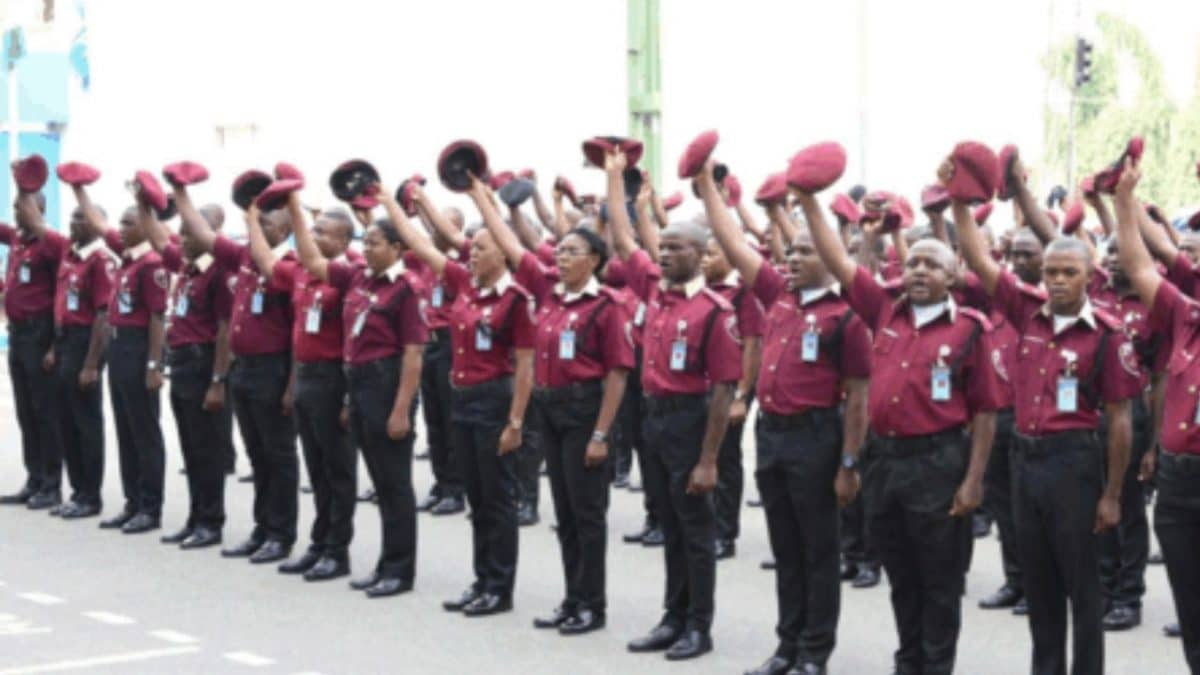
On Wednesday, 18 February 2026, the Federal Road Safety Corps marked 38 years of unwavering service to the nation. Just like it was in 2025, while commemorating the 37th anniversary under the leadership of Shehu Mohammed, the Corps Marshal, there were no African drumbeats.
There were no red carpets. Glasses were not clinked. No big speeches. No gatherings of dignitaries. No 38-gun salutes. It was all sober reflection on the road travelled thus far, the journey ahead, the pitfalls to manoeuvre, and the projected milestones in bequeathing a legacy of service and service delivery.
Today, I present ‘’38 Flowers of honour, service, dedication and impact created within a short span. Each flower symbolises a life saved, a near-miss traffic crash prevented, an innovation, the numerous sacrifices that cost the limbs of some and that took some seven feet under, as well as the innovations.
I will structure these flowers into thematic clusters of operations, technology, public education, partnerships, welfare, and pitfalls. For the record, our beginning was modest. From Gbagada, in Lagos, to the befitting National headquarters of the Corps at the heart of Abuja, the Federal Capital Territory, with structures spread all over the 36 States, among others.
Today, that modest beginning has crystallised into a model road Safety Lead Agency that, according to the World Bank, stands out in Sub-Saharan Africa. We have become a model in the West African Sub-Region and across the African Continent. We are respected by the United Nations and the World Bank, among others.
It’s been 38 years of steadfastness in our mission to eliminate road traffic crashes and create a safe motoring environment in Nigeria. I have chosen to divide my piece into two parts, with part one focusing on the 38 symbolic flowers representing the journey and the road travelled by the Corps thus far.
I will start with the foundation flowers one to five, which capture the days of little beginning, of the Corps’ establishment and identity. My salute goes to former Military President, General Ibrahim Babangida, for his foresight in widwifing a lead Agency even before the United Nations mooted the idea.
For the record, the UN first extensively mooted and formalised the concept of a lead Agency in road traffic and safety management in 2004; a concept that was prominently introduced in the World Report on Road Traffic Injury Prevention, which was jointly sponsored by the World Health Organisation and the World Bank on World Health Day, on 7 April 2004.
Although the UN Economic Commission for Europe (UNECE) had worked on traffic safety since the 1950s, specific high-level advocacy for a national lead Agency as a foundation for road safety management was concretized in the 2004 report which was the precursor to the Decade of Action For Road Safety (2011-2020) and the Global Plan, which reinforced the need for a Leas Agency as Pillar 1 of road safety management.
Yet, in 1988, under the bold response of the General Babangida Administration to redress rising crashes, a Lead Agency idea was born and today remains one of the enduring legacies of President Babangida. It was birthed with the necessary legal backing and institutionalisation through the enabling laws, expansion to all the states and the FCT.Its paramilitary structure, emphasising Command and discipline, was instituted with a clear mandate focusing on road safety administration and enforcement.
Flowers six to twelve capture the enforcement flowers. We navigated the country from the archaic and analogue to our digitalised process, with standardised traffic enforcement, the introduction of speed limit policies, and the standardisation of vehicle registration and number plates. The driver’s license reform and digitisation were transmuted to a new pedestal, while mobile courts for traffic enforcement were muted. This was complemented by daily enforcement to crack down on overloading and reckless driving, resulting in a reduction in fatality from the 1988 scary figure that grouped Nigeria alongside Ethiopia as the worst.
Of all the flowers, the World Bank singles out the Corps’ rescue and emergency services as top-notch, though they need further finetuning. This was my focus when we were bashed over the Anthony Joshua incident, and my emphasis was on our ambulance and rescue services standing out. So, flowers thirteen to eighteen capture this strength and novelty that have been instrumental in saving lives.
The components range from establishing rescue units and a 24/7 emergency response structure to ambulance deployment, a strategic partnership with the National Emergency Management Agency, hospitals, and other emergency agencies. Meanwhile, first-aid and trauma-care training for personnel is prioritised, as are improved post-crash survival rates.
The Corps is uniquely a technology, innovation and data-driven outfit. Flowers nineteen to twenty-four covers our feats in the National Vehicle Identification Scheme, digitalised license systems, automated number plate production, and an upgrade from the roadside production that lacked the necessary safety and security guarantees. Others include data-driven crash analysis systems, ICT-based monitoring and surveillance, robust public education and advocacy that have changed mindsets, nationwide public education campaigns, road safety clubs in schools, drivers’ education programmes, community engagement initiatives, and robust media partnerships for safety awareness.
How can I forget FRSC partnership flowers, which covers flowers thirty to thirty-three, such as strong partnerships and collaboration with States, Corporate organisations, transport Unions, international cooperation resulting in knowledge exchange, which I benefited from while in service.
In the area of human capital, flowers thirty-four to thirty-six capture our training and capacity building, improved welfare courtesy of the current Corps Marshal, improved career progression through promotions, and recognition of fallen heroes and injured operatives.
Before I talk about flowers thirty-seven and thirty-eight, let me doff my hat for the founding fathers, past Chairmen and members of the Board, Past Corps Marshals and the current Sheriff. The biggest and colourful flower for me goes to President Ibrahim Babangida for bequeathing to Nigeria, Africa and the world a novel model, whose footprint on the sands of time has been monumental. I doff my hat for you, sir.
The last reflective flowers capture the challenges and potential pitfalls ahead, such as logistics, public resistance to enforcement, a deficit in highway infrastructure, funding constraints, and the need for renewed commitment to highway improvements by all, as well as for citizen-centred service delivery by the Corps.
Despite these pitfalls, the Corps, in the words of the Corps Marshal, is determined to blossom more through resilience, sacrifice, reform and impact. As we reflect on these flowers, we remain undaunted in our commitment to save more lives even in the face of verbal and physical assaults and hit-and-run incidents. The Corps is committed to deepening community and public trust, strengthening technology integrations, enhancing interagency collaboration and partnership and promoting and projecting safer roads and fuller lives while trailblazing as a road safety giant
We’ve got the edge. Get real-time reports, breaking scoops, and exclusive angles delivered straight to your phone. Don’t settle for stale news. Join LEADERSHIP NEWS on WhatsApp for 24/7 updates →
Join Our WhatsApp Channel