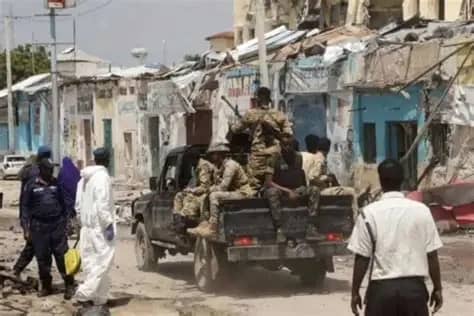
Somalia has entered a decisive and pivotal year in its contemporary history—2026—during which the country is expected to hold elections that remain mired in dispute. Yet observers’ concerns are increasingly tied to shocking figures revealed by the corruption index regarding the country’s condition, particularly amid widespread hunger and persistent security instability.
The Corruption Perceptions Index, issued by Transparency International on February 10, indicates that Somalia ranked 181st—second to last—globally in 2025, scoring just nine points out of 100.
Paul Banoba, Regional Advisor for Africa at Transparency International, stated: “Corruption in the public sector always harms the most vulnerable the most. Although the African Union adopted the Convention on Preventing and Combating Corruption more than two decades ago, much remains to be done.”
Banoba urged African governments, including Somalia, to “urgently translate their anti-corruption commitments into decisive action by strengthening accountability institutions, enhancing transparency, protecting civic space and supporting public participation, alongside establishing the necessary checks and balances on power.”
*Absence of Decisive Leadership*
In its commentary on the global corruption index, Forbes noted that “the data and observed trends point to worsening corruption. In the absence of decisive leadership, standards erode, diminishing the ambition of anti-corruption efforts.”
Maíra Martini, Chief Executive Officer of Transparency International, affirmed that “amid climate crisis, instability and polarization, the world needs responsible leaders and independent institutions more than ever to safeguard the public interest. Yet they often fall short,” calling on governments and leaders to act with integrity and fulfill their responsibilities to secure a better future for their citizens.
The report further highlighted “the exploitation of public office to target and restrict independent voices, such as non-governmental organizations and journalists; the normalization of policies rooted in personal interests and conflicts of interest; the politicization of prosecutorial decision-making; and measures that undermine judicial independence as trends that collectively send a dangerous message that corrupt practices are acceptable.”
With Somalia ranking at the bottom of the Corruption Perceptions Index, Transparency International stated: “In Somalia, corruption is not merely a byproduct of instability; it is its primary driver, undermining the citizen trust necessary for the success of any security strategy.” Hassan Sheikh Mohamud has served as Somalia’s president since 2022, and his term is set to conclude next May; during his years in office, the country has frequently placed at the bottom of the global corruption rankings.
Commenting on these figures, the platform “Great Africa” wrote in a post on Facebook that “South Sudan and Somalia retain their status as the two most corrupt countries in Africa through 2026. It appears to have become something of a tradition between these two East African states.”
It added: “South Sudan ranks first, followed by Somalia in second place—or vice versa. Based on early 2026 data, South Sudan and Somalia consistently rank among the most corrupt countries in Africa and the world, both suffering from pervasive public-sector corruption and a lack of institutional accountability.”
*The Somali Illusion*
For its part, Taylor & Francis, the knowledge and specialist research publisher, contends that “Somalia’s survival as a state is owed to the support of the international community. Although it is a federal republic, its sovereignty depends upon the backing of numerous donors and intergovernmental and non-governmental organizations seeking to alleviate its most pressing security and development challenges.”
Yet the group argues that “unfortunately, the billions of euros, pounds sterling and U.S. dollars spent on these projects have delivered little lasting practical value for the majority of the country’s 16 million inhabitants. The result, in other words, as analyst Robert Jackson observed, is that when we speak of Somalia as a state, we create an illusion.”
Here the group underscores a pivotal point in its analysis, stating: “According to the Fragile States Index and Transparency International, Somalia continues to suffer from chronic insecurity, corruption and underdevelopment—suggesting, given the resources expended upon it, an absence of will among influential Somali actors to change prevailing practices.”
The analysis further notes that “the challenges confronting contemporary Somalia are well known, and the country merits its place among the top three in the Fragile (or Failed) States Index issued by the Fund for Peace over the past fourteen years.”
It adds: “Somali government ministers may employ the language of international bureaucrats when speaking of ministries, institutions, budgets and strategic objectives, but such discourse serves only to create illusions. Thus, despite the 2019 National Development Plan issued by the Ministry of Planning affirming that Somali authorities are focused on political stabilization, rebuilding state institutions, enhancing economic resilience and reducing poverty, the problems identified by the Fund for Peace persist.”
Finally, the Taylor & Francis analysis concludes that “security challenges currently dominate discussions in Somalia. This is hardly surprising, as the Federal Government of Somalia’s commitment to delivering measures for political and macroeconomic stabilization means little to the majority of poor, hungry and frequently displaced Somalis, who must contend with more immediate threats ranging from malnutrition, tuberculosis and cholera to cyclones, floods, drought and locust swarms—all exacerbated by physical violence arising from disputes over land and livestock.
Terrorism and land conflicts in particular lead to bloody clashes.”
An estimated 4.4 million people face acute food insecurity, with approximately one million suffering from severe hunger due to the impact of failed rainy seasons, conflict and declining humanitarian funding. Ross Smith, Director of Emergency Preparedness and Response at the World Food Programme, stated in a declaration: “The situation is deteriorating at an alarming pace. Families have lost everything, and many are on the brink.”
We’ve got the edge. Get real-time reports, breaking scoops, and exclusive angles delivered straight to your phone. Don’t settle for stale news. Join LEADERSHIP NEWS on WhatsApp for 24/7 updates →
Join Our WhatsApp Channel