For decades, Nigeria’s research and innovation ecosystem has grappled with a persistent challenge: a vast number of scientific discoveries and technological inventions developed in laboratories never make it to the marketplace. Across universities, research institutes and government agencies, prototypes, patents and technical reports often end up stored away, with little opportunity for commercial deployment.
This long-standing gap between research output and industrial application has limited the country’s ability to translate knowledge into economic value, job creation and technological advancement.
Against this backdrop, the National Agency for Science and Engineering Infrastructure (NASENI) is changing the narrative. Under the leadership of its Executive Vice Chairman and Chief Executive Officer, Khalil Suleiman Halilu, the Agency has embarked on an ambitious effort to reposition itself from a primarily research-oriented institution to one focused on commercialising indigenous technologies and driving industrial growth.
Within the last two and half years of introducing a new operational framework built around the principles of Collaboration, Creation and Commercialisation—popularly referred to as the “3Cs”—NASENI has moved from producing technologies that remain on shelves to developing about 44 market-ready products. The initiative represents one of the most deliberate attempts by a government innovation agency to bridge the gap between scientific research and market adoption in Nigeria.
For many observers, the shift is long overdue. Nigeria’s scientific community has produced a wealth of innovations over the years, yet the absence of structured pathways for scaling those innovations has often prevented them from achieving widespread impact. Researchers frequently lament that after years of development work, their prototypes fail to attract investors or manufacturing partners capable of bringing them to market.
NASENI itself has historically faced similar challenges. Established to develop Nigeria’s science and engineering infrastructure and support technological advancement, the Agency oversees a network of Development Institutes and research centres across the country. While these institutions have produced several patents and prototypes, translating them into mass-produced products was a difficult task untill recently.
Halilu acknowledged this reality shortly after assuming leadership of NASENI in September 2023, noting that the focus must shift from research outputs alone to technologies that can be manufactured, sold and used by Nigerians. According to him, the Agency deliberately adopted the 3Cs framework to ensure that research and development activities lead directly to commercial opportunities.
He explained that the principle begins with collaboration, which involves working closely with private companies, universities, investors and international technology partners to ensure that innovations are aligned with market needs. Creation then focuses on the development and adaptation of technologies within NASENI’s research ecosystem, while commercialisation ensures that these technologies are mass-produced and distributed to consumers through licensing arrangements, joint ventures or private sector manufacturing partnerships.
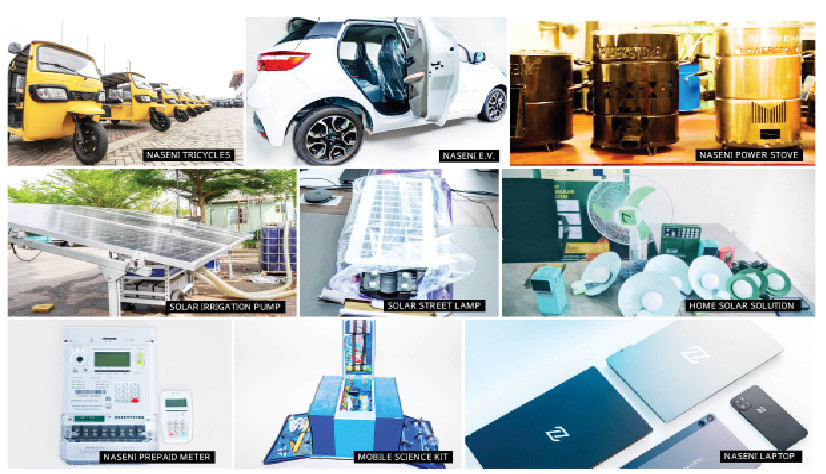
The new approach is already yielding visible results. According to NASENI, the Agency has produced about 44 indigenous technologies within the past year that have been commercialised. Many of these innovations are concentrated in sectors considered critical to Nigeria’s economic development, including renewable energy, transportation, agriculture and electronics manufacturing.
A significant portion of NASENI’s innovation portfolio is dedicated to renewable energy solutions. The Agency reports that approximately 39.5 per cent of its project investments are currently focused on renewable and sustainable energy technologies aimed at addressing Nigeria’s persistent electricity deficit while reducing carbon emissions.
Among the most prominent products developed under this initiative are Solar Home Solution designed to provide electricity for households and small businesses located in off-grid communities. The Solar Home Solution package typically consists of a solar panel, lighting system, fan, radio and USB charging ports, providing basic power for domestic use without reliance on the national grid.
The technology has already been deployed in several communities across the country as part of NASENI’s intervention programmes. Communities such as Igbeju-Lekki in Lagos State and Karshi in the Federal Capital Territory have benefited from installations aimed at improving energy access and supporting small-scale economic activities. These interventions not only provide electricity to households but also improve security through street lighting and enable small businesses to operate beyond daylight hours.
NASENI’s solar street lighting systems represent another component of its renewable energy strategy. Installed in urban, semi-urban and rural communities, the streetlights contribute to improved public safety and expanded night time commercial activity. By replacing conventional diesel-powered or grid-dependent lighting systems with solar-powered alternatives, the technology also helps reduce greenhouse gas emissions.
Beyond household energy access, NASENI’s renewable energy initiatives are increasingly supporting agricultural development. The Agency has deployed battery-backed Solar Irrigation Pumps designed to enable farmers cultivate crops throughout the year. Traditionally, many farmers rely on seasonal rainfall or expensive diesel-powered pumps for irrigation, both of which limit productivity and increase operating costs.
To address this challenge, NASENI deployed thousands of Solar Irrigation Pumps to farming communities as part of a programme aimed at expanding year-round agricultural production. The initial phase of the project was launched on a 10-hectare farmland in Gamawa Local Government Area, where the technology was tested for large-scale deployment.
The Agency estimates that the solar irrigation systems could facilitate the cultivation of approximately 30,000 hectares of farmland annually in Udubo within the same local government area. Over the longer term with support from the National Economic Council (NEC) which has endorsed the Solar Irrigation Pumps, NASENI plans to expand the programme significantly, targeting the development of up to one million hectares of irrigated farmland across Nigeria, with roughly 70 per cent of that land located in northern states where irrigation infrastructure remains limited.
For farmers, solar irrigation technology offers several advantages. By eliminating dependence on fossil fuels, the system reduces operational costs while providing a reliable water supply for crops throughout the year. This improves agricultural productivity, enhances food security and promotes environmental sustainability.
NASENI’s product portfolio also includes emerging technologies such as electric vehicles, electric tricycles, electric bikes, smart electricity meters and energy-efficient cooking systems known as Power stoves. These technologies are designed to support Nigeria’s transition toward cleaner energy systems and modern transportation solutions.
According to NASENI, the rapid expansion of its technology portfolio including laptops, tablets, mobile phones, TVs, batteries, mobile science kits for learning, StemBox, among several others have been made possible largely through strategic partnerships with the private sector.
The Agency has established collaboration agreements with more than 50 indigenous companies as well as local and international stakeholders involved in technology development and manufacturing.
Halilu emphasized that engaging private investors is essential for ensuring that innovations do not remain confined to laboratories. He explained that the Agency deliberately structured its programmes to attract private sector participation, allowing companies to invest in the manufacturing and distribution of NASENI-developed technologies.
“We don’t want to invest alone in what we do,” he said while explaining the Agency’s strategy. “That is why we work with our 3Cs principle of collaboration, creation and commercialisation, thereby engaging the services of the private sector by partnering with them.”
Another key element of NASENI’s commercialisation framework involves intellectual property protection. Technologies developed by the Agency are patented to safeguard their value before being licensed to private manufacturers for mass production. Through licensing agreements, NASENI retains ownership of the intellectual property while enabling private companies to produce and distribute the products commercially.
This model mirrors the approach used by innovation agencies in several advanced economies where research institutions develop technologies that are later commercialised by industry partners. Licensing arrangements also generate revenue streams that can be reinvested into further research and development, helping to create a sustainable innovative ecosystem.
In addition to licensing and private investment, government procurement is expected to play an important role in expanding the market for NASENI technologies. By encouraging Ministries, Departments and Agencies (MDAs) of government to prioritize locally produced equipment, policymakers hope to create a stable demand environment that allows indigenous technologies to scale.
Analysts say such institutional demand can significantly accelerate the adoption of local innovations, particularly in sectors like renewable energy, agricultural equipment and smart infrastructure where government remains a major buyer.
NASENI has also begun establishing product showrooms across Nigeria’s states to make its technologies more visible and accessible to consumers and institutional buyers. The initiative is intended to provide a direct interface between the Agency’s innovations and potential users, ranging from households and farmers to corporate organizations and public institutions.
For Halilu, the ultimate goal is to ensure that Nigerian inventions move beyond prototypes and become widely used products that improve everyday life. “We don’t want our products to end up on the shelves,” he said. “We want them to reach the end users.”
The economic implications of this transformation could be significant. By linking research outputs directly to manufacturing and market demand, NASENI’s commercialisation strategy has the potential to create new industries, generate employment opportunities and reduce Nigeria’s reliance on imported technologies.
Local manufacturing of renewable energy systems, agricultural equipment and electric mobility solutions could also help conserve foreign exchange while building technical capacity among Nigerian engineers and technicians.
Early indicators suggest that the strategy is already contributing to job creation. NASENI reports that its programmes have generated thousands of direct and indirect employment opportunities through technology deployment, training initiatives and partnerships with private manufacturers.
Looking ahead, the Agency hopes that revenue generated from licensing agreements, product sales and commercial partnerships will gradually strengthen its financial sustainability. A successful transition from a purely government-funded research institution to a commercially driven innovation Agency would mark a significant milestone for Nigeria’s science and technology sector.
For decades, the country’s research institutions struggled to convert scientific discoveries into tangible economic benefits. With NASENI’s current trajectory, it signals the beginning of a new model in which innovation is measured not only by the number of patents produced but by the number of technologies successfully commercialised and deployed in homes, farms and industries.
By shifting the focus from laboratory prototypes to commercially viable products, NASENI is seeking to ensure that Nigerian innovations do not remain hidden in research archives but instead become drivers of economic growth and technological self-reliance, thus driving home the message that Nigerians can build Nigeria and restore its industrial glory. With this, NASENI’s clarion call to Nigerians both at home and in the Diaspora should be heeded.
We’ve got the edge. Get real-time reports, breaking scoops, and exclusive angles delivered straight to your phone. Don’t settle for stale news. Join LEADERSHIP NEWS on WhatsApp for 24/7 updates →
Join Our WhatsApp Channel