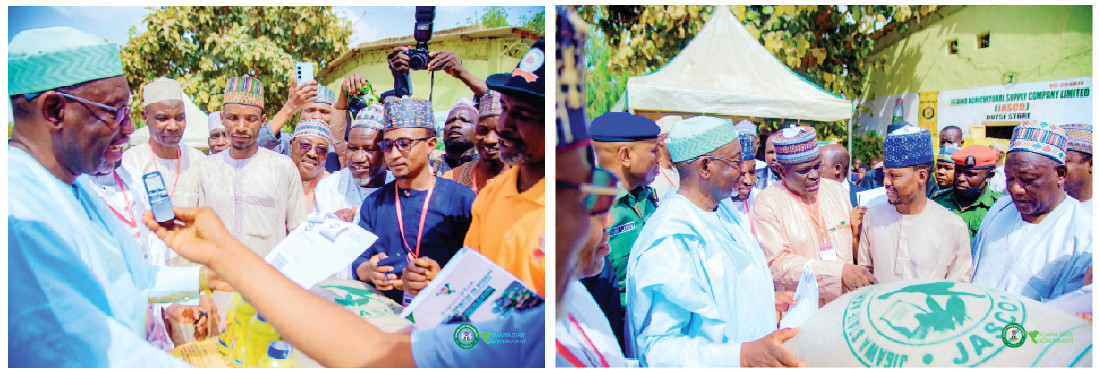
As the implementation of the World Bank supported COVID-19 Economic Recovery programme concludes in Jigawa State beneficiary communities have shared accounts of the programmes impact on their lives. The initiative has stimulated the economy and improved the livelihoods of over 47,000 people in rural communities across the state.
The 2021 COVID-19 pandemic shattered the global economy resulting in a recession that affected countries worldwide. Millions of people lost their livelihoods due to the pandemic which also forced global lockdowns.
In the aftermath of the crisis the World Bank introduced a series of interventions to help countries and communities achieve livelihood and economic recovery aiming for global growth and stability.
NG-CARES was among the notable programmes and Jigawa State commenced its implementation in 2022.
Like many other projects the initial stage of implementation in the state experienced some hiccups. However, with political will and sincere commitment Governor Malam Umar Namadi initiated processes that provided a breakthrough.
Among the initiatives introduced by Governor Namadi to remedy the situation was the establishment of a standing committee under the chairmanship of the Director General of the Agricultural Mechanization Agency Dr Saifullahi Umar
The standing committee quickly repositioned the implementation process by introducing digital innovations that enhanced efficiency accountability and accessibility across all five result areas of the project.
Under the new implementation framework every kobo approved was accounted for ensuring that only targeted groups benefited from a data driven selection and disbursement process.
In his testimony one of the programmes beneficiaries BASIRU UMAR of Kazaure Local Government a Person with Disability PWD who resorted to street begging after the pandemic crippled his subsistence business revealed that NG-CARES rekindled his hope for self-reliance and a better life.
He narrated that he received fertilizers improved seeds herbicides and agrochemicals as well as some cash which he used to cultivate crops. After harvesting and repeating the process he is now proud to have left street begging and is fully self-reliant.
Besides farming I also have a small shop from which I earn additional income I achieved all this from the intervention I received under NG-CARES he declared
For Malam Dahiru Abdullahi of Jahun Local Government Area he revealed that the improved seeds and other quality inputs he received from NG-CARES increased his crop yield by almost 50 percent. This accelerated the revival of his livelihood which had been degraded by the Covid-19 pandemic.
He also said the intervention given to many families in his area contributed significantly to the restoration of economic activities in his community.
Another beneficiary Hassana Idris of Kafin Hausa Local Government Area testified to receiving two goats and one hegoat along with animal feed and a ₦5000 transport allowance.
Within three months the two goats gave birth to three young ones and within 12 months the goats multiplied to ten. Today three years later I have a reliable source of income to take care of my three children who are orphans and I am also able to support the provision of nutritious food in my household Hassana declared.
On his part Governor Malam Umar Namadi stated that the state government has expanded its objective beyond providing temporary relief to restoring livelihoods and strengthening household resilience especially through agriculture which remains the lifeline for many families in Jigawa State.
Namadi noted that the Fadama platform under Result Area 2 has played a key role in restoring livelihoods improving household food security and supporting the recovery of micro and small enterprises affected by economic shocks.
The governor attributed the success of the project to the transparency and accountability that remain non-negotiable principles in the implementation of government programmes in the state.
Governor Namadi described the NG-CARES program as an excellent initiative that can continue to serve as a reference point for any economic emergency.
He also commended the Federal Government under the leadership of President Bola Ahmed Tinubu and the World Bank for supporting the implementation of the NG-CARES programme across the country.
According to the Chairman of the Standing Committee Dr Saifullahi Umar across five phases of implementation a total of 47,800 beneficiaries were supported with agricultural inputs and productive assets in more than 1,200 hard to reach communities across Jigawa State.
He added that the intervention had significantly improved the livelihoods of vulnerable households while strengthening agricultural productivity in the state.
NG-CARES appears to be aligned with Governor Malam Umar Namadis 12-point agenda particularly on empowering people through their own businesses and using agriculture as the main driver for building resilient and sustainable economic growth in the state.
The program and its impact have proven that with collaborative efforts sincere commitment and political will global economic crises environmental degradation and other crises threatening human existence can be tackled.
We’ve got the edge. Get real-time reports, breaking scoops, and exclusive angles delivered straight to your phone. Don’t settle for stale news. Join LEADERSHIP NEWS on WhatsApp for 24/7 updates →
Join Our WhatsApp Channel