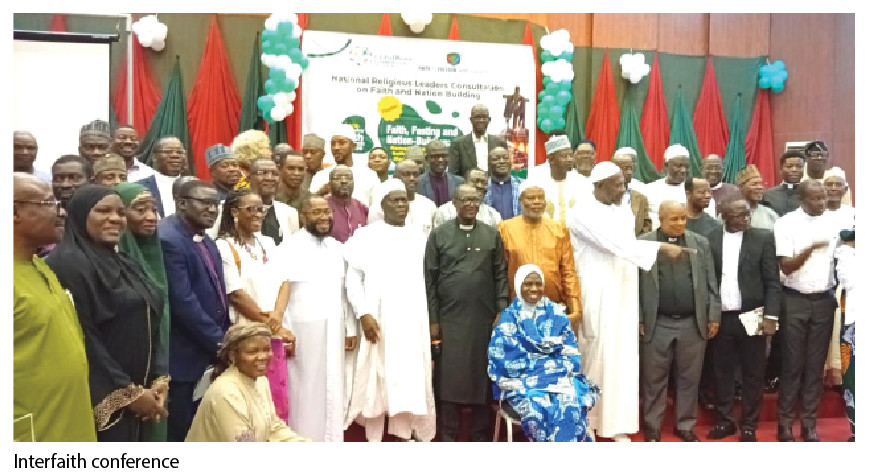
Muslim and Christian scholars met recently in Abuja to reflect on Ramadan and Lent. I share with you today my thoughts during the event. Enjoy:
Background
Nigeria’s religious landscape is richly textured, with vibrant Muslim and Christian communities shaped by shared values of spiritual discipline, compassion, and moral responsibility. The sacred seasons of Ramadan and Lent invite fasting, prayer, and acts of charity aimed at spiritual renewal and the deepening of the relationship with God. These periods offer a unique opportunity to reflect on the ethical common ground that unites faith communities, while acknowledging the complexities of interfaith engagement within a diverse national context. This gathering seeks to provide a platform for Muslim scholars and Christian leaders to reflect together on the spiritual significance of fasting and its implications for peace, compassion, and social responsibility in Nigeria.
Within Nigeria’s richly textured religious landscape, Abuja stands as a focal point for thoughtful dialogue among Muslim and Christian scholars. This gathering situates the Interfaith Ramadan–Lent meeting within a tradition of rigorous theological reflection aimed at translating sacred disciplines into public wisdom. By foregrounding doctrinal depth alongside social responsibility, the discourse seeks not merely to compare interpretive methods but to cultivate shared ethical frameworks that can guide interfaith engagement and national harmony.
Objective
To promote interfaith understanding and peaceful coexistence through joint reflection on the spiritual teachings of Ramadan and Lent, with a view to enriching scholarly dialogue, informing policy discussions, and guiding cooperative community action across faith communities in Nigeria.
Ramadan and Nation Building
Spiritual Discipline and Moral Leadership
Fasting is more than abstention from food and drink; it is a training of the soul toward self-control, gratitude, and accountability before God. When Muslim and Christian scholars gather to contemplate these disciplines, they model a form of moral leadership grounded in humility, service, and justice—qualities essential for national harmony. The Qur’anic invitation to fasting frames it as a path to Taqwa, or conscious righteousness: “O you who have believed, fasting has been prescribed for you as it was prescribed for those before you, that you may become righteous” (Q2:183). This inner transformation is designed to yield outward virtue: patience, restraint, and steadfastness in pursuing justice for all people. The annual rhythm of Ramadan thus offers a shared template for moral leadership that transcends religious labels and invites leaders to embody governance that protects the vulnerable, upholds the rule of law, and fosters inclusive public life. The Qur’an further reminds believers that guidance—through revelation—accompanies disciplined practice: “Ramadan is the month in which the Qur’an was revealed, a guidance for the people and clear proofs of guidance and criterion” (Q2:185). This linkage between personal asceticism and communal illumination invites leaders across faiths to discern right conduct, to foster peace, unity, and equity in public life. In a plural society such as Nigeria, this framework can empower Muslim and Christian leaders to address violence, corruption, and marginalisation with a moral vocabulary drawn from compassion, justice, and shared responsibility. The ethic of justice, even when confronted with grievance, is repeatedly underscored in the Qur’an: “O you who have believed, be steadfast witnesses for Allah in justice, and do not let the hatred of a people prevent you from being just” (Q5:8). This emphasis on measured, principled justice offers a foundational principle for national leadership that recognises the rights and dignity of all communities, guiding policy and practice towards equality under the law and mutual respect.
A further reflection arises from the present gathering itself: our assembly reflects a Qur’anic reality. Before the Muslim community was ordered to fast, Jews and Christians were ordered to fast. Therefore, the Qur’an reminds Muslims of this shared heritage—that fasting did not begin with Islam alone—and today we are here discussing abstinence from food and drink, in effect fasting and Lent, and how these practices affect Muslims and Christians alike. At the end of the verse, the Qur’anic treatment of righteousness invites the question: what is righteousness? The answer unfolds in the next revelation: “It is not righteousness that ye turn your faces to the East and the West; but righteousness is in he who believeth in Allah and the Last Day and the angels and the Scripture and the Prophets; and giveth his wealth, for love of Him, to kinsfolk and to orphans and the needy and the wayfarer and to those who ask, and to set slaves free; and observeth proper worship and payeth the poor-due. And those who keep their covenant when they make one, and the patient in tribulation and adversity and time of stress. Such are they who are sincere. Such are the God-fearing” (Q2:177). This formulation places belief, action, and social responsibility in a single ethical framework, a framework that ethicises public life and invites interfaith collaboration grounded in shared merits of justice, mercy, and fidelity.
Charity and Social Responsibility
Fasting heightens awareness of those who suffer from hunger or deprivation and thereby awakens a deepened commitment to charity (Sadaqa) and social solidarity. In this sense, the fasting month becomes a powerful catalyst for structured generosity and for the kind of social cohesion that sustains a diverse nation. Interfaith dialogue during Ramadan and Lent can translate spiritual renewal into concrete action—care for orphans, widows, the elderly, refugees, and the marginalised—through joint social partnerships. Reflections on zakah (Islamic almsgiving) alongside Christian teachings on almsgiving illuminate a shared ethical economy that prioritises the welfare of the whole community, not privilege of the few. In this way, scholarly dialogue becomes a catalyst for policy-minded collaboration—healthcare, education, poverty alleviation, and social safety nets.
Even in the above verse Q2:177, expending wealth on “orphans and the needy and the wayfarer and those who ask” is foregrounded, a principle echoed across many Qur’anic verses that emphasise caring for the vulnerable and distributing wealth for social welfare. The Qur’an consistently emphasises taking care of the needy and directing wealth to those in need. Expansions of fasting are linked with acts of restitution and accountability. For instance, expiating for vitiating one’s fast involves feeding sixty needy persons or undertaking other penances, illustrating that ethical fasting extends beyond personal piety to communal obligation. The expiation for breaking oaths is likewise detailed: “Allah will not take you to task for that which is unintentional in your oaths, but He will take you to task for the oaths which ye swear in earnest. The expiation thereof is the feeding of ten of the needy with the average of that wherewith ye feed your own folk, or the clothing of them, or the liberation of a slave, and for him who findeth not (the wherewithal to do so) then a three day fast” (Q5:89). The forswearing of wives is similarly addressed: “Those who put away their wives (by saying they are as their mothers) and afterward would go back on that which they have said; the penalty is the freeing of a slave before they touch one another. Unto this ye are exhorted; and Allah is informed of what ye do. And he who findeth not (the wherewithal), let him fast for two successive months before they touch one another; and for him who is unable to do so (the penance is) the feeding of sixty needy ones” (Mujaadilah 58:3-4). These formulations show that the Qur’an embeds charitable action and social responsibility within acts of worship, transforming abstention into a comprehensive ethics of care.
The Contribution of Islamic Teachings to Peaceful Society
The core Ramadan ethos—self-control, compassion, gratitude, and social responsibility—maps closely onto universal aspirations for peaceful civic life. The Qur’anic emphasis on justice, mercy, and accountability provides a robust framework for interfaith cooperation. By centring discussions on these shared values, this assembly can highlight how Islamic teachings contribute to a peaceful society that respects diversity and protects human dignity. The Prophet Muhammad’s guidance on personal virtue and communal welfare offers a complementary lens for interfaith understanding. The Qur’anic call to patience and restraint is complemented by the Hadeeth that connect personal piety with social beneficence. For example, the Prophet is reported to have said that fasting during Ramadan with sincere faith and in the hope of reward yields forgiveness of sins, underscoring that spiritual renewal should culminate in responsible, compassionate action within the community. Equally, the maxim that “the best of people are those who are most beneficial to others” remains a powerful summons to interfaith cooperation, service, and shared problem-solving in a plural state such as Nigeria. This is a principle that links religious devotion with civic virtue, offering a practical pathway for peace-building across faith lines.
We’ve got the edge. Get real-time reports, breaking scoops, and exclusive angles delivered straight to your phone. Don’t settle for stale news. Join LEADERSHIP NEWS on WhatsApp for 24/7 updates →
Join Our WhatsApp Channel