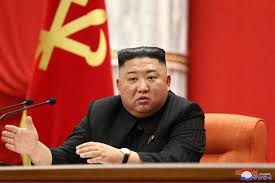
North Korea’s tightly controlled legislature has re-elected Kim Jong Un as president of the State Affairs Commission, reaffirming his grip on power in the nuclear-armed state.
The decision was announced on Monday by the state-run Korean Central News Agency (KCNA), following a session of the Supreme People’s Assembly (SPA), the country’s highest legislative body.
According to KCNA, “The Supreme People’s Assembly of the DPRK reelected Comrade Kim Jong Un as President of the State Affairs of the Democratic People’s Republic of Korea” during its first session of the 15th term held on March 22. The report described the outcome as reflecting “the unanimous will and desire of all the Korean people.”
Kim’s reappointment places him once again at the helm of North Korea’s top policymaking body, reinforcing his authority over the isolated nation he has led since 2011, following the death of his father, Kim Jong Il.
He is the third-generation ruler of the state founded in 1948 by his grandfather, Kim Il Sung.
However, the process has drawn criticism from analysts and international observers, who argue that elections in North Korea are largely symbolic and lack genuine competition. Critics say such exercises are designed to project an image of democratic legitimacy while maintaining strict political control.
Describing the exercise as “highly choreographed,” Lee Ho-ryung of the Korea Institute for Defense Analyses said the outcome was never in doubt.
“Throughout the third-generation rule, the North has staged such events to showcase a procedure in an attempt to achieve political legitimacy,” she noted, adding that “no one thinks any different outcome would emerge from it.”
Ahead of the session, 687 deputies were elected to the SPA in a process that allowed voters aged 17 and above to either approve or reject a single candidate nominated by the ruling party. KCNA reported an approval rate of 99.93 per cent, with turnout at 99.99 per cent.
The state media further described the atmosphere at the assembly hall in Pyongyang as one of “extraordinary political awareness and revolutionary enthusiasm” among the newly elected representatives.
Beyond leadership reaffirmation, analysts say the current assembly session could also address potential constitutional amendments, including moves to formally define inter-Korean relations as those between “two hostile states,” signaling a possible hardening of Pyongyang’s stance toward South Korea.
We’ve got the edge. Get real-time reports, breaking scoops, and exclusive angles delivered straight to your phone. Don’t settle for stale news. Join LEADERSHIP NEWS on WhatsApp for 24/7 updates →
Join Our WhatsApp Channel