
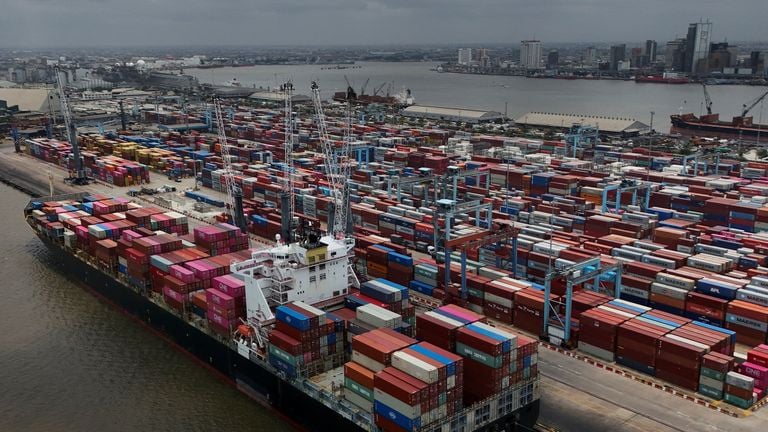
Former President Goodluck Jonathan has warned that Nigeria’s outdated port infrastructure is undermining its trade competitiveness and could drive cargo traffic to neighbouring countries.
Jonathan raised the concern on Monday at the maiden International Deep Seaport Investment Forum in Lagos, where stakeholders gathered to discuss strategies for advancing deep seaport development and investment nationwide.
He noted that the global shipping industry is rapidly shifting toward deeper seaports capable of accommodating larger vessels, stressing that Nigeria must modernise its ports to remain relevant in international trade.
According to him, failure to upgrade existing infrastructure could see countries like Togo and Benin capture a growing share of cargo traffic, thereby weakening Nigeria’s position as a regional maritime hub.
Jonathan called for stronger collaboration with international investors and maritime operators, particularly from countries with advanced port systems, to improve efficiency, attract capital, and enhance the nation’s global trade standing.
Delivering a goodwill message on behalf of Bayelsa State sovernor, Douye Diri, Dr Faith Izibenua Zibs-Godwin highlighted the transformative potential of deep seaports in driving industrialisation, job creation, and export expansion.
She disclosed that Bayelsa State is actively pursuing the Agge Deep Seaport project, describing it as a strategic initiative that could reposition the Niger Delta as a major logistics and trade hub within the Gulf of Guinea.
She added that the project offers strong investment prospects due to its natural deep draft, proximity to international shipping lanes, and access to resource-rich regions.
Chairman of the occasion and former Chairman of the Nigerian Ports Authority, Chief Bode George, underscored Lagos’ strategic importance in Nigeria’s maritime ecosystem, citing its navigational advantage over ports in other parts of the country.
He also highlighted the global significance of major maritime routes such as the Strait of Hormuz and reiterated the need for presidential assent to the pending regulatory bill aimed at strengthening the sector.
The Minister of Marine and Blue Economy, Gboyega Oyetola, represented by Iyawe Seyi Akinyemi, emphasised the importance of developing a digitally integrated and environmentally sustainable port system.
He advocated for smart port infrastructure driven by automation, connectivity, and green initiatives, noting that future investments must prioritise digital integration, including national single window systems, in line with global best practices.
Convener of the summit, Elder Asu Beks, Chief Executive Officer of Maritime Media Ltd and publisher of Shipping World Magazine, described the forum as the culmination of over a decade of sustained effort despite numerous challenges.
He commended President Bola Tinubu for his contributions to the maritime sector and urged him to assent to the Nigerian Shipping and Port Economic Regulatory Agency (NPERA) Bill to enhance regulatory efficiency and boost investor confidence.
Beks also traced the evolution of Nigeria’s maritime infrastructure, referencing key assets such as Rivers Port, Lekki Deep Sea Port, and the proposed Badagry Deep Seaport, noting their critical role in strengthening trade and economic growth.
Other stakeholders, including Dr. Ibrahim Shehu Shema and former Managing Director of the Nigerian Shippers’ Council, Malam Bello Hassan Bello, called for urgent regulatory reforms and investor-friendly policies to unlock the full potential of the maritime sector
We’ve got the edge. Get real-time reports, breaking scoops, and exclusive angles delivered straight to your phone. Don’t settle for stale news. Join LEADERSHIP NEWS on WhatsApp for 24/7 updates →
Join Our WhatsApp Channel