
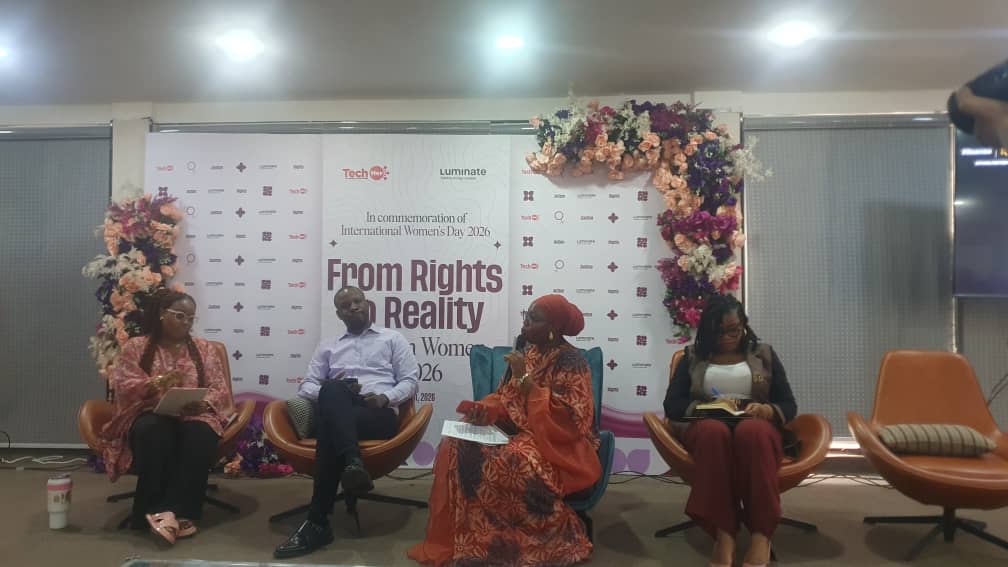
Stakeholders have called for urgent, coordinated action to bridge the widening gap between women’s rights and access to justice in Nigeria, as TechHer convened its 2026 International Women’s Day event themed “Rights. Justice. Action.”
The dialogue brought together civil society actors, law enforcement agencies, policymakers, and community voices to interrogate persistent challenges facing Nigerian women, particularly gender-based violence (GBV), digital abuse, and political exclusion.
Gbemisola Adebowale, the women’s rights and safety officer of TechHer, admonished participants to keep reinforcing the conversations central to discussions was the disconnect between existing legal frameworks and their implementation.
Participants noted that while policies supporting women’s rights were in place, weak enforcement continued to deny many survivors justice.
Rising cases of sexual violence and technology-facilitated abuse, including cyberstalking, sextortion, and online harassment, were highlighted as emerging threats.
Speakers stressed that Nigeria’s digital safety systems remained inadequate, leaving victims exposed and offenders largely unaccountable.
Political underrepresentation also featured prominently, with Cynthia Mbamalu, Director of Program of Yiaga Africa, warning that limited female participation in governance continued to sideline women’s issues in policy decisions.
The event featured an accountability panel and a live podcast session, amplifying cross-sector perspectives and lived experiences. A key milestone was the unveiling of a visual roadmap outlining policy reforms and digital safety strategies aimed at strengthening protection for women and girls.
TechHer emphasised the importance of multi-sector collaboration, citing ongoing partnerships with institutions such as the National Human Rights Commission (NHRC), NSCDC, and global digital platforms to improve reporting systems and response mechanisms.
Oluseyi Olufemi, country director, Dataphyte, underscored that sustained advocacy remained critical, noting that consistent messaging and collective action were essential to driving cultural and institutional change.
The organisation also highlighted its psychosocial support systems, which provide immediate emotional care and referrals for long-term therapy, reinforcing a holistic approach to survivor support.
Participants agreed that achieving gender justice requires stronger enforcement of laws, expanded digital protections, and inclusive governance structures.
The event concluded with a renewed call to move beyond awareness to measurable action, ensuring that women’s rights were not only acknowledged but actively protected in practice.
We’ve got the edge. Get real-time reports, breaking scoops, and exclusive angles delivered straight to your phone. Don’t settle for stale news. Join LEADERSHIP NEWS on WhatsApp for 24/7 updates →
Join Our WhatsApp Channel