Every year, the World Health Day is marked globally with renewed calls for stronger, more equitable health systems. Yet, in Nigeria, the commemoration often serves as a reminder of how far the nation still has to go to guarantee quality healthcare for its citizens.
Despite ambitious policies, spirited commitments, and the tireless efforts of healthcare workers, Nigeria’s progress continues to be undermined by poor budget implementation and others.
While the country allocates funds to health annually, the real challenge lies not just in what is budgeted, but in what is released, cash-backed, and implemented.
Health experts and advocates have consistently noted that although budgetary provisions look promising on paper, actual disbursements fall far short. Delayed or incomplete releases stall critical projects; from primary healthcare revitalisation to procurement of medical equipment, leaving facilities ill-equipped and citizens underserved.
The result is that even the most basic care becomes an uphill task. Patients wait hours sometimes days for services that should be readily available. In some rural areas, access to qualified health workers is still a luxury.
Strengthening primary healthcare (PHC) has been a national priority for over a decade, but implementation has been inconsistent. While some states have made progress, many PHC centres remain nonfunctional, lacking electricity, water, staff, and essential drugs.
The promise of the Basic Health Care Provision Fund (BHCPF) has also been hindered by bureaucratic delays and uneven state-level adoption. Communities that should benefit most continue to rely on poorly maintained facilities or resort to out-of-pocket care.
However, the federal government has restated its commitment to strengthening country’s health system and expanding universal access to quality healthcare as the world marks the 2026 World Health Day.
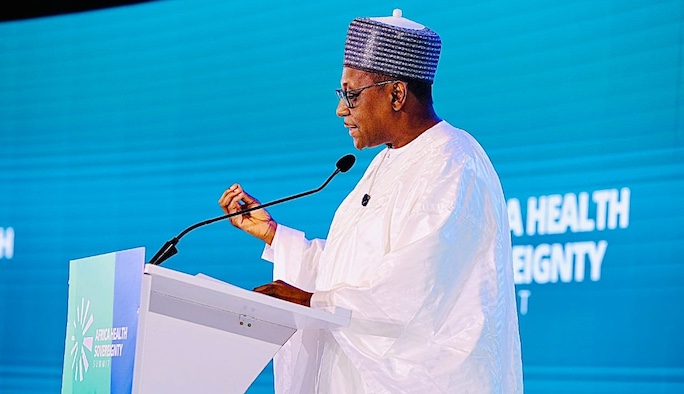
Speaking at a ministerial press briefing on Tuesday in Abuja, the Minister of State for Health and Social Welfare, Dr. Iziaq Salako, said the present administration remained committed to placing health at the centre of national development through evidence-based policies, scientific innovation, and strengthened health financing.
World Health Day is celebrated annually on April 7 to mark the founding of the World Health Organization (WHO) in 1948. This year’s theme, “Together for Health: Stand with Science,” underscores the importance of science-driven policies and the One Health approach in addressing modern health challenges.
The minister highlighted ongoing reforms under the Nigeria Health Sector Renewal Investment Initiative, describing it as the government’s strategic framework for strengthening health systems through improved financing, coordinated reforms, and stronger institutions.
He said the government was committed to ensuring that “every Nigerian, regardless of income, location or social status, can access quality healthcare without suffering financial hardship.”
According to him, significant progress has been recorded in the last three years of the administration, particularly in immunisation coverage, primary healthcare utilisation, and maternal health improvement.
Salako revealed that over 14 million girls have been vaccinated with the HPV vaccine, while more than 102 million children have been reached with the combined measles-rubella vaccine, achieving 99% coverage. Primary healthcare visits, he added, have grown from 10 million in early 2024 to 45 million by mid-2025, reflecting renewed confidence in the system.
The minister emphasised that reducing the burden of out-of-pocket expenditure currently between 60–70 per cent, remains a priority. He disclosed that 21.7 million Nigerians are now enrolled in health insurance schemes, marking a 33% increase from 2023.
While appreciating development partners, donors, private sector players, and state governments for supporting Nigeria’s health agenda, Salako said increasing domestic health financing remained a key priority for sustainability.
He also commended health workers for their resilience and service to Nigerians.
“As we mark World Health Day, we reaffirm that health for all Nigerians is not merely an aspiration, it is a commitment,” the minister said.
He called on all stakeholders to join hands in ensuring that “every mother receives quality care, every child is protected from preventable dis eases, and every family can access the health services they need.”
We’ve got the edge. Get real-time reports, breaking scoops, and exclusive angles delivered straight to your phone. Don’t settle for stale news. Join LEADERSHIP NEWS on WhatsApp for 24/7 updates →
Join Our WhatsApp Channel