When the Nigerian Content Development and Monitoring Board invited me to Yenagoa as guest author and lead facilitator for its quarterly leadership dialogue, I accepted without hesitation. There was no lavish fee, no elaborate theatre of protocol, only something far more valuable: a platform aligned with a cause I consider urgent—the making of leaders who can think clearly in turbulence, build institutions that do not fracture under pressure, and move society forward through adaptive intelligence rather than empty performance.
I arrived with the usual mental picture of a riverine capital: a city contending with difficult terrain, hemmed in by water, history, and the tired assumptions too often attached to the Niger Delta. But Yenagoa offered a different story. It bore visible signs of intention. Roads had opened up older spaces. New corridors suggested a government not merely improving movement but enlarging possibility. The city felt less like a place trapped by geography than one quietly insisting that geography need not be destiny.
Over the next day, through the dialogue, the book reading, and a closer encounter with Bayelsa’s changing landscape, a number of reflections emerged for me. Each began in Yenagoa, but each reached beyond it to the larger Nigerian condition.
Nigeria’s Crisis Is Structural
The first is that Nigeria’s crisis cannot honestly be described as occasional, cyclical, or confined to one sector. We still speak as though the country is passing through a difficult phase, as though one election, one reform, or one favourable oil-price cycle might restore equilibrium. But what confronts us runs deeper than episodic strain. We are dealing with an extended crisis of leadership, institutional credibility, public trust, and developmental imagination.
The most dangerous part of this condition is not only the hardship it imposes on citizens. It is the normalisation of dysfunction among those entrusted with power. Too many now behave as though instability is ordinary, as though public anger is merely a communication problem, and as though insecurity, economic pain, and institutional decay are just atmospheric conditions to be endured until the next news cycle passes.
The Cost of Reactive Leadership
The second reflection emerged sharply during the dialogue itself: Nigeria suffers not only from recurring crises, but from a deeply entrenched culture of reaction. One intervention, in particular, stayed with me. Dr Ebiwari Wariowei, a seasoned public relations practitioner, asked a question that goes to the heart of our dysfunction: why do Nigerian leaders prefer to manage crises after they erupt rather than prevent them before they mature into disaster?
That question deserves to be asked in every cabinet room, governor’s office, boardroom, and security council in the country. Pre-emptive leadership is the discipline of anticipation. It requires leaders to identify vulnerabilities early, study patterns, learn from previous failures, track emerging risks, and build systems capable of absorbing shocks before they become emergencies. It values prevention over spectacle, foresight over drama, and resilience over panic.
Yet ours remains a reactive political culture. We wait for insecurity to spiral before rediscovering intelligence. We wait for floods before discussing drainage. We wait for economic hardship to become politically combustible before admitting that short-termism has consequences. We wait until institutions fail in public before pretending to seek reform. In such a culture, visible reaction is often rewarded more than quiet prevention. Heroism begins to matter more than stewardship. Applause matters more than preparedness.
The Quiet Work of Capacity Building
The third lesson from Yenagoa was more hopeful. Some of the most important nation-building in Nigeria is being done quietly, away from the glare that often accompanies political performance. NCDMB is one example. It is underreported and insufficiently appreciated in many quarters. Yet its work suggests an institution trying to move beyond regulatory routine towards capability creation.
What impressed me was not merely the scale of its programmes, but the logic beneath them. Innovation challenges, technology incubation, equity support for indigenous oil-service firms, technical training for young engineers, and partnerships aimed at building specialised skills all point to one central idea: national content is not a slogan. It is a long-term project of building competence, confidence, and local capacity. It is about ensuring that Nigerians are not perpetual spectators in an industry operating in their own country, but genuine participants in its technical, managerial, and commercial value chain.
That distinction matters. Too much of our public conversation celebrates commissioning ceremonies and headline announcements while neglecting the slow, unglamorous work of building ecosystems. But no country becomes self-reliant through slogans. Self-reliance is built painstakingly—through finance, research, training, technology transfer, institutional patience, and a stubborn commitment to developing people and firms over time. In that regard, NCDMB appears to be doing something important: converting the rhetoric of local content into an architecture of local capacity.
Why Intellectual Culture Matters
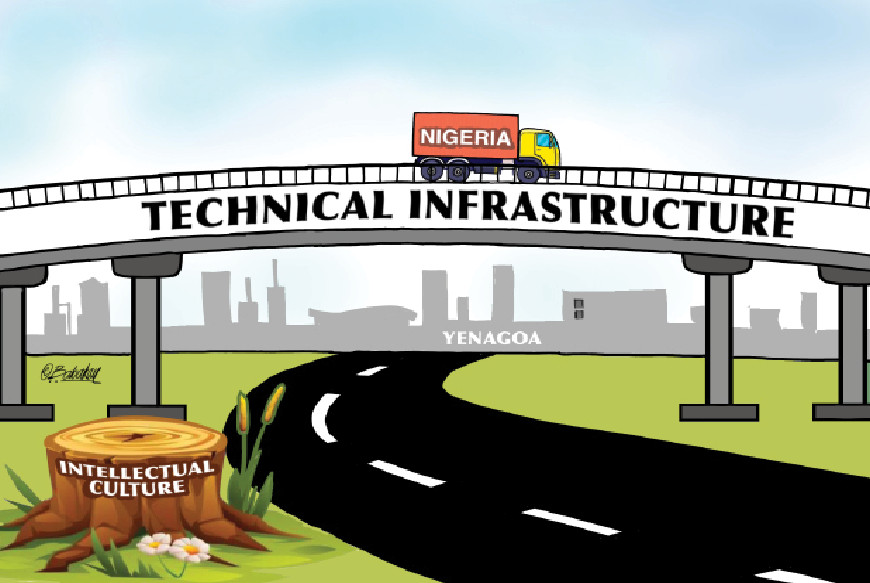
The fourth reflection concerned something some would dismiss as secondary, but which I consider central: NCDMB’s decision to sponsor a book reading and leadership dialogue. At first glance, this may seem peripheral to its mandate. It is not. If anything, it reveals a deeper understanding of development itself.
No serious society rises on technical infrastructure alone. It also rises on intellectual culture—on what its people read, the kinds of leaders they admire, the habits of thought its institutions encourage, and whether public life still makes room for reflection as well as regulation. A country that wants capable industries must also cultivate capable minds. A sector that seeks long-term growth cannot ignore the moral and intellectual formation of the people who will eventually lead it.
Bayelsa and the Myth of Impossible Terrain
The fifth lesson came from Bayelsa itself, and it challenged one of Nigeria’s laziest assumptions—that some terrains are simply too difficult for development. For too long, we have spoken of the Niger Delta’s creeks and swamps as though they were destiny, as though the landscape itself were a sufficient explanation for underdevelopment. But geography, however difficult, is never the full story. Often, what presents itself as geographic defeat is political failure.
As I moved through parts of Bayelsa and saw road construction, expanding corridors, bridges, new quarters, and a growing urban ambition, one truth became impossible to ignore: terrain may complicate development, but it does not make development impossible. What is often lacking is not technical possibility, but political will. What fails first is rarely the land. It is leadership.
In places long neglected, roads are never just roads. They are declarations. They announce that remoteness need not be permanent, that abandonment can be reversed, and that the map itself can be challenged by vision and execution.
The Larger Lesson
All of this led to a conclusion. Yenagoa reminded me that national renewal will not come through noise, sentiment, or hype. It will come through adaptive action—through leaders and institutions capable of linking vision to execution, foresight to policy, and ambition to systems.
Yenagoa, for me, became more than a destination. It became a metaphor. In a country wearied by disappointment, it offered evidence that the future can still be assembled with discipline and intent.
Beyond the creeklines, I saw evidence that resilient leadership does more than survive chaos. It reorganises it. It turns difficult terrain into possibility, neglected margins into strategic frontiers, and institutional seriousness into hope. Bayelsa’s recent trajectory suggests that vision, coupled with determination, can conquer even difficult terrain. That, ultimately, is the promise Yenagoa whispered to me: Nigeria’s renewal will not be born of rhetoric. It will come from the quiet power of institutions that work, leaders who think ahead, and governments willing to prove that even the most unlikely landscapes can bear the weight of progress.
Dr Dakuku Peterside is the author of “Leading in a storm” and “Beneath the surface.”
We’ve got the edge. Get real-time reports, breaking scoops, and exclusive angles delivered straight to your phone. Don’t settle for stale news. Join LEADERSHIP NEWS on WhatsApp for 24/7 updates →
Join Our WhatsApp Channel