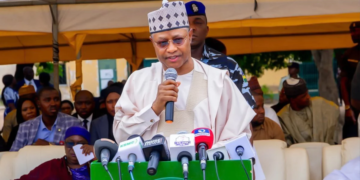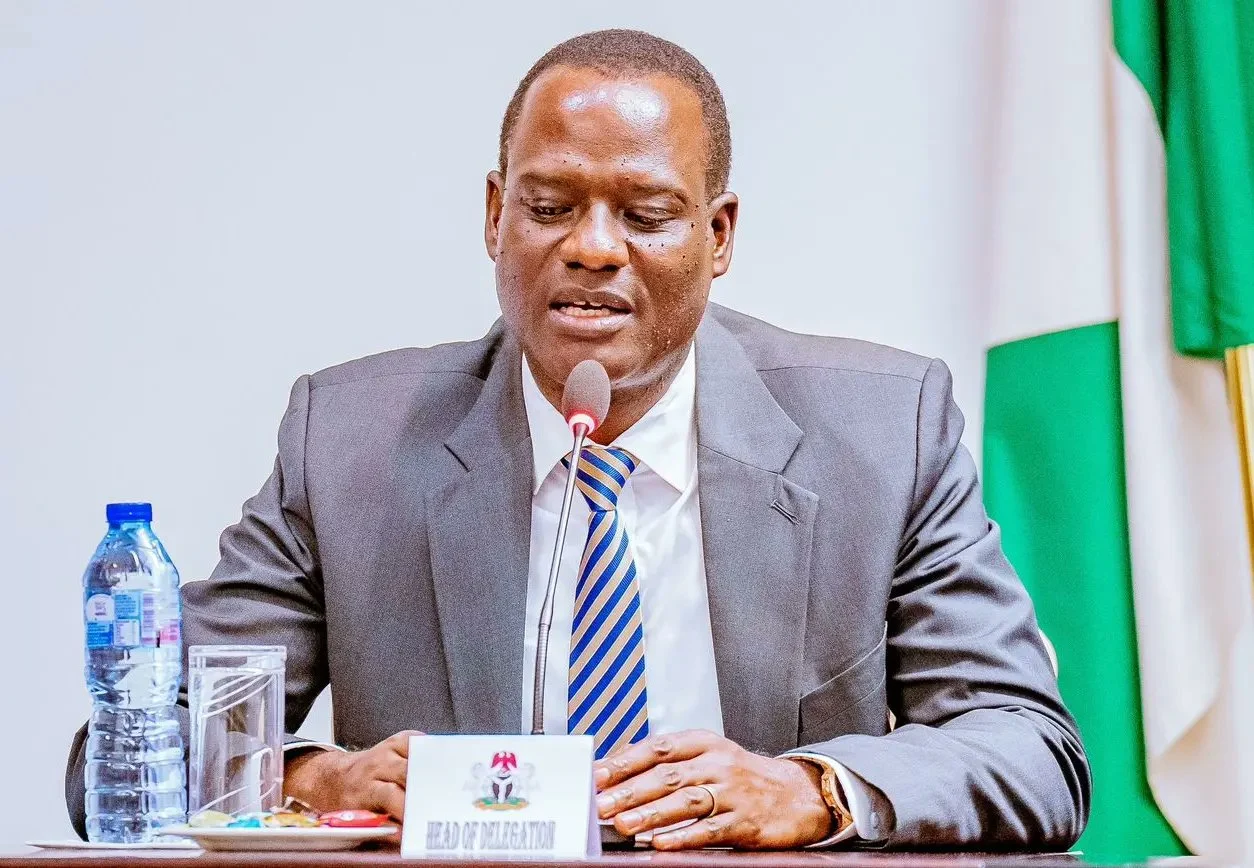
The departure of Wale Edun from the post of Minister of Finance and Coordinating Minister of the Economy this week, barely two and a half years into his tenure, drew immediate attention. Whatever the merits of the official account that ill health necessitated the exit, the transition was swift and the replacement already in the building.
Taiwo Oyedele, confirmed as Minister of State for Finance only weeks earlier in March, was elevated to assume the full portfolio at once. The country now has a new helmsman for its fiscal affairs at a testing moment, and the weight of expectation on his shoulders is considerable.
Oyedele is no stranger to these responsibilities. For several months before his ministerial appointment, he served as chairman of the Presidential Committee on Fiscal Policy and Tax Reforms, which undertook a sweeping overhaul of Nigeria’s tax regime provisions that came into force at the start of this year. Prior to that, he spent 22 years at PricewaterhouseCoopers, rising to the position of Fiscal Policy Partner and Africa Tax Leader, advising governments and contributing to regional tax harmonisation efforts across more than 30 African countries. His academic profile spans executive programmes at Harvard, the London School of Economics and Yale, a professorship at Babcock University, and a visiting scholarship at the Lagos Business School.
When President Tinubu described Oyedele as the man who “rewrote the entire tax policy of this country,” it was not empty praise. The expectation, therefore, is that his elevation to the top economic management post signals a doubling down on reform, not a retreat from it.
What the new minister must confront, however, is a set of economic realities his predecessor struggled to resolve. Nigeria’s headline inflation rate rose to 15.38 per cent in March 2026, according to the National Bureau of Statistics, reversing a 12-month streak of declining inflation.
The figure represented a 0.32 percentage point increase over the February rate of 15.06 per cent, but the more troubling signal was in the month-on-month data, which showed inflation accelerating from 2.01 per cent in February to 4.18 per cent in March ,more than double in four weeks. Food and non-alcoholic beverages contributed 5.55 percentage points to the headline figure; restaurants and accommodation services contributed 3.26 percentage points; transport contributed 1.80 percentage points.
In our view, these are not peripheral indicators. They represent the daily cost of living for the overwhelming majority of Nigerians, and they are moving in the wrong direction.
We have stated on this page, and more than once, that the pain arising from the removal of the fuel subsidy and the unification of the exchange rate needed to be addressed not merely through monetary tightening but through concrete interventions in food supply chains, logistics costs and household purchasing power.
The administration has pointed to the moderation in year-on-year figures — core inflation, for instance, fell from 27.12 per cent in March 2025 to 16.21 per cent this year as evidence of progress. That progress is real and should be acknowledged. But it has not translated into perceptible relief at the level of ordinary market transactions, and the March reversal is a reminder that gains remain fragile.
Oyedele must approach the inflation question not as a communication problem to be managed but as a structural challenge requiring a concrete, time-bound plan with milestones the Nigerian public can hold him to.
The task before the new minister extends well beyond inflation management. Nigeria’s debt profile demands sustained attention. The country’s debt-to-revenue ratio has long passed the threshold at which credible fiscal management becomes difficult, and the tax reform that Oyedele himself championed was explicitly premised on widening the revenue base to reduce dependence on borrowing. The proof of that reform now falls to him to deliver, not merely to defend.
He must accelerate the revenue diversification the Presidential Fiscal Committee recommended, ensure that exemptions granted to lower-income earners are not quietly reversed under pressure from vested interests, and demonstrate that broadening the tax net can be achieved without further squeezing businesses already labouring under high interest rates and inadequate infrastructure.
We also urge the new minister to address the condition of the real economy with similar urgency. The exit of several multinational companies from Nigeria in recent years was not incidental. It was a verdict on the cost of doing business here ;an unstable power supply, logistics failures, a costly regulatory environment and, for a prolonged period, an unpredictable foreign exchange market. The stabilisation of the naira was a necessary first step, but stability without growth is insufficient. Manufacturing capacity utilisation remains low.
Unemployment among young Nigerians is a crisis in plain sight. The connection between fiscal policy decisions and real employment outcomes must be made explicit and measurable, not left to assumption.
President Tinubu, in charging Oyedele with his expanded brief, spoke of consolidating ongoing reforms with renewed focus, discipline and innovation.
We endorse the spirit of that charge, but wish to enter a caution: consolidation must not become a synonym for entrenching what is not working. Where the sequencing of reforms has left households without adequate cushioning, course corrections are warranted. Where promised social protection programmes have fallen short of their targets, honest accounting is owed to the Nigerian people, and the new minister is in a position to provide it.
Oyedele brings to this office a record of intellectual rigour and institutional credibility that is not easily dismissed. The question now is whether those qualities will translate into actions that Nigerians can feel. He has goodwill enough to begin with. He must take care not to spend it on the familiar habits of grandiose announcements and unmet timelines that have characterised too many ministerial tenures before his.
We’ve got the edge. Get real-time reports, breaking scoops, and exclusive angles delivered straight to your phone. Don’t settle for stale news. Join LEADERSHIP NEWS on WhatsApp for 24/7 updates →
Join Our WhatsApp Channel