Recent data show that about 90 per cent of the movement of people and goods across Nigeria is handled by road transport. This overdependence on roads partly explains why the country records approximately 42,000 road deaths annually – a fatality rate of 21 per 100,000 inhabitants, far exceeding the global average and nearly four times that of the European Union.
Drive from Lagos to Ibadan, Port Harcourt to Warri, Kaduna to Jos, Kaduna to Abuja, Numan to Jalingo, or Gombe to Biu, and you will encounter a national disgrace. Many of these roads and highways swallow vehicles, frustrate travellers, and undermine economic activity. Rather than connecting communities and facilitating commerce, they punish commuters and betray the promise of Africa’s largest economy.
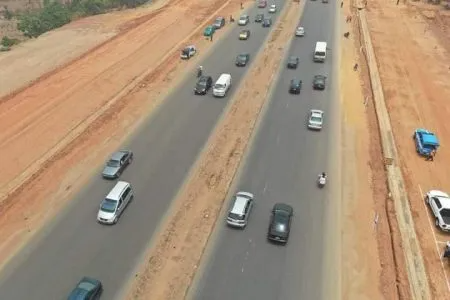
The recent five-day gridlock on the Abuja–Kaduna Highway is a painful illustration of the state of Nigeria’s transport infrastructure. Triggered primarily by ongoing road construction, the breakdown of heavy-duty vehicles, and increased traffic during the Eid-el-Kabir festive period, the congestion left thousands of commuters stranded for hours and, in some cases, days. The Abuja–Kaduna Highway represents the broader story of Nigeria’s roads. With only about 19 per cent of the country’s road network paved – and much of that fraction riddled with potholes deep enough to damage vehicles – the nation is, quite literally, moving on broken bones.
The situation has been compounded by rising transportation costs driven by fuel price increases. According to the latest Premium Motor Spirit (Petrol) Price Watch Report released by the National Bureau of Statistics (NBS), the average retail price of petrol rose to N1,532.93 per litre nationwide. The report noted significant increases in fuel prices on both a monthly and annual basis, reflecting sustained pressure in Nigeria’s downstream petroleum market following deregulation reforms.
From collapsing rural roads to chaotic traffic congestion in major cities and along key federal highways, transportation in Nigeria has deteriorated into a national crisis requiring urgent and sustained government attention.
The onset of the rainy season further worsens an already difficult situation. Potholes become craters, drainage systems fail or become blocked with debris, flooding major roads and rendering entire sections impassable. Yet year after year, substantial budgetary allocations are announced with little visible improvement in the daily experiences of ordinary Nigerians.
The economic consequences are severe. The World Bank estimates Nigeria’s infrastructure deficit at approximately $100 billion (137 trillion naira) – a gap that the federal budget alone cannot bridge. Poor roads increase transport costs, delay the movement of goods, damage vehicles, and reduce productivity. Travellers spend valuable hours trapped in traffic rather than contributing meaningfully to economic activity. Businesses lose billions through delayed logistics and disrupted supply chains. Farmers struggle to move produce from rural communities because feeder roads remain in deplorable condition, thereby worsening food inflation and increasing post-harvest losses.
Beyond economics, the consequences affect public safety and national security. Bad roads and weak transport systems contribute directly to road accidents, insecurity, and growing social frustration. Unfortunately, governments at both federal and state levels often respond with cosmetic interventions rather than comprehensive planning. Nigerians repeatedly witness the ceremonial commissioning of buses without maintenance plans, flyover projects without integrated urban transport strategies, and road contracts that are either abandoned or deteriorate shortly after completion.
What makes this situation particularly frustrating is that solutions are neither unknown nor unattainable. The Federal Government’s adoption of Continuously Reinforced Concrete Pavement, designed to last up to 50 years with minimal maintenance, suggests a recognition that the traditional asphalt approach has largely failed. Public-private partnerships on corridors such as Benin–Asaba and Abuja–Keffi offer useful models for sustainable infrastructure financing. Major projects such as the Lagos–Calabar Coastal Highway and the Sokoto–Badagry Superhighway are commendable. However, these initiatives should not distract from the reality that millions of Nigerians still travel daily on roads that are unfit for safe and efficient transportation.
Transportation must no longer be treated as a political project designed primarily for headlines and ribbon-cutting ceremonies. It is a strategic national development issue. Countries that successfully transformed their economies did not do so through speeches alone. They invested heavily in reliable road networks, efficient public transportation systems, rail connectivity, urban planning, and long-term infrastructure maintenance. Nigeria cannot continue to expand its cities and population without corresponding investments in transportation systems capable of supporting modern economic life.
The government must therefore think beyond short-term interventions. Nigeria urgently needs sustainable urban mass transit systems, consistent rehabilitation and maintenance of federal and state roads, safer and better-regulated commercial transportation, integrated transport planning, improved rural road networks, and strict accountability for infrastructure contracts. There must also be greater transparency in road construction and transportation projects. Nigerians deserve to know how public funds allocated to infrastructure are spent and why so many projects fail despite enormous expenditures.
Roads are more than concrete and asphalt; they are the veins through which a nation’s economy flows and a visible measure of governance. Every failed drainage system, every cratered intersection, and every unmarked bend reflects a policy choice. Nigeria’s roads do not merely require repair; they demand a fundamental rethinking of how the nation builds, maintains, and values public infrastructure.
The current situation is unsustainable. A nation where movement itself becomes a hardship cannot achieve meaningful productivity or sustainable development. If citizens expend more energy struggling to move from one place to another than building their lives, businesses, and communities, then economic reforms alone will never deliver the prosperity Nigerians seek.
We’ve got the edge. Get real-time reports, breaking scoops, and exclusive angles delivered straight to your phone. Don’t settle for stale news. Join LEADERSHIP NEWS on WhatsApp for 24/7 updates →
Join Our WhatsApp Channel