Germany has raised concerns over the application of blasphemy laws in parts of northern Nigeria, warning that their enforcement could lead to serious violations of human rights, including the freedom of religion and belief.
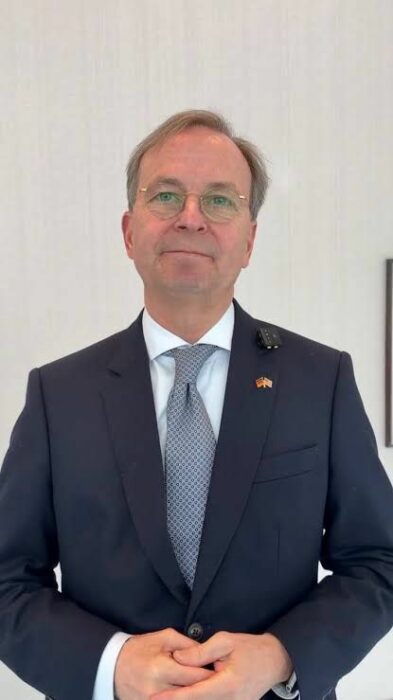
Germany’s Federal Government Commissioner for Freedom of Religion or Belief, Thomas Rachel, made this known during a press engagement in Abuja,following his visit to Nigeria, where he met with government officials, religious leaders, and victims of violence.
Rachel noted that while Nigeria remains a key partner for Germany and a vibrant religious society, there are growing concerns about reports of rights abuses linked to the selective enforcement of blasphemy laws in certain states.
“We heard about the concerns of quite a lot of people about the partial application of blasphemy laws in certain northern states, which leads to severe violations of human rights, as well as the freedom of religion and belief,” he said.
The German envoy reaffirmed his country’s commitment to promoting religious freedom globally, referencing Article 18 of the Universal Declaration of Human Rights, which guarantees the right to freedom of thought, conscience, and religion.
He described freedom of religion and belief as a fundamental human right and a key indicator of human dignity, stability, and peace in any society.
During his visit, Rachel travelled to Makurdi in Benue State, where he interacted with internally displaced persons (IDPs) and victims of attacks. He said the experiences left a deep impression on him, particularly the uncertainty expressed by victims about their future.
“I visited the IDP camp at the International Market in Makurdi. I spoke with victims and family members, and you can feel that they are not sure if they have a perspective for their life,” he said.
He also recalled his visit to Yelawata, a community in Benue State where more than 200 people were reportedly killed in an attack in June 2025, describing the incident as deeply troubling.
According to him, victims and affected communities are primarily seeking safety, support, and the opportunity to return to their ancestral homes.
Rachel further observed that both Christians and Muslims in Nigeria are victims of violence perpetrated by extremist groups such as Boko Haram and Islamic State, stressing that terrorism—not religion—remains the common enemy.
“You see that Christians and Muslims have a common enemy. These are the terrorists. So let me express my full solidarity with Nigeria,” he said.
The German official emphasised that security remains a dominant concern across affected regions, urging continued efforts to protect lives and uphold fundamental rights.
He disclosed that Germany is supporting peacebuilding initiatives in Nigeria through dialogue and mediation efforts in collaboration with local and international partners, including the Centre for Humanitarian Dialogue.
“These processes bring conflicting groups together, often for the first time, to speak to each other and work toward a common perspective,” he explained.
While commending Nigeria’s strong religious culture, Rachel stressed the need for unity across faiths, noting that lasting peace can only be achieved when citizens, regardless of religious affiliation, work together.
He referenced Nigeria’s national motto—unity and faith, peace and progress—as a guiding principle for building a more stable and inclusive society.
“I am convinced that peace and security will only succeed if unity prevails despite different religions, whether one is Muslim or Christian or of another belief,” he said, adding that Germany would continue to support Nigeria’s efforts toward peace and stability.
We’ve got the edge. Get real-time reports, breaking scoops, and exclusive angles delivered straight to your phone. Don’t settle for stale news. Join LEADERSHIP NEWS on WhatsApp for 24/7 updates →
Join Our WhatsApp Channel