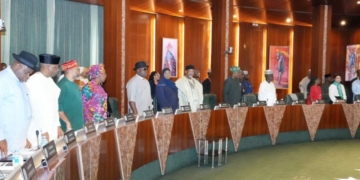

The Supreme Court has fixed Thursday, April 30 for judgement in the leadership crisis rocking the African Democratic Congress (ADC).
The five-member panel led by Justice Mohammed Garba will resolve the appeal filed by the David Mark-led faction of the party concerning the authentic leadership of the party one way or the other.
Also, on the same Thursday, the party will resolve the leadership crisis rocking the People’s Democratic Party (PDP).
Two factions of the party, one led by Kabir Turaki, SAn and the other led by the minister of the Federal Capital Territory, Nyesom Wike, were laying claims to the leadership of the party.
Recall that on Tuesday, the ADC had formally wrote the Chief Justice of Nigeria (CJN), Justice Kudirat Tomori Kekere-Ekun, pleading for quick delivery of judgement in the leadership tussle of the party at the national level.
The party claimed that it will suffer irreparable harm if judgement in the protracted battle was not delivered by the Supreme Court during the period allowed by the Electoral Act to field candidates for the 2027 general election.
The Supreme Court had on April 22 reserved judgement in the ADC crisis till a date that would be communicated to parties involved in the tussle.
At the April 22 hearing of the case, Jibrin Okutepa, SAN, who represented David Mark had urged the Supreme Court to allow the appeal as he submitted that the apex court had in a judgement on March 21, 2025 put an end to the issue before the court when it held that “no court has jurisdiction to entertain cases bordering on internal affairs of political parties.”
During the hearing, Counsel to the ADC, Jibril Okutepa, SAN, urged the apex court to hold that the Abuja Federal High Court lacked the jurisdiction to entertain a suit bordering on the ADC’s internal matters.
However, Robert Emukpero, SAN, who represented the 1st respondent, Nafiu Bala Gombe had urged the apex court to reject the appeal and affirm the judgement of the lower court which held that the case of the appellant was premature and dismissed it.
It will be recalled that a three-member panel of the Court of Appeal had dismissed Mark’s appeal, challenging the jurisdiction of the Federal High Court presided by Justice Emeka Nwite, to entertain the suit filed by Bala against the leadership of the ADC.
The Court of Appeal had in its decision held that the appeal was not only premature but was brought without leave of the trial court.
LEADERSHIP reports that on Wednesday, April 29, Justice Joyce Abdulmalik of the Federal High Court in Abuja, stopped the Independent National Electoral Commission (INEC) from recognising or participating in any congress organised by the fcational leadership of ADC.
The court, in its judgement, barred the former Senate President, David Mark, and other prominent figures in the party from interfering with the functions and tenure of elected state executives.
Norman Obinna and six others on behalf of state chairpersons and executive committees of the party had filed the case to challenge the legality of actions taken by a caretaker or interim national leadership, particularly the move to organise state congresses through an appointed committee.
They argued that the caretaker body lacked constitutional authority to organise such congresses or to appoint any committee for that purpose. According to them, only duly elected party organs recognised under the party’s constitution possess the power to conduct congresses.
The plaintiffs, therefore, asked the court to affirm the tenure of the state executive committees and restrain any parallel processes that could undermine their authority.
In resolving the dispute, Justice Abdulmalik held that the claims brought before the court were valid and deserving of judicial consideration, especially in view of alleged breaches of constitutional and statutory provisions.
She stated that she found “the issue in the originating summons meritorious.”
The judge framed the central issue as whether the second to sixth defendants, including Mark, had the constitutional or statutory authority to assume the powers of elected state organs of the ADC, whose tenure is guaranteed under the party’s constitution.
She relied on section 223 of the 1999 Constitution, which mandates political parties to conduct periodic elections based on democratic principles, as well as Article 23 of the ADC constitution, which provides that national and state officers shall hold office for a maximum of two terms spanning eight years.
According to her, “the question is whether there is any infraction committed by Mr Mark and co-defendants when they convened meetings and appointed a body known as a congress committee to organise state congresses.”
On the defence raised by the defendants that the matter was an internal affair of a political party and therefore outside the jurisdiction of the court, the judge acknowledged the settled legal position but clarified its limits.
She held that while courts are generally reluctant to interfere in internal party matters, they will intervene where there is a clear allegation of violation of constitutional or statutory provisions.
“The law is settled that courts will not interfere. However, where there is an allegation of breach of constitutional or statutory provisions, the court has a duty to intervene,” she ruled.
“Where a party alleges that its constitution has been violated, the court is bound to adjudicate. Any argument that this court lacks jurisdiction on that basis fails.”
Justice Abdulmalik stressed that political parties must operate strictly within the confines of their constitutions, noting that any deviation from prescribed procedures, particularly in leadership matters, cannot be justified under the guise of internal autonomy.
She found that the procedure adopted by the defendants, including the appointment of a “congress committee,” was not recognised by the ADC constitution and therefore invalid.
Consequently, the court held that the tenure of the state executive committees remains valid and must be allowed to run its full course without interference.
In the PDP appeal, the first appeal marked SC/CV/164/2026 stems from a decision of Peter Lifu, judge of a federal high court in Abuja, who issued a temporary order on November 11, restraining the party from proceeding with the planned convention pending the determination of a substantive suit filed by Sule Lamido, former governor of Jigawa state.
On November 14, he made a final order restraining the PDP from conducting its national convention.
In his judgment, Lifu held that the evidence before the court established that Lamido was “unjustly denied” the opportunity to obtain a nomination form to contest the position of national chairman of the party, in violation of the PDP constitution and its internal regulations.
The decision was later upheld by the court of appeal on March 9.
Aggrieved, the PDP further appealed the decision of the appellate court.
During the hearing of the appeal, the appellants, through their team of lawyers led by Paul Erokoro, a senior advocate of Nigeria, prayed the supreme court to allow their appeal and to dismiss a cross-appeal lodged against them by a faction of the party aligned with Nyesom Wike, minister of the Federal Capital Territory (FCT).
The respondents including Sule Lamido, who was represented by J. C. Njikonye, SAN, as well as the Wike-backed faction, represented by Joseph Daudu, filed preliminary objections seeking dismissal of the appeal.
The second appeal, marked SC/CV/166/2026, was filed by the PDP, its national working committee (NWC), and national executive committee (NEC).
The appeal emanates from a judgment of the Abuja federal high court delivered by James Omotosho.
Omotosho had stopped the PDP faction from going ahead with its Ibadan national convention.
The judge ruled that the evidence before the court showed that the party failed to hold valid state congresses before the planned convention as stipulated in the 1999 constitution and INEC guidelines, as well as its own constitution.
The judgment was also upheld by the court of appeal on March 9.
The appellate court panel held that it found no reason to overturn Omotosho’s verdict, which barred INEC from validating the Ibadan convention outcome.
After hearing all parties in the appeals, a five-member panel of the apex court, headed by Mohammed Garba, reserved the matter for judgment. The court said a date will be communicated to the parties in the suit.
We’ve got the edge. Get real-time reports, breaking scoops, and exclusive angles delivered straight to your phone. Don’t settle for stale news. Join LEADERSHIP NEWS on WhatsApp for 24/7 updates →
Join Our WhatsApp Channel