
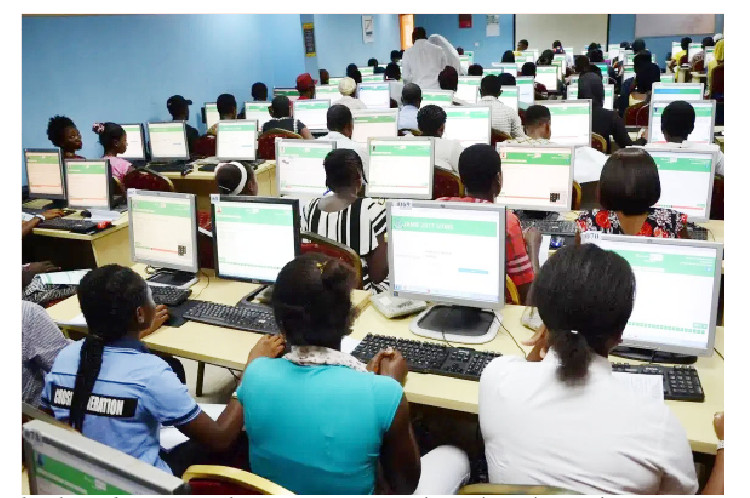
As the Unified Tertiary Matriculation Examination (UTME) 2026 cycle unfolds, conversations are once again dominated not only by candidates’ performances, but also by a surge of viral claims and unverified scorecards circulating across social media platforms.
Each year, the UTME conducted by the Joint Admissions and Matriculation Board (JAMB) returns with a familiar mix of anticipation, anxiety, and controversy.
What should be a straightforward process of assessing academic readiness has increasingly become a battleground between official data and online misinformation.
Since JAMB first released the results of the first batch of 2026 UTME candidates on 17 April 2026, the Board has continued to release results daily, usually within one or two days. However, what followed has been a mix of fake high scores dominating online platforms.
In recent years, the UTME period has witnessed repeated waves of exaggerated or entirely fabricated claims about highest scorers, often amplified by blogs and social media influencers eager for attention and engagement.
High-profile controversies, including the widely discussed case involving Mmesoma Ejikeme, who forged her JAMB score in the 2023 examination, have exposed how quickly false narratives can gain traction before being officially debunked.
Despite JAMB’s consistent position that it does not officially rank candidates or recognise top scorers, such claims continue to resurface, feeding public confusion and gradually eroding trust in the examination process.
The 2026 season appears no different. As candidates, parents, and schools navigate the high-stakes admissions, distinguishing verified information from digital hoaxes has become more critical than ever.
In an era where a single screenshot can spark nationwide debate within minutes, the challenge is no longer just about sitting for the examination, but also about protecting the integrity of its outcomes against the growing misinformation.
The rapid spread of fake results is largely driven by the speed of social media platforms, where unverified content can go viral before fact-checking catches up.
Many users share such posts without confirming their authenticity, while some content creators deliberately circulate false claims to attract traffic, followers, or attention.
This environment has made examination seasons particularly vulnerable to digital manipulation, especially among impressionable audiences.
JAMB has repeatedly clarified that it does not officially recognise or promote a single highest scorer in the UTME. Instead, the examination body focuses on broader performance statistics and trends, rather than ranking candidates as number one nationwide.
Over the years, JAMB has also cautioned against the growing obsession with identifying a highest scorer, noting that it often fuels misinformation, result falsification, and viral social media hoaxes.
Incidents involving exaggerated or completely fabricated scores have surfaced in previous examination cycles, prompting the Board to reiterate that such claims should be treated with scepticism unless verified through official channels.
Candidates and members of the public are encouraged to rely solely on the JAMB portal and accredited announcements for accurate information.
In some instances, particularly during annual policy meetings, JAMB usually release a list of top-performing candidates or highlight outstanding scores. There year also, a policy meeting will be held to decide such outcomes.
However, this should not be mistaken for an endorsement of a single best candidate. Despite this clarification, media organisations, schools, and private bodies often single out the highest mark from available data and label the student as the top scorer, further blurring the line between official records and public interpretation.
Ultimately, while high scores are acknowledged and sometimes rewarded through scholarships or public recognition, JAMB maintains that it does not confer an official highest scorer title.
This distinction remains a key issue each UTME season, including 2026, where the gap between verified data and online claims continues to generate confusion among stakeholders in the education sector.
The spread of misinformation also places additional pressure on candidates and parents, many of whom experience unnecessary anxiety when false results circulate.
In some cases, families celebrate prematurely based on fake scorecards, only to later discover that the information was false.
Reacting to one of the fake online high scores trending on social media, which claimed that a candidate scored 396 in the 2026 UTME, the Board described it as entirely false.
“It is surprising that such a fabrication is being shared by otherwise well-informed Nigerians. Firstly, the Board has clearly stated that UTME results are view-only. The circulated document appears on a fabricated result template, which on its own is sufficient indication that it is not authentic.
“Secondly, the Board’s registration numbers are system-generated and do not follow the pattern ‘20269’ as seen on the fake slip. There are several other inconsistencies that, even at a glance, expose the result as fraudulent,” Dr Fabian Benjamin, the Board’s spokesperson stated.
We’ve got the edge. Get real-time reports, breaking scoops, and exclusive angles delivered straight to your phone. Don’t settle for stale news. Join LEADERSHIP NEWS on WhatsApp for 24/7 updates →
Join Our WhatsApp Channel