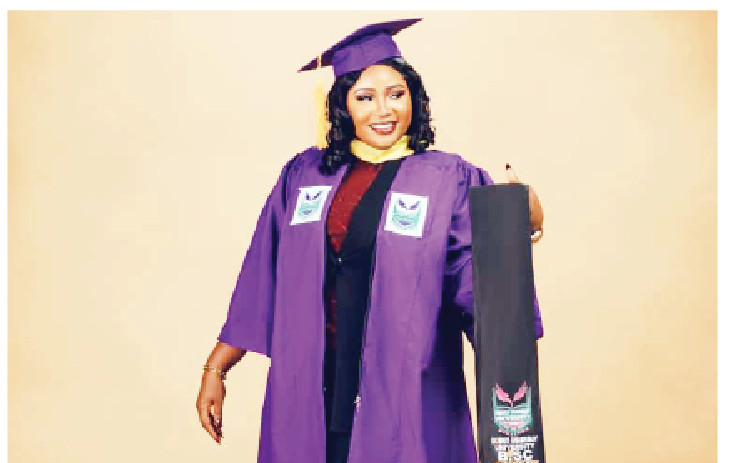
Ogharanduku Princess Omoghene is a graduate of Microbiology from Dennis Osadebay University, Delta State. In this interview with Felix Lgbekoyi, the first-class graduate said she really wanted to make her mum proud, stayed disciplined and focused, and avoided anything that could distract her, and at the end, it wasn’t a mistake at all that she graduated with distinction.
Can you give us a brief introduction of yourself?
My name is Ogharanduku Princess Omoghene, and I studied Microbiology at Dennis Osadebay University, Delta State.
What was your university experience?
My university experience was actually quite balanced. I didn’t have a lot of friends, not intentionally, though. I’m more of an ambivert, and I just didn’t really click with many people. So my circle stayed small, but over time, I was still cool with most of my classmates.
Campus life was calm for me. I kept my routine simple and focused. And just because I graduated with a first class doesn’t mean I was a bookaholic. I actually watch a lot of sci-fi, and I think the curiosity it stirs helped me, especially when I was learning new concepts. It made me want to understand things more deeply.
Honestly, I just didn’t want to drop my hand. I’ve always come across as intelligent, so I wanted my results to actually match that. I also felt like I had to live up to how people saw me, as a smart person. And most importantly, I really wanted to make my mum proud.
How did you sustain your academic performance and stayed focused to get a first class?
It was mostly internal motivation. I kept reminding myself of the standard I had already set and didn’t want to drop. So, I stayed disciplined and focused, and avoided anything that could distract me.
What was your reaction when you found out you graduated with a first-class degree?
I was really happy, like genuinely excited. For me, it meant I had improved from the IJMB result I used to enter school. I had been in first class from the beginning, so finishing that way felt really satisfying.
With your intelligence, why did you prefer to study Microbiology?
Honestly, I won’t even say I chose Microbiology; I’d say Microbiology chose me. When I was applying, I had to be strategic. I looked at Biochemistry and thought, “The chemistry part will require a lot more time and stress.” Then, Biology — I wasn’t really a fan of the plant aspect. Same with Plant Science. Physics? That one was just full focus not to make mistakes. So I asked myself, what course will I struggle with the least? That was how I settled for Microbiology. But even at that, it came with its own challenges. From learning about different microorganisms, to their resistance mechanisms, antibiotics, life cycles, and even clinical manifestations… it was a lot. But in the end, it wasn’t a mistake at all.
How did you balance academics with financial challenges and campus activities?
My parents handled everything financially, so I didn’t really have that pressure. And to be honest, there weren’t many extracurricular activities, so it was easier to just focus on school.
What were your immediate plans after graduation, and how are you approaching the next phase of your life?
Right now, my plan is to go through Direct Entry and get back on track for medicine. I’m just taking things step by step and focusing on what will move me closer to that goal.
What key lessons helped you maintain excellence?
I learned how to filter things, like what actually matters and what doesn’t. I always try to think about the outcome of whatever I’m doing. If it won’t help me in the long run, I just don’t give it much attention.
What advice would you give to younger students who want to achieve academic excellence?
Be disciplined and intentional. Not everything deserves your attention. Focus on what matters and always think about the results your actions will bring.
In what way can your education contribute to society?
My education has helped me develop discipline and critical thinking skills. As I continue toward medicine, I believe I’ll be able to make a real impact, especially in healthcare.
How would you describe your experience and academic environment at Dennis Osadebay University, Delta State?
My experience was actually good. The lecturers were approachable, which made things easier. I’d say we weren’t just lectured — we were taught. The system was quite supportive.
Looking back, what was your greatest achievement and your biggest challenge?
My greatest achievement is definitely graduating with a first class. As for my deficiency, I’d say I was very academically focused, maybe to the point of not exploring other things as much as I could have.
How did your parents shape your journey as an undergraduate?
They supported me financially all through, which made a big difference. My mum always said if you’re not disciplined, it’s hard to handle both school and financial stress, so that support really helped me stay focused.
What was your living situation, and what challenges did you face?
I stayed with my aunt and uncle instead of living alone because I didn’t want to manage money myself. I had tried that before and didn’t like it. I preferred knowing that if my money finishes, I can just ask for more.
But living with family also had its own ups and downs, noise, chores, running errands, even when you’re in the middle of reading. I remember there were times I had to go outside, even behind the house, just to read in peace, and they would start looking for me.
What strategy did you adopt for reading style and discipline?
As I said, I’m not a bookaholic. I just read so I won’t fail. You just have to find what motivates you. For me, I made sure I read each course at least four times before exams. I also set myself possible questions and made sure I attended classes, because lecturers always emphasise areas likely to come up.
Were you having faith combined with strategy?
One thing I always add is prayer. My mum always tells me to come humbly before God, admit that I can’t do it on my own, and let Him take over. And honestly, the one time I didn’t do that and just read on my own… I scored 5/20. That alone taught me a lesson. So my approach was always: be calculative, plan your reading, and also pray. Combine both.
What was your reaction when you found out you graduated with a first-class degree?
I was really happy, like genuinely excited. For me, it meant I had improved from the IJMB result I used to secure admission. I had always been in the 4-point range, so graduating with a first class felt like a big step up and something I was really proud of.
We’ve got the edge. Get real-time reports, breaking scoops, and exclusive angles delivered straight to your phone. Don’t settle for stale news. Join LEADERSHIP NEWS on WhatsApp for 24/7 updates →
Join Our WhatsApp Channel