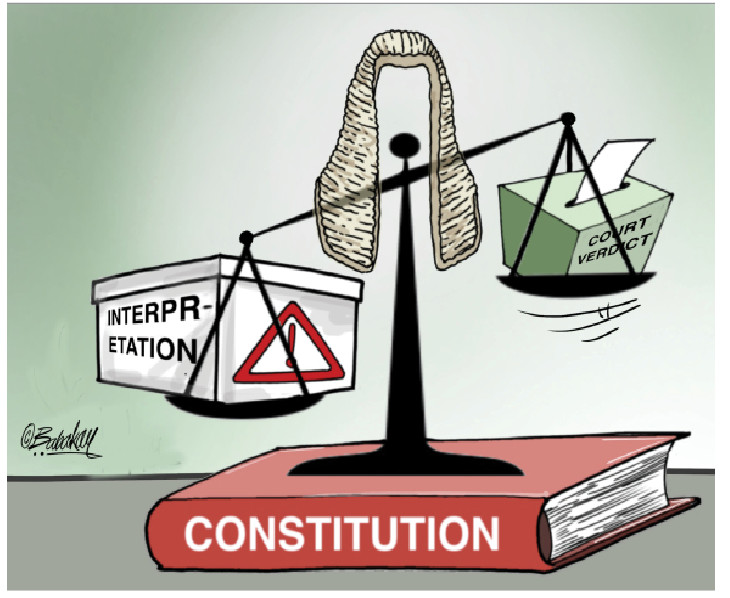
This week’s Thursday proved a long wait for both factions of the African Democratic Congress (ADC) and Peoples Democratic Party (PDP) as they awaited the verdict of the Supreme Court on its appeal. Senator David Mark, whose leadership of the ADC had been derecognised, approached the apex court to regain his status as the legitimate leader of the opposition coalition. For the PDP, the Saminu Turaki-led factional group was challenging the declaration of the Ibadan convention as an exercise of illegality.
Moment of Anxiety
In the PDP matter, the apex court voided the PDP national convention that was held in Ibadan, Oyo State, on November 15, 2025. The Ibadan convention had attracted protracted legal disputes before the Supreme Court’s verdict. A Federal High Court in Ibadan had earlier barred the convention, quoting breaches of the party’s constitution and failure to observe due process, including unresolved disputes arising from state congresses.
The Court of Appeal would subsequently uphold the decision of the lower court, stressing that a violation of a valid court judgement must be obeyed. In line with the Appeal Court’s verdict, the Supreme Court this Thursday voided the convention, finally putting to rest the legal tussle that had given rise to factional leadership in the party.
Apart from annulling the derecognition of the David Mark leadership of ADC, the apex court also ordered the return of the leadership dispute rocking the party to the Federal High Court for determination. In a unanimous ruling, the Supreme Court set aside the Court of Appeal’s order directing parties to maintain the status quo ante bellum.
The court held that the matter must proceed at the trial court for a full hearing and determination and frowned at the “unnecessary, improper and unwarranted” ante bellum order by the Appeal Court. It also refused to entertain the appellant’s argument challenging the jurisdiction of the Court of Appeal, ruling that the lower appellate court acted within its powers. By this decision, the highest court in the land effectively restored the David Mark-led executive of the ADC, pending the outcome of the substantive case at the Federal High Court.
Stormy Reactions
As soon as the verdicts of both cases were pronounced on Thursday, various interpretations rippled through, with interested political interests assuming legal expertise in the interpretation of the verdicts. The former Turaki-led faction that had been declared out of existence released a press statement under a new platform called ‘Uncompromised PDP’, saying that, with the apex court’s verdict, the judgement has left the party without a defined leadership.
In response to the verdict, the chairman of the Board of Trustees (BOT) for the Barr Nyesome Wike-led faction, Senator Mao Ohuabunwa, in a press statement, declared the legal positions arising from the apex court’s verdict are clear and unambiguous.
“The Ibadan Convention stands nullified, and any structure emanating therefrom has no legal foundation. Accordingly, the leadership structure of the Party under Alhaji Abdulrahman Mohammed – National Chairman and Senator Samuel Nnaemeka Anyanwu, FCIPA – National Secretary, remains the valid and stabilising authority to guide the affairs of the Party at the national level.
“The Party remains fully functional and will continue to operate through its recognized organs in line with the Constitution of our party (as amended in 2017). Necessary constitutional steps will be taken, as appropriate, to further strengthen the Party’s unity, stability, and preparedness for upcoming electoral engagements.”
What Must Be Done
It is categorical to state here that a verdict from the Supreme Court is considered final and binding because there is no higher court in the judicial hierarchy. Once it declares its verdict, the court becomes functus officio (it has completed its duty and generally cannot revisit the case). In a situation of genuine doubts, such as an ambiguity, a clerical error, or a fundamental defect, there are many means of obtaining clarification. The first is the application of the “Slip Rule” (clarification/correction): Under Order 8, Rule 16 of the Supreme Court Rules, a party can apply for the court to correct “clerical mistakes” or “accidental slips or omissions” to obtain the true judgement that accurately reflects the court’s actual intention. However, resorting to this means cannot be used to change the substantive decision or re-argue the merits of the case.
When the verdict of the apex court is in dispute, a party can apply for an Application for Interpretation. This is to assist in obtaining an interpretation of a judgment to erase ambiguities or uncertainties regarding the verdict. In rare cases, the apex court can set aside a nullity if it’s proven to be a nullity on grounds of lack of jurisdiction or a judgement obtained through fraud or deceit. Section 235 of the 1999 Constitution explicitly states that “no appeal shall lie to any other body or person” from a Supreme Court determination.
Sadly, Thursday’s verdict was subjected to varied interpretations in a bid to score political points. Though the verdicts leave many gaps that need clarification, the tools of politics are being used to score a point in the swinging interpretation of the apex court verdict. For both the ADC and PDP, the best they can do for now is to await the final interpretation of the courts. And for those who have become legal overnight, we should note that Thursday’s judgements were delivered on the many appeals that had lingered for a long time. Expecting an unambiguous interpretation of the verdict without obtaining the certified true copy (CTC) of the judgement amounts to a daylight dream.
We’ve got the edge. Get real-time reports, breaking scoops, and exclusive angles delivered straight to your phone. Don’t settle for stale news. Join LEADERSHIP NEWS on WhatsApp for 24/7 updates →
Join Our WhatsApp Channel