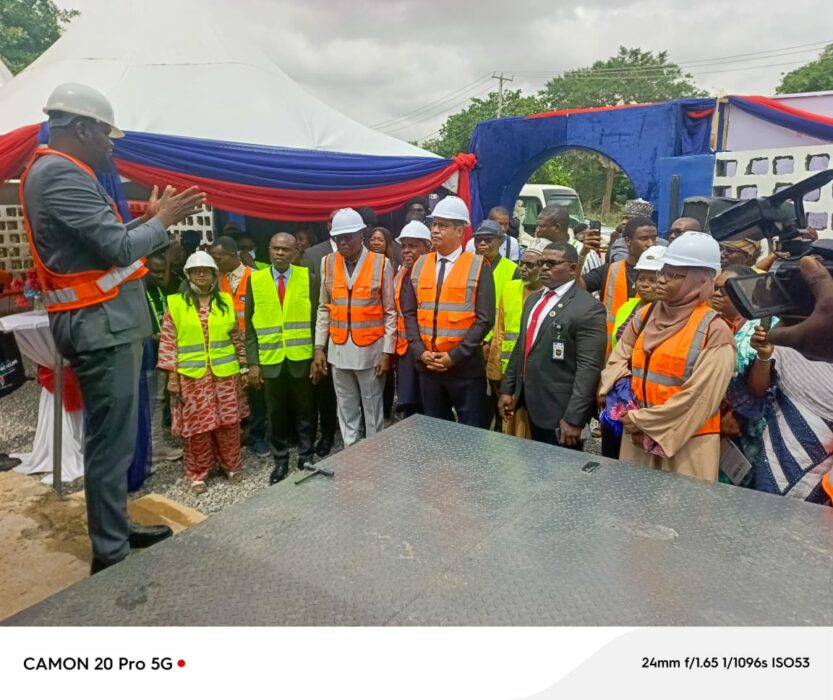
The French Embassy in Nigeria and Nile University have commissioned a state-of-the-art micro-plant for plastic waste management on the university’s Abuja campus, signaling a transformative shift in how Nigerian higher education is confronting the global plastic pollution crisis.
The project, supported by the French Embassy Fund (FEF), aims to transform discarded plastic bottles and waste into valuable commercial goods.
Delivering the keynote address yesterday on behalf of the Ambassador of France to Nigeria, Marc Fonbaustier, the deputy head of cooperation at the French Embassy, Pierre Andriamampianina, said, “Now, a long-suffering plastic bottle that might once have slowly made its way along the paths of the university will now begin a new life in the machine of the micro-plant, and also in the minds of those driving this transformation. It will re-emerge as a useful object here in Abuja or somewhere beyond.”
The French envoy placed the modest micro-plant within a sweeping global context, revealing that France co-chaired a United Nations Conference in Nice in June 2025 alongside Costa Rica, which announced four key priorities including the fight against plastic pollution.
He noted that on April 7, at the World Health Summit in Lyon, a coalition of scientists published a declaration on the impact of plastics within the World Health Framework.
“One of our priorities is to support the energy and drive of the Nigerian academic community in tackling the challenge of plastic waste management. This issue has been on the agenda for many years, and today there is a growing global momentum building around the fight against plastic pollution,” he said.
Quoting the French chemist Antoine Lavoisier, he added, “The old saying, ‘Nothing is created, everything is transformed,’ feels particularly relevant here. What we are inaugurating today is a new starting point for fresh ideas and a different way of thinking about modernity, one that brings together the present and the future, biodiversity, and the realities of economy and business.”
The ambassador’s representative described the project as a modest contribution perhaps, but a real and tangible one and expressed hope that the micro-plant would become a new centre of gravity, a place of ideas, projects, knowledge, and applied research.”
The vice-chancellor of Nile University, Prof. Dilli Dogo, in a welcome address that quickly evolved into a national call to action, delivered a searing indictment of Nigeria’s waste management culture while offering the micro-plant as a template for national renewal.
“What is often dismissed as waste is actually a valuable resource. Around the globe, the focus is on how we can transform waste into wealth, and I believe the French Embassy is championing this cause.
“Whenever I move around and see plastic waste scattered everywhere with little being done about it, and then compare it with other continents where the environment is cleaner, it reminds us that there is still a lot of work to be done,” he said.
The vice-chancellor then issued a warning; “We cannot continue to live amidst poverty while surrounded by resources in the form of recyclable waste. What Nigerians need is proper motivation, creativity, innovation, guidance, and support to transform the abundance of waste around us into opportunities,” he said.
Dogo revealed that the university was establishing a School of Vocational Skills, questioning why Nigerians seek foreign labour for tasks citizens could perform themselves.
“If people seek quality craftsmanship, they often look outside Nigeria, to places like Togo or Guinea-Bissau. Why should that be the case? What is wrong with us?
“Part of the challenge is that we became too comfortable in a society where many things appeared easy and freely available. But the realities of our time now demand hard work and productivity.
“Universities in Nigeria must wake up and ensure that what we do reflects the expectations of society and the aspirations of young people. Otherwise, if the youth become frustrated, society itself will face serious consequences. By empowering young people positively and creatively, we can avoid a ticking time bomb,” he said.
Dogo took time to celebrate the deepening partnership with the French Embassy, revealing personal details of his collaboration with Ambassador Marc Fonbaustier.
The managing consultant of Weircapacity, Nyananso Ekanem, while delivering a goodwill message titled ‘The Ivory Tower as a Beacon: Resolving the Global Crisis of Plastic Waste Through Innovation,” offered the university model as the only viable solution.
“We live in an era defined by ‘polycrisis’—a time when environmental, economic, and social challenges collide. Universities are no longer just repositories of ancient knowledge; they are the engines of modern survival.
“Globally, we have produced over 8.3 billion metric tonnes of plastic, yet only about 9% has ever been recycled. The rest clogs our oceans, infiltrates our food chain as microplastics, and lingers in landfills for centuries.
“With an annual solid waste generation exceeding 32 million tonnes, plastic constitutes a staggering proportion of our urban clutter. From the blocked drainage channels of Lagos to the open burning sites in Makurdi, plastic waste is not just an eyesore, it is a public health emergency. It fuels urban flooding, decimates aquatic life, and undermines our agricultural productivity,” he said.
Ekanem argued that universities provide three essential tools that neither government nor industry can offer alone: interdisciplinary research, the living laboratory effect, and entrepreneurial incubation.
“The French Embassy Fund (FEF) project, worth over 500 million, is a testament that collaboration between development partners and research institutions can achieve a positive impact,” he revealed.
He praised the recognition of four researchers and their teams from the University of Qatar, Yabate, FUNAI, and DELTA for their work on plastic waste management, noting that the French Embassy had been genuinely impressed by the quality of research being carried out across Nigeria.
“Today, we are pleased to be on the side of a solution to the plastic waste menace in Nigeria,” Ekanem said.
We’ve got the edge. Get real-time reports, breaking scoops, and exclusive angles delivered straight to your phone. Don’t settle for stale news. Join LEADERSHIP NEWS on WhatsApp for 24/7 updates →
Join Our WhatsApp Channel