From an obscure foreign concept to a booming, culture-defining phenomenon, Mixed Martial Arts ( MMA), has erupted into the Nigerian mainstream.From a dusty makeshift ring under the scorching Kano sun, to a caged octagon in Lagos’s upscale Lekki district, under the bright glare of international media attention. AFFA ACHO analyses the journey of Mixed Martial Arts in Nigeria over the last decade.
Long before the Ultimate Fighting Championship (UFC),was a glint in Dana White’s eye, Nigeria had its own warriors.Dambe, the ancient striking art of the Hausa people dating back over a century is widely considered one of Africa’s oldest combat sports. Originating as a method of spear-and-shield training for warriors, traveling butchers transformed it into a competitive spectacle marked by raw ferocity and cultural pride.
Maxwell Kalu, the founder of African Warriors and organiser of the Emir Ado Bayero Dambe Championship, explains the deep cultural significance of the sport’s origins: “Dambe’s history is in spear and shield warfare. It’s how warriors used to prepare for battle”. This warrior ethos—strength in the face of adversity, a deep-seated resilience and a hunger to dominate—has carried over into the modern MMA era.
By the 2010s, MMA began to trickle into Nigeria’s consciousness through satellite TV broadcasts of the UFC and a new generation of fighters hungry for a global stage. But the transition from a fringe activity enjoyed by expatriates to a national passion required a catalyst.
The Pioneer And The Formalisation
The man holding the clipboard in 2014 was just as important as the ones throwing punches. Ambassador Henry George, a world champion in karate and a veteran of combat sports administration, realised that “it wasn’t enough to improve the rules, the entire foundation needed to change”. On March 11, 2014, he established the Nigerian Mixed Martial Arts Federation (NMMAF).
For years, it was a lonely fight. George organised obscure amateur bouts, trained referees, and lobbied unimpressed government officials. However, his vision slowly began to materialize. In July 2019, NMMAF joined the International Mixed Martial Arts Federation (IMMAF). In 2023, after nearly a decade of relentless effort, George secured full recognition for MMA as a national sport from the Federal Ministry of Sports Development and the Nigerian Olympic Committee.
Under his leadership, the federation secured full recognition from the Nigerian Olympic Committee and the Federal Ministry of Sports, officially establishing MMA as a national sport.
The breakthrough moment arrived with the National Amateur MMA Championships in Asaba in March 2022. The four-day competition crowned Nigeria’s first female national amateur champions—Beauty A. Timothy and Chinonye Attoh—giving the sport a legitimate grassroots structure. Working closely with the Nigeria Police Force, which funded national championships and endorsed the sport’s governance, George’s NMMAF succeeded in getting MMA included as a demonstration sport at the National Sports Festival. By 2026, MMA is set to debut as a compulsory, scoring event at the National Sports Festival in Enugu—cementing its place in Nigeria’s multi-sport calendar.
The “Nigerian Nightmare” And The New African Kings
If the NMMAF supplied the foundation, the flywheel of popularity was ignited by the fire of a global icon: Kamaru Usman.
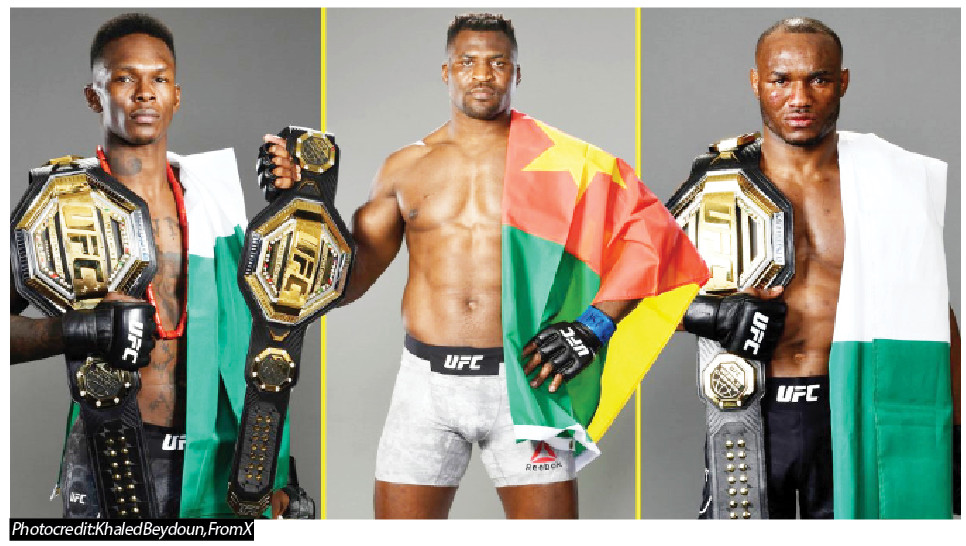
Born in Auchi, Edo State, and raised in Texas, Usman carried his Nigerian heritage like a badge of honor. Opponents feared his relentless wrestling pressure, top-tier cardio, and granite chin, earning him the nickname “The Nigerian Nightmare.” On March 2, 2019, he dismantled Tyron Woodley to claim the UFC welterweight title, becoming the first African-born fighter to win a UFC world championship. He would go on to hold the belt for over 1,000 days, defending it five times in dominant fashion.
Alongside Usman, the flamboyant Israel Adesanya—born in Lagos and raised in New Zealand—captured the UFC middleweight title in October 2019. Known as “The Last Stylebender” for his flashy striking style and anime-inspired persona, Adesanya became a global superstar. Together with Cameroon’s Francis Ngannou, they formed the “Three African Kings” of the UFC, simultaneously holding world titles in three different weight classes at the end of 2021.
“When I was growing up, people from Africa were seen as just coming to survive. Now we’re coming to conquer,” Usman once famously declared.
The impact was immediate. Across Nigeria, millions of fans stayed up late to watch their heroes. Internet cafes played UFC fights on repeat. A generation of young men and women looked at Usman’s Nigerian passport and thought, That could be me. In 2025, Usman proved he wasn’t done yet, securing a dominant unanimous decision victory over Joaquin Buckley and improving his professional record to 21 wins and four losses.
The “Nigerian Invasion” didn’t stop there. Sodiq Yusuff, born in Lagos, earned a UFC contract via Dana White’s Contender Series in 2018 and has since competed multiple times in the featherweight division. Kennedy Nzechukwu, originally from Imo State, also secured a UFC contract through the Contender Series. Nigerian fighters now populate MMA rosters across the globe, proudly wrapping themselves in the green and white flag.
Building The Homegrown Ecosystem
The presence of superstars solved the visibility problem, but the next challenge was infrastructure.Across Lagos, Abuja, and Port Harcourt, a network of MMA academies has blossomed. MMA Factory in Lekki offers Brazilian Jiu-Jitsu, Muay Thai, wrestling, and boxing under coaches with international experience. Taurus Martial Arts in Abuja, founded by African KnockOut Championship (AKO),star Segun Ogunnoiki, provides everything for beginners to advanced fight preparation for aspiring professionals. BodyRox Fitness & MMA Centre in Victoria Island boasts a full-size MMA cage and top-tier facilities, while FIT2FIGHT Combat Academy in Surulere has earned a reputation for its competitive training environment.
These gyms are more than just fitness centers. They are proving grounds for the next generation of champions. Fighters like Muzan Richard, Eze Daniel, Busayo Idowu, Olanike Sodiq, and Joy Obanla won gold medals for Nigeria at the 13th African Games in Ghana, bringing glory to their nation and earning praise as “role models for the country’s youths”.
Yahuza, a national gold medalist in wrestling, has transitioned seamlessly into professional MMA, extending his perfect record to 7-0 and being hailed as “the symbol of Nigeria’s MMA future”. Women’s MMA is also flourishing: Jane Osigwe and others are stepping into the cage with increasing frWequency, breaking down barriers in a traditionally male-dominated space.
The crowning jewel of this growth is the African KnockOut Championship (AKO). Founded in Lagos in 2020, AKO began as an MMA talent reality TV show called “African Knockout,” which achieved the distinction of becoming Netflix’s first unscripted sports reality show. It has since evolved into a full-fledged professional championship featuring fighters from over 21 African nations. With Kamaru Usman as its President and Co-founder, AKO has secured a landmark broadcast deal with SuperSport to beam its events across Sub-Saharan Africa.
The numbers speak for themselves: 5,000 fans packed the venue for AKO’s recent Lagos event, with thousands more watching via livestream.
Institutional Recognition And The Mainstream Breakthrough
The government finally took notice. After serving as a demonstration sport at the 14th edition of the Biennial Police Games (BIPOGA) in Ibadan, MMA was fully recognised as a scoring sport for the 15th edition in Asaba in 2026. CSP Kalu Chijioke Erem, a board member of NMMAF, attributed this development squarely to the institutional efforts of the Nigeria Police Force: “After being a demo sport at the 14th BIPOGA edition in Ibadan, Oyo State, MMA became a fully recognised, scoring sport for the first time in the history of the sport in the 15th edition in Asaba, 2026”.
The approval of MMA as a compulsory sport for the 26th National Sports Festival in Enugu in 2026 cemented its place in Nigeria’s sporting structure. Henry George’s long-term ambition remains clear: “to see Nigeria win its first gold medal when MMA becomes an Olympic sport”. With Nigeria’s steady climb in international amateur competition, that dream looks less like fantasy and more like a matter of time.
Cultural Impact And Youth Development
The rise of MMA is not just a sports story—it’s a cultural and social one.In a country grappling with youth unemployment and restiveness, MMA has emerged as a powerful tool for engagement and empowerment. “MMA is a way of engaging the youths, keeping them busy,” noted a combat sports stakeholder, pointing to the sport’s role in providing structure and discipline to young people.
The maiden Abia and South East MMA Festival of Warriors attracted spectators from within and outside the state, including 16-year-old rising female martial artist Eberechi Unekwu. The Nigeria Police Force has produced globally competitive athletes like Juliet Chukwu, Juliet Ukah, and Ewah Bernard, who “bring pride to the Nigeria Police Force and Nigeria. These athletes embody the vision of transforming MMA from a fringe activity into a structured, regulated, and globally competitive sport that can provide viable career paths.
Ryan Fayad, COO of African Knockout, sees the movement as the beginning of something much larger: “African Knockout was created because Africa does not yet have a platform that is fully focused on showcasing African talent to the world and helping fighters progress to international stages”.
Challenges And The Future Horizon
Despite the meteoric rise, significant hurdles remain.
Nigeria still lacks the high-performance centers and sports science infrastructure available to fighters in the US, Europe, or even South Africa. Top Nigerian prospects often face a difficult choice: train in suboptimal conditions at home or seek opportunities abroad. Many still relocate overseas to access world-class coaching and competition levels.
Moreover, while the NMMAF has done remarkable work in establishing legitimacy, the sport’s professional ecosystem remains fragmented. Fighters often rely on meager purses from local promotions, and the transition from amateur to professional ranks is fraught with financial uncertainty.
But the ambition is undeniable. NMMAF Technical Director Victor Akhimien, a 7th Dan black belt, is crafting competition rules and referee education programs that align with international standards. International partnerships with the UFC, Professional Fighters League (PFL), and Brave FC are being actively pursued to create pathways for Nigerian talent. Henry George remains unrelenting in his mission to bring sports science, athlete career planning, and welfare initiatives to the heart of Nigerian MMA.
What began as a whisper in a remote Hausa village centuries ago, then flickered to life in a cramped Port Harcourt gym in 2014, has now become a movement.From zero to knockout, Nigeria has announced itself to the world of combat sports. And the most explosive rounds are yet to be fought.
We’ve got the edge. Get real-time reports, breaking scoops, and exclusive angles delivered straight to your phone. Don’t settle for stale news. Join LEADERSHIP NEWS on WhatsApp for 24/7 updates →
Join Our WhatsApp Channel