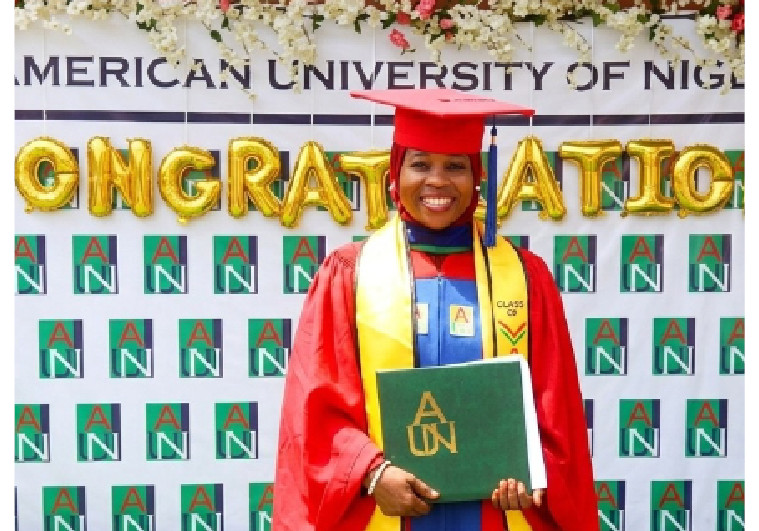
When you first entered the university, was it always your dream to become a valedictorian?
Honestly, no. My plan was simply to do my best and graduate successfully. But during my first semester, students from my secondary school, Air Force Comprehensive School in Yola, came for an orientation visit. I met my principal, and she pointed at the pictures of past valedictorians and class speakers displayed on the wall. She told me she hoped that one day my picture would also be there. That was the first time I truly noticed the whole valedictorian idea. At first, I doubted myself, but I decided to try. Eventually, I stopped focusing on becoming valedictorian and concentrated more on academics and extracurricular activities. Then, in my final year, my friend, Muhammad Bashir Zakari, told me I was among the top contenders for valedictorian, and that conversation reignited my motivation.
The encouragement and support from my friends pushed me to work harder, and eventually, I became the valedictorian.
How do you feel now that you are the valedictorian?
Honestly, it still does not feel real sometimes. There are mornings when I wake up feeling like the email announcing it will disappear and say there was a mistake with the grading system.But gradually, I am learning to accept it and embrace the reality that I am truly the valedictorian.
What was the most difficult academic moment for you?
Thank you for this question. This semester was the hardest academic period of my life. During midterms, I had five exams in one day, including four law courses and mathematics. The exams were back-to-back, and it was also during Ramadan. I spent the whole night reading. My head became so hot from stress that I had to place ice on it before I could continue studying. On the exam day, I woke up earlier than usual and moved continuously from one exam hall to another. Between exams, I used every available minute to read for the next paper. By the time I finished the final exam, which was mathematics, I got home and completely shut down from exhaustion. I slept through the breaking of the fast without even realising it.
Honestly, my brain shut down after that period, and I was grateful we had a break immediately afterwards so I could recover. The final examinations also took a toll on me, especially with my research project and jurisprudence.
How would you describe the support you received from your parents?
Honestly, my parents deserve their flowers. My mum had been sick for about 20 years, so I was much closer to my dad. We did almost everything together. Initially, I never planned to attend the American University of Nigeria. I wanted to study abroad, but eventually AUN became the best option after several discussions with my family.
My dad was very supportive of my academics. After seeing my first semester results, he became even more encouraging and proud of me.
After I lost my mum in 2025, many people from AUN came to support me, including the provost and the Dean of the School of Law. My dad was deeply touched by that gesture.
He told me he did not regret sending me to AUN because the school truly cared for its students like family.
Sadly, a month after that conversation, my dad also passed away.
But honestly, the support I received from my friends, instructors, and the university community helped me survive those difficult moments.Recently, during an Honour Society event, everyone had their parents around except me. I felt empty sitting there alone. Then one of my instructors, Dr Obinna Dike, called me over and reminded me that my parents would be proud of everything I had achieved. He sat with me so I would not feel alone. That moment made me realise that my dad was right about AUN. I am truly grateful for the people I met there.
Were there moments when extracurricular activities became overwhelming or affected your academics?
Yes, definitely. There were moments when I felt my grades were dropping, and I didn’t understand why. I even had to meet with the school psychologist to discuss it. From our discussion, she pointed out that I was involved in so many extracurricular activities that I had little time left for studying. She advised me to either reduce the number of activities or find a balance between academics and extracurriculars.
At the end of the day, it came down to determination. I believed I could succeed in both areas, so I pushed myself harder.
Did you eventually drop some activities?
I didn’t drop any. I simply became more determined and tried to manage my time better. Sometimes I scheduled my day, although I wasn’t always consistent with it, but I was able to pull through eventually.
We’ve got the edge. Get real-time reports, breaking scoops, and exclusive angles delivered straight to your phone. Don’t settle for stale news. Join LEADERSHIP NEWS on WhatsApp for 24/7 updates →
Join Our WhatsApp Channel