The federal government has revealed a dramatic decline in the number of former inmates returning to correctional centres after release, describing it as one of the clearest indicators that ongoing reforms in the Nigerian Correctional Service are producing results.
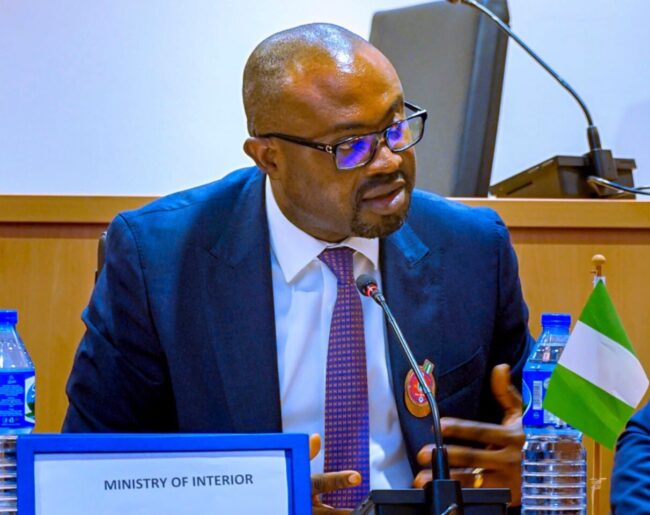
The minister of Interior, Dr Olubunmi Tunji-Ojo, disclosed this yesterday in Abuja that the number of inmates who re-offended and returned to custody dropped from 11,616 in 2023 to 3,156 in 2024, before falling further to 1,382 in 2025.
The figures, according to Tunji-Ojo, represent an 88 per cent reduction in recidivism within two years.
During the presentation of the Investigative Panel’s Main Report on “Allegations of Corruption, Abuse of Power, Cruel and Inhumane Treatment against the Nigerian Correctional Service”, the minister described the development as the most encouraging outcome of the government’s correctional reforms.
“The one that makes me the happiest is the issue of recidivism,” he said. “When the new government came in 2023, the number of recidivists was 11,616. In 2024, it came down to 3,156, and in 2025, it dropped further to 1,382.”
According to him, the sharp decline suggests that correctional centres are gradually shifting from being mere detention facilities to institutions focused on rehabilitation, reformation and reintegration.
Tunji-Ojo attributed the improvement to a combination of capacity-building initiatives, mentorship programmes, educational opportunities and skills acquisition schemes introduced across correctional facilities.
He noted that 62 inmates are currently pursuing postgraduate studies, while 261 are enrolled as undergraduates. More than 1,125 inmates are engaged in formal educational programmes, while 9,382 others are undergoing vocational training in areas such as carpentry, agriculture, welding, electrical installation, hairdressing and barbing.
The minister stressed that despite the progress, government would not consider the mission accomplished until recidivism is completely eradicated.
“Not until recidivism gets to zero, we have no reason to say we are successful. We are on the right path, but we still have a lot to achieve,” he said.
The minister assured Nigerians that the recommendations contained in the investigative panel’s report would be implemented through a structured framework backed by monitoring and evaluation mechanisms.
The report was presented by the investigative panel chaired by the permanent secretary, Ministry of Interior, Dr Magdalene Ajani, following visits to 86 correctional centres across 23 states and months of public hearings and stakeholder consultations..
Tunji-Ojo also revealed that Nigeria’s correctional centres admitted no fewer than 15,632 inmates in May 2026 alone, underscoring the enormous pressure facing the country’s custodial system despite ongoing efforts to tackle congestion.
According to him, 14,190 inmates were released during the same period, leaving admissions ahead of releases and highlighting the continued strain on correctional facilities nationwide.
The development, he says, comes as Nigeria’s custodial centres currently house about 80,000 inmates, significantly above the nation’s official custodial capacity of 68,486.
Tunji-Ojo said, “Our custodial capacity in Nigeria at the moment is about 68,486, and we have about 80,000 inmates as of this morning.”
This is as he disclosed that the federal government is constructing three new custodial centres expected to add about 15,000 bed spaces to the system upon completion.
According to him, major facilities under construction, including those in Abuja and Kano, are already above the 50 per cent completion mark and are expected to significantly ease overcrowding.
The minister added that current records show that 1,004 offenders are serving community service sentences, while 170 are participating in restorative justice programmes. A further 34 offenders are on probation, bringing the total number benefiting from non-custodial measures to 1,227.
On her part, the secretary of the panel and chairman of PRAWA, Prof. Uju Agomoh, described the presentation of the report as a historic moment for Nigeria, noting that it reflected the willingness of government institutions to subject themselves to scrutiny and accountability.
Agomoh disclosed that the panel submitted three volumes of reports to the minister. According to her, the first volume contains a verbatim account of proceedings from the public hearings conducted between December 2024 and August 2025, while the second details the panel’s findings, methodology and recommendations.
She added that the third volume contains reports from field visits to correctional centres across the country, including findings from investigations into specific cases referred to the panel.
Earlier, the permanent secretary and chairman of the Investigative Panel, Mrs. Magdalene Ajani, said the panel was constituted by the Minister of Interior in September 2024 following public complaints and concerns about the operations of the Nigerian Correctional Service.
She said the committee was mandated to investigate the allegations and review programmes and activities within the correctional system with a view to strengthening reforms and improving service delivery.
Ajani explained that the panel spent about 20 months carrying out its assignment, visiting correctional centres in 23 states and engaging extensively with officials of the Nigerian Correctional Service and other stakeholders.
We’ve got the edge. Get real-time reports, breaking scoops, and exclusive angles delivered straight to your phone. Don’t settle for stale news. Join LEADERSHIP NEWS on WhatsApp for 24/7 updates →
Join Our WhatsApp Channel