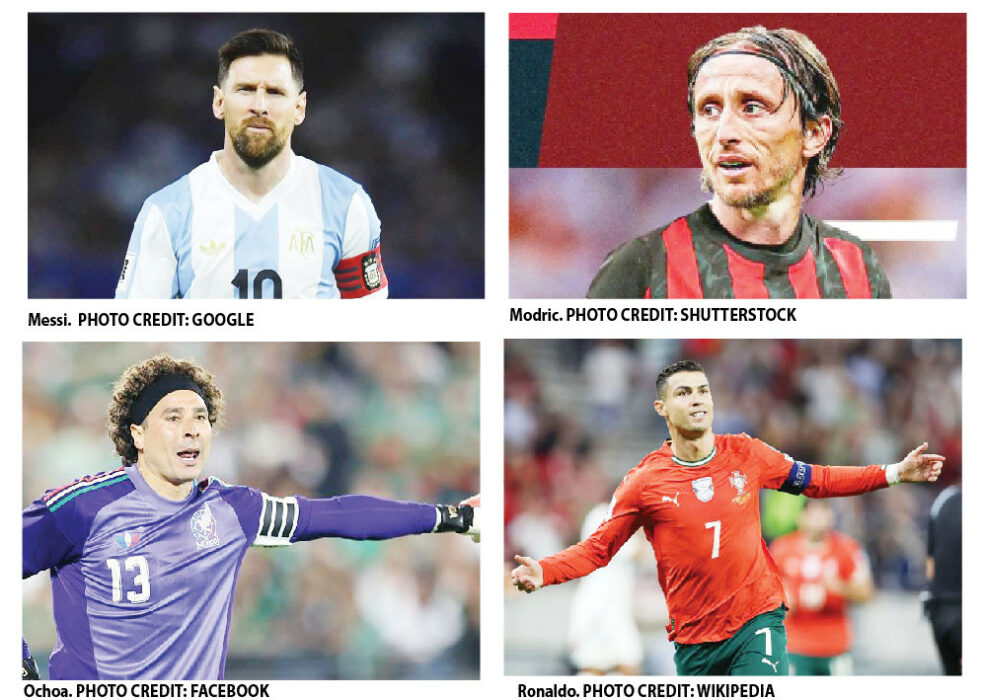
The 2006 World Cup in Germany feels like a lifetime ago. No iPhone. Facebook for students only. And a 34-year-old Zidane, conducting France to the final, ended it all with a headbutt heard around the world. AFFA ACHO examines the four men who played in 2006 and are still standing for the 2026 World Cup.
The 2006 World Cup featured 736 players from 32 nations. They came from every corner of football – legends at their peak, young prospects taking their first steps, and role players who would never again taste the World Cup stage. Nearly twenty years later, the game has transformed. The 2026 World Cup will be hosted by three countries (the United States, Mexico, and Canada) and feature 48 teams. The men who dominated headlines in 2006 – Zidane, Ronaldo de Lima, Ronaldinho, Thierry Henry, and Michael Ballack – have long since retired to coaching, punditry, or quiet lives. Yet, improbably, four players from that 2006 roster are still standing. And they are not just making a sentimental cameo. They are set to become the first male footballers in history to appear in six World Cups.
Lionel Messi (Argentina) – From Prodigy To Deity
Age in 2006: 18 | Age in 2026: 38 | World Cups: 2006, 2010, 2014, 2018, 2022, 2026
When Argentina coach José Pekerman sent a curly-haired teenager onto the pitch against Serbia and Montenegro in 2006, few realised they were watching the future. Within 15 minutes, Lionel Messi had a goal and an assist – a precocious appetiser for the feast to come. Argentina lost to Germany in the quarterfinals, and the young Messi watched from the bench, powerless.
What followed is the most decorated career in football history. Seven Ballons d’Or. Four Champions Leagues. Countless broken records. But for sixteen years, a World Cup trophy remained an agonising ghost. In 2014, Messi walked past the gold trophy in the Maracanã, his stare becoming an icon of silent heartbreak. In 2018, Argentina stumbled. The narrative grew heavy: he could never do it for his country.
Then came 2022 in Qatar. In one of the greatest finals ever played – a 3-3 thriller against France decided on penalties – Messi finally exorcised that demon. He lifted the trophy, and the debate over football’s greatest ever player was effectively settled.
Currently 38, playing his club football for Inter Miami. His legs are not what they used to be. But his brain remains a supercomputer, and his presence transforms teammates. He will not be Argentina’s solo hero this time. Instead, he will be the spiritual anchor – the man who shows a new generation (Enzo Fernández, Julián Álvarez, Gabriel Martinelli ) what it means to bleed for the shirt.
If he lifts the trophy again, he will retire as the undisputed god of the sport. If he falls short, he will walk away with grace – because he already gave Argentina the one thing they begged him for.
Cristiano Ronaldo (Portugal) – The Relentless Machine
Age in 2006: 21 | Age in 2026: 41 | World Cups: 2006, 2010, 2014, 2018, 2022, 2026
In 2006, Cristiano Ronaldo was a skinny winger with a thousand stepovers and a famously short fuse. He scored one penalty in Germany, provoked Wayne Rooney into a red card (and that infamous wink), and helped Portugal reach the semifinals. He was brilliant, but raw—a show pony.
Five Ballons d’Or. Five Champions Leagues. The all-time men’s international goal scorer (over 130 goals for Portugal). Ronaldo’s longevity is the product of obsessive discipline, tailored nutrition, and a body fat percentage that would embarrass athletes half his age.
At 41, he will be the oldest outfield player in World Cup history. He no longer dribbles past four defenders. But his leap remains explosive, his header lethal, his instinct for the big moment undimmed. His role has shifted from protagonist to finisher – the man who comes off the bench to convert one chance, then writes another record.
And there is one record he desperately wants: first man to score in six different World Cups (he has scored in five). He also wants what Messi has – a World Cup winner’s medal. Portugal came close in 2006 (semifinals) and again in 2016 when they won the European Championship, but the World Cup has always been one step too far.
In 2026, expect a defiant Ronaldo, still leaping for headers in the 90th minute, still roaring “Siuuu” as if time has no meaning. Critics call his persistence stubbornness. Supporters call it a legend. Both are right.
Luka Modrić (Croatia) – The Maestro Who Refuses To Stop
Age in 2006: 20 | Age in 2026: 40 | World Cups: 2006, 2014, 2018, 2022, 2026 (missed 2010 due to qualifying failure)
The quietest of the four is also the most astonishing. In 2006, Croatia crashed out in the group stage. A young Luka Modrić played just 47 minutes across two substitute appearances. He was promising, but forgettable.
Twelve years later, he became unforgettable. At the 2018 World Cup, Modrić dragged Croatia – a nation of just 4 million people – to the final. He played every minute of every knockout game, covered more ground than any midfielder, conducted attacks with his wand of a left foot, then sprinted back to make tackles. He lost the final to France, but won the Golden Ball as the tournament’s best player. And then, in a stunning upset, he broke the Messi-Ronaldo duopoly to win the Ballon d’Or – the first player other than those two to win it since 2007.
In 2022, still going at 37, he led Croatia to another bronze medal. Now, at 40, he will be the oldest captain in World Cup history. Croatia has a superb new generation – Joško Gvardiol, Luka Sučić, Martin Baturina – but Modrić remains the heartbeat.
He no longer needs to run 12 kilometres per game. He needs to receive the ball, turn, and find the pass no one else sees. His game has always been about elegance and intelligence, traits that age better than raw pace.
If this is his last dance – and it almost certainly is – expect him to conduct the orchestra one final time, with the calm of a man who has already defied every limit.
Guillermo Ochoa (Mexico) – The Eternal Understudy Turned Colossus
Age in 2006: 20 | Age in 2026: 40 | World Cups: 2006, 2010, 2014, 2018, 2022, 2026
In 2006, Guillermo Ochoa was a 20-year-old third-choice goalkeeper with zero caps before the tournament. He sat behind Oswaldo Sánchez and Jesús Corona. He did not play a single minute. Most players in his position become trivia.
He has never played for a truly elite club – bouncing from Ajaccio to Málaga to Granada to Salernitana. But in every World Cup, he transforms into a superhuman shot-stopper. In 2014, he made a ridiculous save against Neymar – diving to his right, stretching every sinew – that broke Brazilian hearts and became an instant meme. In 2018, he frustrated world champion Germany in a historic 1-0 Mexican victory. In 2022, he saved a penalty against Poland. He has never reached the quarterfinals (Mexico’s curse is the round of 16), yet he is his nation’s most beloved figure.
Now 40, and Mexico is a co-host. He may no longer be first-choice heading into the tournament – younger keepers like Luis Malagón are pushing hard. But do not bet against Ochoa. Goalkeepers age like fine wine, and Ochoa has always saved his best for the world’s biggest stage.
If Mexico finally makes a run to the quarterfinals for the first time since 1986 (when they also hosted), Ochoa’s gloves will be at the center of it. He is the ultimate underdog – the man who didn’t play a second in 2006 and will now hold the record for most World Cups by any goalkeeper (six, tied with Messi, Ronaldo, and Modrić).
The One Who Almost Joined Them
There is a fifth man from the 2006 World Cup who is still playing professional football: Mateus Galiano of Angola. The 40-year-old midfielder, now with Angolan side Petro de Luanda, remains active. But Angola failed to qualify for the 2026 World Cup. So Galiano will watch from home, leaving our quartet as the only players to bridge a twenty-year chasm between two tournaments that feel like different sports.
When the 2026 World Cup ends, these four men will likely retire from international football. With them will go the last living connection to an era that now feels almost mythical.
Think back to 2006. Ronaldinho was still magical. Gennaro Gattuso was still growling. The final was decided on penalties after Zidane’s head met Marco Materazzi’s chest. And four men – a teenage Argentine, a petulant Portuguese, a quiet Croatian, and a Mexican reserve goalkeeper – walked onto the pitch for the first time, unaware that they would still be doing it twenty years later.
They represent different archetypes: the genius (Messi), the machine (Ronaldo), the artist (Modrić), and the showman (Ochoa). But together, they are a monument to human endurance, to the refusal to accept that time must win.
We’ve got the edge. Get real-time reports, breaking scoops, and exclusive angles delivered straight to your phone. Don’t settle for stale news. Join LEADERSHIP NEWS on WhatsApp for 24/7 updates →
Join Our WhatsApp Channel