
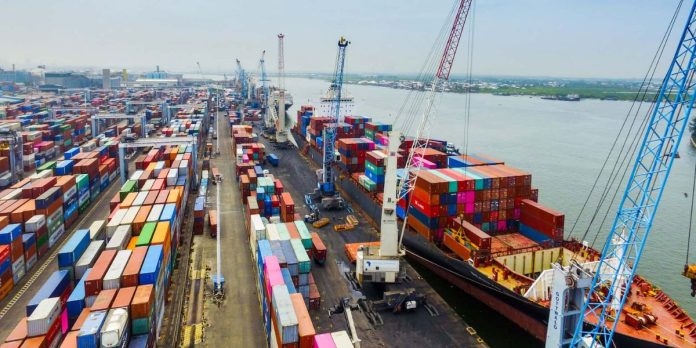
Stevedoring operators under the National Association of Stevedoring Operators (NASO) have called for an efficiency-driven green transition framework to reduce emissions across Nigerian ports, urging regulators to anchor port modernisation on practical, performance-based environmental standards.
The association said Nigeria’s push for greener ports must be supported by a realistic equipment upgrade road map developed in collaboration with the Nigerian Ports Authority (NPA) and the Nigeria Maritime Administration and Safety Agency (NIMASA), and aligned with operators’ financial capacity.
NASO President, Bolaji Sunmola, made the call at the weekend in Lagos, stressing that efficiency remains the most immediate pathway to reducing the maritime sector’s carbon footprint.
He warned that environmental compliance efforts could fail if treated as unfunded obligations on operators.
“We must also be frank: the equipment our industry deploys, the cranes, forklifts, terminal tractors, and cargo-handling machinery, contributes materially to the emissions footprint of port operations.
NASO is committed to engaging actively with the NPA and NIMASA to develop an industry-wide equipment upgrade roadmap,” Sunmola said.
He stressed that any green transition framework must be backed by viable financing structures, including access to climate-related funding streams such as the Green Climate Fund (GCF), with participation from institutions like the Development Bank of Nigeria (DBN).
According to him, “green practices must not become an unfunded mandate imposed on operators who lack the capital to comply. That would be neither fair nor effective.”
Sunmola also urged the government to fully integrate environmental benchmarks into Nigeria’s ongoing port modernisation programme, noting that infrastructure expansion without emissions controls would leave reforms incomplete.
He called on the Minister and the NPA leadership to ensure that every investment, operational upgrade, and regulatory reform under the modernisation agenda incorporates binding green performance indicators covering emissions reduction, equipment efficiency standards, waste management, and cargo dwell time.
“Modernisation that expands cargo handling capacity without simultaneously addressing environmental performance is modernisation that is only half-complete,” he said.
Beyond infrastructure and regulation, Sunmola emphasised that operational efficiency remains the most powerful and immediate green intervention available to the sector.
He argued that reducing cargo dwell time, minimising vessel waiting periods at anchorage, and eliminating prolonged truck idling at port gates would automatically deliver measurable emissions reductions without additional capital expenditure.
“From NASO’s standpoint, the single most powerful green port initiative available to Nigeria today requires no imported technology and no capital that we do not already possess. It requires operational efficiency. When stevedores discharge and deliver cargo faster, when dwell times fall, when vessels wait less at anchorage, and when trucks do not idle for days at the port gate, the environmental benefit is automatic, measurable, and immediate. The carbon that is never emitted is the greenest of all,” he said.
He further noted that sustainability in the maritime sector must also extend to workers’ welfare, warning that a “green port” that neglects safety and living conditions for dockworkers would be fundamentally flawed.
“A green port that exposes its workers to toxic emissions, unsafe working conditions, and degraded welfare is a contradiction in terms. The sustainability agenda must extend to the sustainability of livelihoods,” he added.
Sunmola commended the Shipping Correspondents Association of Nigeria (SCAN) for consistently advancing discourse in the maritime industry, describing this year’s theme, “Green Ports: Sustainable Practices for Dockworkers,” as timely and impactful.
He said SCAN had continued to play a critical role in documenting and shaping conversations around the sector’s evolution, challenges, and opportunities.
NASO reaffirmed its commitment to collaborating with stakeholders to build a port ecosystem that is efficient, environmentally responsible, and economically sustainable.
We’ve got the edge. Get real-time reports, breaking scoops, and exclusive angles delivered straight to your phone. Don’t settle for stale news. Join LEADERSHIP NEWS on WhatsApp for 24/7 updates →
Join Our WhatsApp Channel