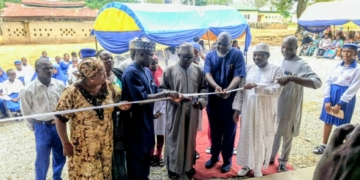
The Kogi State Government has reiterated its commitment to educational development, revealing that the state currently allocates 30 percent of its annual budget to education, exceeding the 26 percent benchmark recommended by UNESCO
The Commissioner for Education, Hon. Wemi Jones, made the disclosure during the commemoration of the 2026 Financial Literacy Day organized by the Nigeria Deposit Insurance Corporation (NDIC) at the GYB Model Secondary School, Adankolo, Lokoja, for secondary schools in Lokoja.
The secondary schools are; Crowther Memorial College, Army Day Secondary School, GYB Model Lokoja, Bishop Delise College all in Lokoja Lokoja
Represented by the Permanent Secretary of the Ministry of Education, Dr. Albert Alabi Bamidele, the Commissioner said the administration of Governor Ahmed Usman Ododo has sustained and expanded the educational achievements recorded under the immediate past administration of former Governor Yahaya Bello.
According to him, Kogi remains the only state in Nigeria committing 30 percent of its budget to education, a policy that has translated into significant improvements across the sector.
He disclosed that the state now has three fully functional universities with all academic programmes accredited by the relevant regulatory bodies, while several developmental projects are ongoing across the institutions.
Jones further noted that the government has sustained free education at the primary and secondary school levels and continues to pay for major entry and exit examinations for students in public schools.
He added that under the Adolescent Girls Initiative for Learning and Empowerment (AGILE) Programme, renovation and construction works are currently ongoing in 728 schools across the state.
The Commissioner said the state had also maintained its student exchange programme within the North-Central region to promote social and cultural integration, with hundreds of students already benefiting from the initiative.
On students’ welfare, he stated that bursary payments have been restored and significantly increased, with students studying Medicine and Law receiving N300,000 each, while undergraduates in other higher institutions across the country receive N30,000 as support.
He said the interventions have contributed immensely to reducing the number of out-of-school children and boosting enrolment in public schools across the state.
Speaking on the theme of the event, “Smart Money Talks,” Jones described financial literacy as a necessity rather than an optional life skill, stressing that young people must be equipped with the knowledge and discipline required to manage resources wisely, save responsibly, avoid fraud and embrace entrepreneurship.
He called for practical financial empowerment initiatives for students, including school savings clubs, financial literacy competitions, entrepreneurship support programmes, mentorship opportunities, scholarships, innovation grants and youth-focused financial inclusion projects.
The Commissioner commended the NDIC for choosing Kogi State to host the 2026 Financial Literacy Day celebration, describing the corporation’s efforts as complementary to the state’s policies aimed at poverty reduction, citizen empowerment and crime prevention through quality education.
He appealed to the NDIC to sustain its interventions in the state, assuring that the government remains open to partnerships with organizations committed to advancing education and youth empowerment.
Delivering the first paper, Social Media Expert in the Communication Department of NDIC, Bello Muhammed, said the day was set aside to educate young people on financial management, inclusion and savings.
He highlighted some of the functions of the Central Bank of Nigeria (CBN), including monetary policy formulation, price stability, issuance of legal tender, management of external reserves and ensuring a sound financial system, as well as serving as banker and adviser to the Federal Government.
Muhammed explained that financial literacy enables people to manage their finances effectively, make informed investment decisions and protect themselves against fraud and scams.
He emphasized the importance of saving for the future, noting that “smart money” means thinking before spending and understanding the difference between needs and wants.
Also speaking, Deputy Manager, Bank Examination Unit of NDIC, Mahmod Shafihi, presented a paper on the mandates and operations of the corporation.
In his welcome address, the Principal of GYB Model Secondary School, Adankolo, Ajofe Yakubu Godwins, commended former Governor Yahaya Bello for his vision and contributions to the development of education in the state.
He also appreciated the NDIC for selecting the school to host the financial literacy programme and urged students to pay close attention to the lessons and apply them in their daily lives.
Speaking on the sideline of the lecture, Onyekwelu Chiemerie Victor and Yunusa Halimat from Cowther Memorial College Lokaja, said they now understand the difference between needs and wants and how to prioritize them in their scale of preference.
Students from other participating schools, in their various speeches commended the organizers, assuring that they will put to use the knowledge acquired from the training.
Among dignitaries present at the event were the Senior Special Assistant to Governor Ahmed Usman Ododo on Education, Nana Hawa Kazeem, Director of Secondary Education in the Ministry of Education, Salami E. Matthew, and other stakeholders in the education sector.
We’ve got the edge. Get real-time reports, breaking scoops, and exclusive angles delivered straight to your phone. Don’t settle for stale news. Join LEADERSHIP NEWS on WhatsApp for 24/7 updates →
Join Our WhatsApp Channel