By the admission of the terror group behind the kidnapping of retired army general, Rabe Abubakar and his wife Amina Abubakar just over a week ago, the abductions were in response to the government clampdown on their activities, the seizure of their cattle and arrest of three gang members who they want released.
The Abubakars were abducted in Matazu Local Government Area of Katsina State.
While state officials have said they giving priority to their rescue, the officials have also said the couple were deliberately targeted and trailed from their home in Kaduna.
But the abductees are not the only ones being held hostage.
With the media focus on the army officer, the state government’s strategy against banditry, as well as other law enforcement activities against crime in the state are also being held to ransom.
And while the state government has repeatedly said their policies have brought down the number of violent crimes in state, it only takes one incident to spread public fear and question the government’s narrative, even if the numbers and data are in their defence.
The surveillance and investigations, the clampdowns, detention of bandits and enforcement of state and federal laws, no matter how extensive, don’t make news the same way a single act of terror does.
And that was what the kidnappers of the former defence spokesman were counting on to extract concession and lift the siege on their criminal activities in Katsina and surrounding states.
The horror of terror attacks and level of publicity alone make it nearly impossible to sugarcoat the insecurity facing many of the states in the northwest axis of the country.
And it is not just the communities suffering from the violent attacks that are tracking these incidents. So are NGOs, faith-based groups, international advisory firms, security agencies and political opponents of state governors.
But events over the past decade have highlighted the fact that the hands of many state governors are tied when it comes to insecurity, forcing them to rely entirely on the federal government and security agencies.
That has however not stopped many of the governors from taking responsibility.
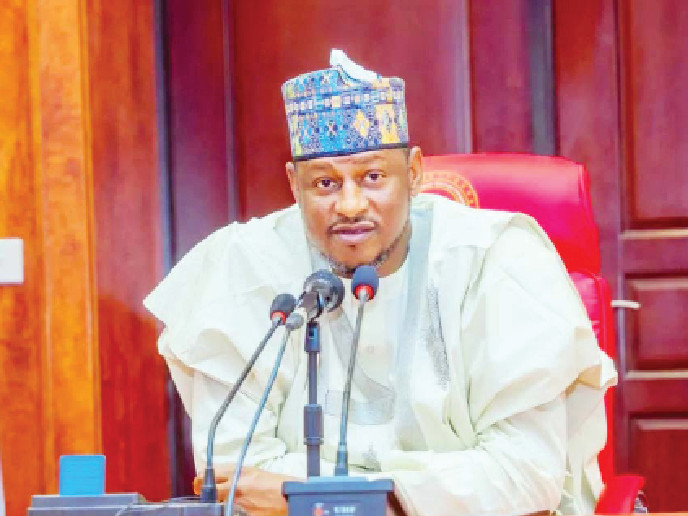
Governor Dikko Radda of Katsina has not left the institutional and policy responses against terrorism and banditry within his state strictly to the federal government, the military or the police.
And to the extent that the constitution allows, even the operational response has seen the state governor taking the initiative.
On the institutional level, Katsina has responded with the creation of the Ministry of Internal Security and Home Affairs.
The ministry coordinates security activities in the state and is responsible for intelligence sharing, threat assessment, and coordination with federal security agencies.
Governor Radda also formed the State Security Council Advisory Committee comprising traditional rulers, religious leaders, community leaders and retired security personnel.
Then there is establishment of the Katsina Community Watch Corps, which according to the governor himself, its members were recruited through structured processes, trained by the military and police, and deployed to complement conventional security agencies within legal frameworks.
It’s the most Radda could do without the needed constitutional amendment for him to take executive control over the security of the state and police it himself.
And should the National Assembly enact laws for the creation of state police, the reality is that it would take most states an average of 10 years to train, equip and build the needed institutional capacity to secure their states.
Here, Radda is already laying the groundwork.
On the side of operations, state officials have publicised the use of youth and community groups for intelligence gathering, the governor has spoken of operational tools provided to some of these groups, to security agencies and even deploying drones for surveillance.
Building institutions, formulating the right policies and putting them in operation; the question is whether all of the efforts are bearing fruits.
The state seems to think so. They point to the arrest of over 1000 informants and bandits operating in plain sight and a reduction in attacks in the most affected local governments.
In terms of policy, community engagement has been a top priority of the state governor.
Again, the country saw a direct effect of that after the abduction of Gen. Rabe Abubakar.
The community wasted no time in reaching out to the authorities, using social media platforms to identify the victims and relating virtually every detail of the criminal gang’s actions before, during and after the abductions. That’s a sign that the communities now have more confidence to engage with state authorities, security agencies and the broader public.
But the state’s policy is not just about wielding the big stick.
It has added carrots to its approach, offering to rehabilitate bandits who renounce violence and hand over their weapons.
Governor Radda has also been promoting peace deals between bandits and suffering communities.
Though some see the policies as controversial, they are some of the most difficult decisions the governor has had to make in his efforts to bring an end to the bloodletting.
In an article about Fulani herdsmen – who make up many of the gangs that carry out the attacks on civilians – published last by the Guardian UK; a picture was painted of young men, teenagers actually, who can be pulled away from a life crime, especially as they habour grievances that can easily be addressed by the government.
The particular gang cited in the article is based near Batsari within Rugu Forest in Katsina, a hotbed of banditry.
While some groups have accepted the rehabilitation offers, many still remain unrepentant and are terrorising communities to devastating effects.
That doesn’t mean progress is not being made and that the progress is not being noticed.
Just weeks ago, members of Senior Course 48 from the Armed Forces Command and Staff College, Jaji in Kaduna paid a visit to Governor Radda as part of their study on community engagement in enhancing national security.
Brig. Gen. K. Rabiu who led the 91-member team described Katsina as a strong reference point in community-based security initiatives, particularly through engagement with traditional rulers, community watch groups, and local stakeholders.
But the assessment of the security study group is very different from that of the communities on the receiving end of attacks, kidnappings and killings.
For these communities, success in curbing security challenges is measured only in one way, and this means nothing but prolonged if not permanent peace and quiet.
And so, in spite of all the work he has already put into securing Katsina, this can only mean more hard work, sleepless nights and endless days for Governor Dikko Radda.
Shuaib, a former editor of Leadership lives in Abuja.
We’ve got the edge. Get real-time reports, breaking scoops, and exclusive angles delivered straight to your phone. Don’t settle for stale news. Join LEADERSHIP NEWS on WhatsApp for 24/7 updates →
Join Our WhatsApp Channel