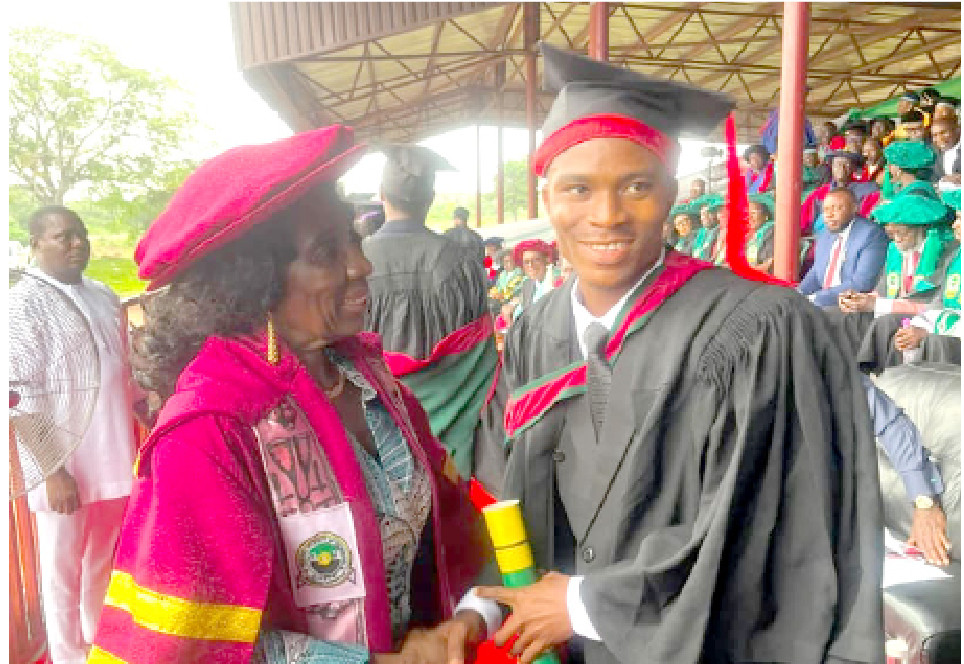
Last week, Peter Ibeh graduated from the Federal University of Technology Owerri (FUTO) in Imo State with a first class in Electrical and Electronic Engineering, earning a 4.80 CGPA. In this interview, he tells ANGELA NKWO-AKPOLU about his study routine and how he worked hard to fulfil his late father’s dream, who he said didn’t live to see him achieve it.
Could you tell us a little about yourself?
My name is Peter Ibeh, a graduate of Electrical and Electronic Engineering with a speciality in Power System Engineering (more of Electrical Engineering) from the Federal University of Technology, Owerri (FUTO). I am a native of the Eziachi community in the Orlu Local Government Area of Imo State, Nigeria. I’m the last child in a family of four. My father, Mr James Obinali Ibeh, was a palm-wine tapper. He died while I was in Junior Secondary School (JSS2). My mum, Mrs Mary Ibeh, an auxiliary nurse, tried her best to take up the responsibility for our education after the demise of my dad.
Could you tell us about the schools you attended?
I attended primary school at Holy Family Nursery and Primary School, Umuzike, in Orlu Local Government Area, and at St. Monica International Nursery and Primary School, Nkwerre, in Nkwerre Local Government Area, both in Imo State. My secondary education was at St. Charles Lwanga Modern Secondary School (SCLMSS) and Eziachi Secondary School (ESSO), both in Orlu LGA. I then proceeded to Federal University of Technology, Owerri (FUTO), where I obtained a Bachelor of Engineering in Electrical and Electronic Engineering with first-class honours.
What’s your reading routine?
I maintained a consistent reading routine by studying daily, usually in the morning (4 am – 6 am), then revising the day’s lectures (5 pm – 7 pm), and then night study (10 pm – 2 am). My study hours varied, but I made sure I had consistent daily reading time, usually an average of 7 hours, but during weekends, I usually study for about 12 hours.
I prioritise difficult topics when my concentration is highest and review previous studies regularly to ensure a long-term understanding. I always ensured I revised my lecture notes after completing the day’s activities. Also, I studied alongside past questions, which helped me understand the topics well and even prepared me for examination mode.
Did you have any special routine for studying? How did you read?
Before the start of each semester, I would gather all the necessary study materials, including textbooks, PDFs, and past exam questions, for all the courses I would be taking that semester. This has been my secret, and it has been very helpful. Getting these study materials early gave me insight and a clear overview of the courses. I studied ahead of the lecturers, which made it easier for me to follow up on lectures, while some of my coursemates struggled to understand what was being taught. I avoided late-hour preparation, so I always ensured that I covered all courses at least two weeks before exams began. I did not go into any exam without at least 80 per cent preparation.
Have you always been an A student?
Yes, I have always been an exceptional student. Right from my primary school days, I used to come first in class. It became a tradition that even my parents wouldn’t ask me my position anytime school closed for the term, because they already knew the outcome. During my secondary school days, I hardly ever took any position other than first place. I entered the University to study Electrical and Electronic Engineering with a JAMB score of 274. But I must add that my hard work and consistency set me apart.
How did you fund your education?
My mum continued where my late Dad left off. Then she worked as an auxiliary nurse at a private maternity clinic. She tried her best to take up the responsibility for our education after the demise of my dad. She supplemented her income by selling farm produce and wisely managed her modest salary from the maternity clinic to meet our basic needs. I owe special thanks to my sponsors, my Uncle, Engr. Nicholas Obiajunwa, and my elder brother, Mr Emmanuel Ibeh. Both of them helped me financially to remain in school and achieve my goal.
Did you experience challenges while at FUTO?
My journey came with its own set of challenges, starting with getting used to the university system and handling very demanding courses. I also had to balance my academics with other responsibilities while studying in an environment with limited learning facilities. On top of that, financial difficulties sometimes made things tougher, but I kept pushing through and stayed focused on my goals.
What motivated you?
My family background was my motivation; the struggle and all we passed through while growing up. While growing up, I would always hear my father talk about how he was unable to further his education, despite being intelligent, because of financial challenges. Seeing myself at the University was a dream come true, so I had to give my all to achieve academic excellence. Also, seeing and reading the stories of those who achieved academic excellence motivated me too.
What other factors can help students achieve the first-class feat?
I want to advise students who want to achieve academic excellence that, in any tertiary institution, they will surely encounter upper-level students who try to discourage them from pursuing it. You will hear words like, “You just dey do initial gra gra; you go still calm down when you see your first results.” Most of them are trying to impose their reality on you. Do not let their words of discouragement affect you. Just remain focused on your goals. Again, if you want to achieve academic excellence, you have to be in the company of those who share the same goal. Do not join an unserious clique, or you may become like them. To sum it all up, take your studies seriously; attend lectures, prepare well for tests and exams, and don’t indulge in examination malpractice. With hard work, consistency, discipline, and determination, academic excellence can be achieved. I leave with a quote: “Motivation sparks the journey, but consistency fuels it.”
Were you involved in student association activities?
Yes, I joined the Institute of Electrical and Electronics Engineers (IEEE) and Enactus, FUTO branch, though I was a volunteer, not an elected executive.
We’ve got the edge. Get real-time reports, breaking scoops, and exclusive angles delivered straight to your phone. Don’t settle for stale news. Join LEADERSHIP NEWS on WhatsApp for 24/7 updates →
Join Our WhatsApp Channel