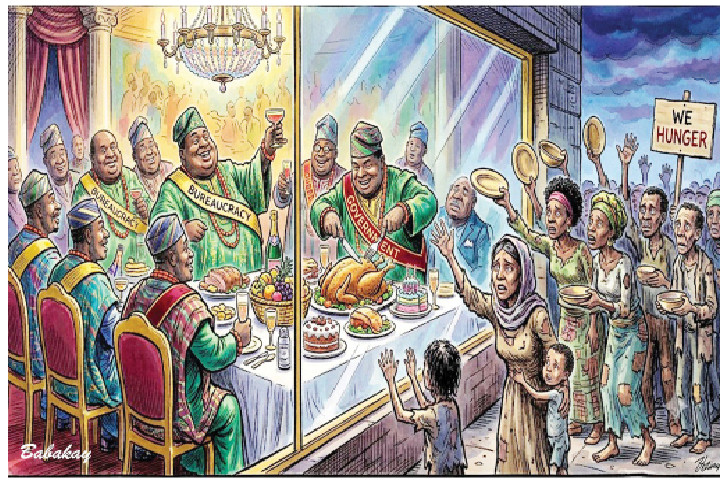
A sailor standing on the upper deck of a luxury liner may sincerely believe the sea is calm. The chandeliers are steady, the orchestra is playing, and dinner arrives on schedule. From his vantage point, there is no storm. What he cannot see are the passengers clinging to fragments of wreckage beyond the glow of the ship’s lights. One of the oldest afflictions of power is not cruelty but perspective. The higher leaders ascend, the easier it becomes to mistake personal observation for national reality. That is why societies invented statistics, surveys, and economic indicators. They exist to help governments see beyond the limits of personal experience.
It is against this backdrop that one must examine the comments attributed to presidential spokesman Bayo Onanuga, who reportedly stated that he does not see the severe hunger many Nigerians complain about. His reasoning, as reported, drew from conversations with people around him and from visible evidence of government activity, including road construction, student loans, and credit schemes. The implication was clear. If these interventions are visible and people appear to be adjusting, perhaps the national conversation about hardship is exaggerated.
One must admire the efficiency of this approach. If national welfare can be measured through conversations with domestic staff and observations from official corridors, the World Bank may have wasted decades conducting poverty assessments. The National Bureau of Statistics could save considerable resources by abandoning household surveys. Why deploy enumerators across thirty-six states when a few conversations and a drive past construction sites can apparently reveal the condition of over two hundred million people?
Dustbins and Memory
For older Nigerians, the controversy immediately evokes memories of Alhaji Umaru Dikko, one of the most powerful figures of the Second Republic. During the economic turbulence of the early 1980s, Dikko became associated with the infamous dustbin controversy. His critics insisted he dismissed reports of hunger by arguing that Nigerians were not yet eating from refuse dumps. Dikko and his supporters maintained he was misquoted, insisting that his actual point was that government would ensure sufficient food so that nobody would be forced to eat from a dustbin.
Whether misquoted or misunderstood, the dustbin survived because it became a metaphor. At a time of inflation, shortages, and economic anxiety, many Nigerians felt those governing them were evaluating hardship from a comfortable distance. Four decades later, the controversy remains relevant because it reminds us that public perception often matters as much as official intention. Once leaders appear detached from lived realities, every statement becomes evidence in the court of public opinion.
Interestingly, Umaru Dikko at least seemed to establish a threshold. The debate revolved around whether conditions had deteriorated to the point where people were eating from refuse dumps. Mr. Onanuga’s formulation appears even more ambitious. He reportedly does not see the hunger at all. In that sense, political evolution has taken a curious turn. Dikko looked at the dustbin and found insufficient evidence. Onanuga appears to have dispensed with the dustbin altogether.
The Orange Economist
Perhaps nobody should be surprised. In 2016, during Nigeria’s recession under President Muhammadu Buhari, Mr. Onanuga, then Managing Director of the News Agency of Nigeria embarked on a road trip from Jos to Kaduna and purchased over fifty oranges, two giant watermelons, and several sweet potatoes for one thousand naira. He subsequently cited the experience as evidence that reports of economic hardship were exaggerated.
That was the moment many observers quietly concluded that Mr. Onanuga and orthodox economics were unlikely to become close companions. The logic was certainly creative. By similar reasoning, one could locate a healthy patient in a cancer ward and conclude oncology is a myth. One could discover a dry patch during a flood and declare the entire city unaffected. Economics, unfortunately, is not conducted through fruit purchases. It is conducted through aggregate data, household welfare analysis, labour statistics, inflation trends, and consumption patterns.
What The Data Says
The problem with dismissing hardship is that facts have an inconvenient tendency to persist. The World Bank estimates that approximately 129 million Nigerians now live below the national poverty line. Various assessments have concluded that poverty has deepened as inflation continues to erode purchasing power and reduce the real value of incomes. For millions of households, wages have simply failed to keep pace with rising prices.
The National Bureau of Statistics has repeatedly documented elevated food inflation and declining purchasing power among vulnerable populations. This matters because poorer households spend a disproportionately large share of their income on food. When food prices rise sharply, the effect is immediate. It translates into fewer meals, reduced nutritional quality, postponed healthcare, and increased economic vulnerability. Economists call this welfare erosion. Ordinary Nigerians call it hardship.
Even the International Monetary Fund, while commending aspects of Nigeria’s macroeconomic reforms, has acknowledged that food insecurity and poverty remain widespread. This distinction is critical. Macroeconomic stabilization is not the same thing as improved living standards. Foreign reserves may rise while dinner portions shrink. Fiscal indicators may improve while households become poorer.
The Republic of Coping
One reason some officials may struggle to see hunger is that modern hardship rarely announces itself dramatically. Hunger is often subtle. It hides behind dignity. It wears clean clothes. It attends weddings. It goes to work. It smiles in public. The mother who quietly removes protein from family meals rarely appears in official reports. The father who skips lunch so his children can eat does not usually hold a press conference. The graduate surviving on one meal a day while searching for employment does not carry a placard announcing his condition.
The remarkable thing about Nigerians is not that they are unaffected by economic pain. It is that they have become remarkably skilled at adapting to it. Families have adjusted consumption patterns. Businesses have downsized ambitions. Households have embraced survival strategies that would have seemed unimaginable a decade ago. Politicians often interpret this resilience as evidence of comfort. It is not. A man balancing on the edge of a cliff demonstrates resilience every second he remains standing. That does not mean he is safe.
History’s Lesson
History offers repeated warnings about governments that mistake official narratives for social realities. The French monarchy did not collapse because information was unavailable. It collapsed because elites increasingly inhabited a different reality from ordinary citizens. Across continents and centuries, political establishments have often convinced themselves that visible symbols of progress invalidate public complaints. Reality eventually rendered its own verdict.
Roads are important. Bridges are important. Student loans are important. Credit facilities are important. But infrastructure cannot be eaten. Asphalt does not substitute for purchasing power. A bridge may connect two cities, but it does not automatically reconnect wages to inflation. Development requires both physical infrastructure and human welfare. Any serious assessment of progress must account for both.
Ultimately, the greatest danger facing any government is not criticism but insulation. Once leaders begin trusting personal impressions more than evidence, they enter a hall of mirrors where perception slowly replaces reality. Nations rarely stumble because their leaders cannot see. They stumble because their leaders become convinced that whatever lies beyond their field of vision does not exist.
We’ve got the edge. Get real-time reports, breaking scoops, and exclusive angles delivered straight to your phone. Don’t settle for stale news. Join LEADERSHIP NEWS on WhatsApp for 24/7 updates →
Join Our WhatsApp Channel