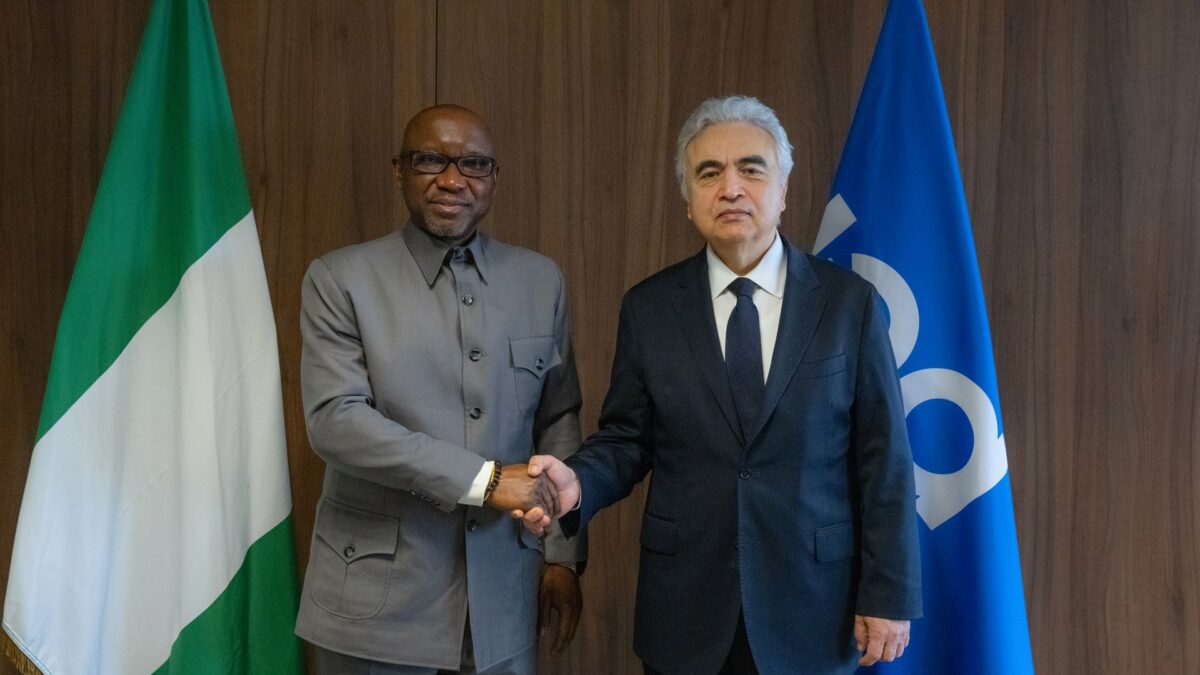
Nigeria has formally joined the International Energy Agency (IEA) as an Association country, a move officials say will sharpen planning, attract capital and speed the country’s clean‑energy transition while boosting its role in global markets.
Nigeria became the first OPEC member to join the IEA as an associate (Association) country, marking a notable shift in its global energy diplomacy.
The IEA Governing Board unanimously approved Nigeria’s accession, expanding an Agency that now represents more than 80% of global energy demand. The decision follows years of collaboration and arrives as Nigeria seeks to fix chronic power shortfalls, strengthen refining capacity, scale decentralised solar and expand access to clean cooking.
Analysts say the move gives Nigeria a voice in both producer and consumer energy policy forums, and could help the country act as a bridge between oil‑exporting nations and major petroleum‑importing economies.
Analyst and senior associate at AO2 Law, Chukwuemeka Ozuzu, told CNBC Africa that the membership is “a very significant development,” noting that Nigeria is no longer limited to discussions within an exporters’ bloc alone. Instead, Nigeria can now contribute to policy conversations that shape energy outcomes across global markets, especially as oil prices and supply remain sensitive to geopolitical tensions and shifting demand patterns.
1. A dual role in global energy policy
OPEC has long represented oil‑exporting countries, while the IEA has traditionally been aligned with major petroleum‑importing nations and large energy consumers. Ozuzu explained that Nigeria’s admission positions the country between these two historically distinct camps.
In practical terms, this allows Nigeria to participate more directly in shaping global energy policy, rather than engaging only from the standpoint of a crude producer. The IEA’s unanimous approval also reflects recognition of Nigeria’s role in supporting fuel supply stability during global disruptions, building on more than a decade of partnership between Nigeria and the agency.
2. Complementing, not replacing, OPEC membership
A key question for many observers is whether IEA membership could complicate Nigeria’s standing within OPEC, especially as the country remains heavily tied to crude exports while also trying to cut imports of refined petroleum products.
Ozuzu argued that the two relationships are not contradictory but complementary. OPEC gives Nigeria a platform among exporters, while the IEA offers access to a forum historically shaped by importers and broader energy consumers. By sitting across both conversations, Nigeria could act as a bridge between producer and consumer interests, making it easier to anticipate market shifts and advocate for producer‑country realities in discussions that extend beyond crude oil alone.
3. Support for refining and domestic supply security
The IEA relationship is not limited to fossil fuels and may also support Nigeria’s efforts to modernise energy infrastructure and strengthen domestic supply security. This is particularly relevant as Nigeria seeks to reduce refined product imports, with the Dangote (Dangote) refinery expected to reshape domestic fuel dynamics.
Membership in the IEA could give policymakers in Abuja greater visibility into how global consumers, importers and energy‑transition stakeholders are thinking about future demand, fuel security and sustainability. That insight can help shape policies that balance hydrocarbon dependence with modernisation of the power sector, refining capacity and distribution networks.
4. Clean energy and energy transition ambitions
Ozuzu stressed that the IEA’s remit is not limited to fossil fuels. He pointed to Nigeria’s efforts to expand decentralised solar capacity in recent years as a factor that likely contributed to the IEA’s decision to admit the country.
This aligns with Nigeria’s broader push to expand access to electricity and clean cooking solutions, while integrating renewable energy into the national grid. Through the IEA, Nigeria can access technical guidance, data and best practices on renewables, grid integration and distributed energy systems, which can accelerate its clean‑energy ambitions.
5. Navigating a volatile global oil market
The discussion comes at a time when global oil markets are navigating a volatile backdrop marked by geopolitical tensions, changing demand patterns and ongoing production adjustments within OPEC+.
Ozuzu noted that recent U.S.–Iran diplomacy has helped ease crude prices in the near term, though uncertainty remains after the 60‑day memorandum period. Any breakdown in regional negotiations could quickly alter oil price outlooks and global supply expectations.
In such a context, Nigeria’s dual access to OPEC and IEA forums may help the country better anticipate market shifts, manage export strategies and safeguard domestic supply. It also strengthens Nigeria’s relevance in discussions that involve both supply discipline and energy security concerns across producer and consumer blocs.
6. Long‑term implications for Nigeria’s energy strategy
While it remains too early to determine the long‑term outcomes of the new relationship, analysts see Nigeria’s IEA admission less as a geopolitical realignment and more as an expansion of its policy reach.
For now, the move is seen as a step in the right direction in the short to medium term, helping Nigeria navigate a more complex and rapidly evolving energy landscape. By combining its OPEC membership with IEA participation, Nigeria can strengthen its influence in global energy governance, support domestic reforms and position itself as a more credible and versatile player in both oil and clean energy markets.
We’ve got the edge. Get real-time reports, breaking scoops, and exclusive angles delivered straight to your phone. Don’t settle for stale news. Join LEADERSHIP NEWS on WhatsApp for 24/7 updates →
Join Our WhatsApp Channel