Effective soil management, which involves policymakers, researchers, experts, farmers, and all critical stakeholders, is described as essential for achieving smart and sustainable agricultural development in Nigeria.
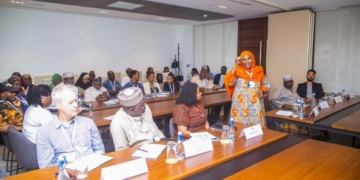
This was stated by Prof. Olumuyiwa James, National Consultant for the Nigeria Farmer Soil Health Scheme and an expert in Soil Science and Smart Agriculture at Bayero University, Kano. He made this remark while presenting a paper at a one-day stakeholder engagement and awareness session on the Nigeria Farmers’ Soil Health Scheme (NFSHS), held in Dutse, the capital of Jigawa State.
He noted that continuous and periodic soil testing provides reliable data and insight into the nature of the soil, the types of crops suitable for planting, fertilizer application, pest control, and other techniques required for smart agricultural practices.
According to him, appropriate soil management practices make smart agriculture productive and sustainable, with a full guarantee of food security for the nation and good returns for farmers.
He therefore encouraged the government, partners, farmers, and all stakeholders to support the policy in order to make the country’s agricultural sector more attractive, viable, reliable, and sustainable.
In his speech at the occasion, the Country Director of Soil Value, Madina Ayuba, said the NFSHS is a flagship national initiative of the Federal Ministry of Agriculture and Food Security, coordinated through the ALCCMS. It is aimed at providing a comprehensive framework for promoting sustainable soil fertility management and climate-smart agriculture.
The initiative is also expected to improve fertilizer use efficiency and data-driven soil governance across Nigeria’s agro-ecological zones, anchored in the National Agricultural Technology and Innovation Policy.
Every state of the federation is expected to domesticate the policy and establish a State Technical Working Committee for engagement with farmers, as well as a Coalition of the Willing platform to drive the scheme forward in the state.
In his remarks, the Director of Agricultural Land and Climate Change Management Services, Mr. Olanipekun Oshadiya, stated that healthy soil is the foundation of sustainable agriculture and food security. He emphasized that the ability to produce sufficient food, improve farmers’ livelihoods, and build resilient agricultural systems depends largely on the health and productive capacity of our soils.
Unfortunately, soil degradation, nutrient depletion, erosion, declining organic matter, and the impacts of climate change continue to pose significant challenges to agricultural production. We must therefore change the way we manage our soils.
“We must move away from a situation where farmers apply fertilizer simply because it is generally recommended, towards an approach where the specific needs of the soil and crop determine the appropriate nutrient application,” he said.
“The success of this Scheme will depend significantly on its effective domestication at the sub-national level. Nigeria has diverse agro-ecological zones, soil types, crops, and farming systems. What works effectively in one location may not necessarily produce the same results elsewhere. States must therefore take ownership and translate the national framework into practical interventions that reflect their local conditions,” he added.
He further called for strengthening soil testing infrastructure, improving laboratory capacity and quality assurance, training technical personnel, and making soil testing services accessible and affordable to smallholder farmers.
“I encourage State Governments to integrate the Scheme into their agricultural development programmes and strengthen collaboration among soil laboratories, research institutions, extension services, farmers’ organisations, development partners, and the private sector,” he stated.
In his speech, the Jigawa State Commissioner of Agriculture and Food Security, Hon. Muttaka Namadi, who was represented by the Permanent Secretary of the Ministry, Alhaji Auwal Ado Shehu, said the state government is committed to the domestication and full implementation of the policy.
According to the commissioner, the soil health scheme is fully in tandem with Governor Namadi’s policy on reforming the state’s agriculture and climate sectors for greater productivity, food security, and sustainable growth.
We’ve got the edge. Get real-time reports, breaking scoops, and exclusive angles delivered straight to your phone. Don’t settle for stale news. Join LEADERSHIP NEWS on WhatsApp for 24/7 updates →
Join Our WhatsApp Channel