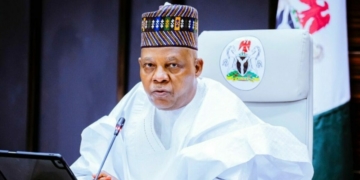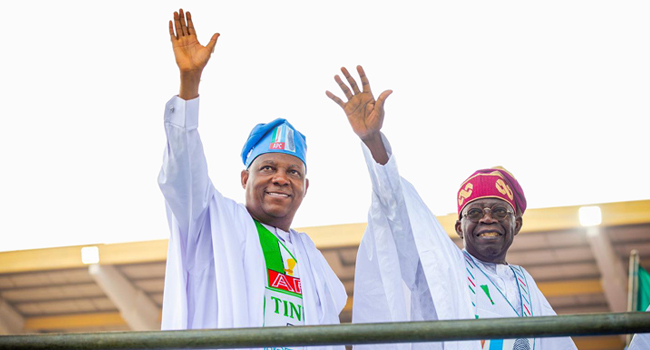
In politics, the most powerful decisions are sometimes the ones that end speculation. President Bola Ahmed Tinubu’s decision to retain Vice President Kashim Shettima as his running mate for the 2027 presidential election is one of such decisions. It is a statement of trust, a signal of continuity, and a calculated move to keep the All Progressives Congress (APC) on familiar ground, as the party prepares for another national contest.
By retaining VP Shettima, President Tinubu has done more than fill a space on the ballot. He has quelled a major source of needless political anxiety within the ruling party, shut down months of speculation over the Vice President’s place on the ticket, and reaffirmed the partnership that led the APC to victory in 2023.
As a political strategy, the president’s decision is also disarming because it denies the opposition the easy path of exploiting a supposed and self-hallucinated crack in the administration. For months, political commentators had speculated about whether the President would bow to ‘inferred’ pressure and alter the ticket. Some presented the issue as a test of religious sensitivity, while others framed it as a question of regional balancing. There are others who saw it as an opportunity to unsettle the APC base. With this landmark decision, President Tinubu has reminded the political class that he is not one to be easily stampeded by noise when he is satisfied with the value of a partner.
This is why VP Shettima’s retention should be understood beyond sentiment. It is the meeting point of loyalty, capacity, and capability. The President has chosen to continue with a deputy who has shown discipline in office, defended the administration’s reforms, chaired critical national economic conversations, engaged governors through the National Economic Council, and carried the Renewed Hope Agenda message into policy rooms, public fora and political spaces without creating confusion about where authority resides.
The choice of Shettima as Tinubu’s running mate in 2022 was never an accidental calculation. It was a deliberate political arrangement that joined President Tinubu’s Southern political structure with VP Shettima’s Northern reach, especially his influence in the North East and his wider acceptance within the North. It was also a choice rooted in the belief that Nigeria’s economic and security challenges required a running mate with administrative experience, political courage, intellectual depth, and the temperament to stand firm under pressure.
That decision came with controversy, and no honest account of the Tinubu-Shettima ticket can avoid that fact. The same-faith ticket unsettled many Nigerians, drew sharp reactions from religious and political groups, and tested the APC’s ability to defend its choice before a deeply sensitive electorate. Yet the campaign insisted that the ticket was built on competence, shared political values, progressive history, and the need for a team that could win power and govern with confidence. The 2023 election eventually showed that the calculation had serious electoral weight.
The comparison often made with the 1993 MKO Abiola and Babagana Kingibe ticket is useful, but it should not be stretched beyond its proper meaning. The point is not that history repeated itself. The Nigeria of 1993 can not be the Nigeria of 2027, and the political conditions are not identical. The real lesson is that Nigerian voters have, at important moments, looked beyond religious arithmetic when a ticket presents a compelling national coalition, a strong political machine, and a message that speaks to the anxieties of the moment.
President Tinubu appears to have drawn from that larger lesson. By retaining VP Shettima, he has chosen continuity over experimentation, tested partnership over a risky replacement, and political chemistry over cosmetic appeasement. A running mate is not useful simply because he balances a ticket on paper. He becomes truly valuable when he strengthens the candidate’s reach, reassures the party structure, helps defend the government’s record, and reduces the cost of political coordination.
This is where VP Shettima’s strongest value lies. He has shown that loyalty can be active without being loud and that deputy leadership can be visible without becoming disruptive. In leadership, trust grows when people repeatedly see steadiness under pressure, clarity of role, and consistency between words and conduct. VP Shettima has largely operated within that discipline. He has spoken forcefully for the administration but has never and will never attempt to build a rival centre of gravity around himself.
As Chairman of the National Economic Council, the Vice President has had to sit at the junction where federal ambition meets state-level realities. The Council brings governors, key federal officials, and economic managers into one platform, and under VP Shettima’s chairmanship it has become an important channel for discussing economic stabilisation, food security, wage pressures, subnational coordination, palliative measures, nutrition, digital enterprise, infrastructure, and security-linked development. In a federation as complex as Nigeria, that role requires patience, negotiation, and the ability to keep different interests in the same room long enough for policy to move.
The early months of the administration tested that capacity. The removal of petrol subsidy created pressure across households, states, and markets, and NEC had to become one of the platforms through which mitigation measures were discussed and coordinated. The Council also became relevant in conversations around food distribution, agricultural support, state-level palliatives, transport relief, wage concerns, and the broader burden created by reforms that were necessary to prevent deeper economic collapse.
VP Shettima’s work at NEC has also touched areas that speak directly to the future of the Nigerian economy. The Council endorsed the rollout of the Investment in Digital and Creative Enterprises programme across the 36 states and the Federal Capital Territory, a major intervention targeted at young people in technology and creative sectors. It has also taken up nutrition through the Nutrition 774 initiative, which is designed to push nutrition interventions across all local government areas, and it has engaged agriculture as a national security and development priority rather than a routine sectoral concern.
That is another reason his retention matters politically. A president entering a re-election cycle does not need a running mate who must first learn the language of the administration, rebuild trust with party actors, or negotiate his own place in the governing structure. President Tinubu already has in VP Shettima a deputy who understands the policy arguments, the political terrain, the administration’s vulnerabilities, and the emotional temperature of the electorate. That kind of familiarity can not be manufactured overnight.
– Nkwocha is Senior Special Assistant to the President on Media and Communications (Office of the Vice President) and wrote in from Abuja.
We’ve got the edge. Get real-time reports, breaking scoops, and exclusive angles delivered straight to your phone. Don’t settle for stale news. Join LEADERSHIP NEWS on WhatsApp for 24/7 updates →
Join Our WhatsApp Channel