Over the years, the National Agency for Science and Engineering Infrastructure (NASENI) has anchored Nigeria’s quest to develop its capacity to manufacture high-precision components locally to achieve sustainable industrialization and drive economic development.
Building local capacity for high-precision manufacturing is the pathway for indigenous self-reliance and the concrete assurance that Nigeria will establish itself as a productive base for industrial goods that will become competitive in the era of Artificial Intelligence (AI) and other emerging technologies.
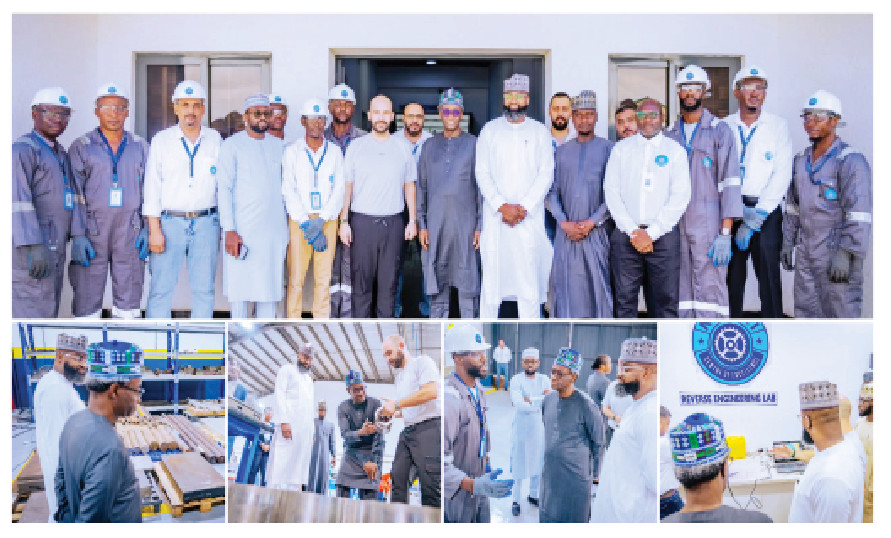
The Executive Vice Chairman/CEO of NASENI, Khalil Suleiman Halilu was emphatic about this critical sector when the Agency hosted the Director-General of the Budget Office of the Federation, Mr. Tanimu Yakubu, at the NASENI Centre of Excellence for Precision Manufacturing in Abuja recently.
Speaking on the commitment and policy direction of the Federal Government on this project, Halilu said the facility was established under President Bola Ahmed Tinubu’s Renewed Hope Agenda to address Nigeria’s dependence on imported precision-engineered components for critical industries.
The Centre was designed to strengthen Nigeria’s advanced manufacturing capabilities and support the production of world-class components required in strategic sectors such as aerospace, automotive, energy, defence, and healthcare among others.
The NASENI boss noted that developing indigenous precision manufacturing capacity is essential to reducing import dependence, enhancing industrial competitiveness, creating high-value jobs, and positioning Nigeria as a regional manufacturing hub.
The Centre is NASENI’s major contribution to Nigeria’s efforts at building the technical capabilities, infrastructure, and skilled workforce needed to accelerate Nigeria’s industrial transformation and unlock infinite possibilities. It is a strategic investment by Nigeria’s Federal Government designed to build advanced local manufacturing capabilities.
The facility focuses on creating high-precision components to reduce the nation’s heavy reliance on imported technologies. The centre has expanded its Core Strategy and Vision to include industrial sovereignty acting as the boost for sustainable industrialization and technological independence.
The idea nurtured by the NASENI boss has become the major plank for improving Nigeria’s technology and within this framework it aims to close critical gaps across the country’s manufacturing value chain. The vision of the centre ensures standard and quality which lays emphasis on intensifying indigenous innovation to match and exceed global market standards.
This initiative is targeting critical sectors such as aerospace and automotive industry as the high-precision components manufactured at the facility will introduce component design for domestic vehicle assembly and aviation requirements. It will also enhance energy and utilities through a systemic production of local energy hardware and smart irrigation technology.
In the defence and health sectors, the facility has secured equipment engineering and healthcare equipment parts. It has an inbuilt capacity building mechanism and policy framework for technology transfer as the bastion of technical competences and skill development sessions to improve engineering knowledge to local technicians.
The facility enhances stakeholder integration with an extensive focus to have engagement with the academia and industrialists across states like Kano, Lagos, and Anambra to scale local innovations.
The “Nigeria First” Policy fits into this initiative and it is encouraging to note that due to massive support of the infrastructure, the Bureau of Public Procurement (BPP) enforces guidelines requiring federal institutions to prioritize these locally manufactured parts.
This vision is a demonstration of NASENI’s commitment to establish Nigeria within the global map among countries such as China, which has the world’s most robust manufacturing capacity, accounting for nearly 30 per cent of global outputs.
NASENI under the leadership of Halilu intends to drive hyper-localized, highly specialized industrial clusters across major cities in the country in order to make an impact in high-precision production through vertically integrated supply chains, massive scale advantages, and extensive integration of AI and smart-factory infrastructure.
NASENI is driving Nigeria’s high-precision manufacturing capacity on several foundational advantages such as regional clusters in different regions such as Kano, Lagos, and Anambra and Rivers in line with President Tinubu’s ambition to aggressively shift towards AI-augmented, smart manufacturing.
Nigeria has promising digitalized institutions across the country integrating artificial intelligence directly into high-precision tooling. NASENI is strengthening the country as a rapidly emerging hub for high-precision manufacturing, driven by a vast engineering talent pool, cost-to-quality advantages, and robust government support.
All over the world, local capacity focuses heavily on medium-to-high precision and large-batch production, serving major sectors and supporting the small and medium enterprises (SMEs). The Idea is to make manufacturing highly localized around established engineering and technology hubs that will provide a strong foundation in heavy industries.
Nigeria has massive engineering potential, but manufacturers face a persistent deficit in localized skills required to operate. With more commitment and adequate funding coupled with consistent policy direction and more investment, NASENI would use this center to move the country towards the desired heights using the nation’s budding talents.
This is imperative to moving the country to a premier destination for advanced aerospace and specialized industrial equipment production.
We’ve got the edge. Get real-time reports, breaking scoops, and exclusive angles delivered straight to your phone. Don’t settle for stale news. Join LEADERSHIP NEWS on WhatsApp for 24/7 updates →
Join Our WhatsApp Channel