By Donald Kumun
For decades, Nigeria’s response to insecurity has largely revolved around the deployment of military force, increased security spending, and legislative interventions.
Yet, despite these efforts, terrorism, banditry, kidnapping, violent extremism, and communal conflicts, continue to threaten national stability, and undermine economic development. The persistence of these challenges has increasingly reinforced an uncomfortable truth: insecurity cannot be defeated by force alone.
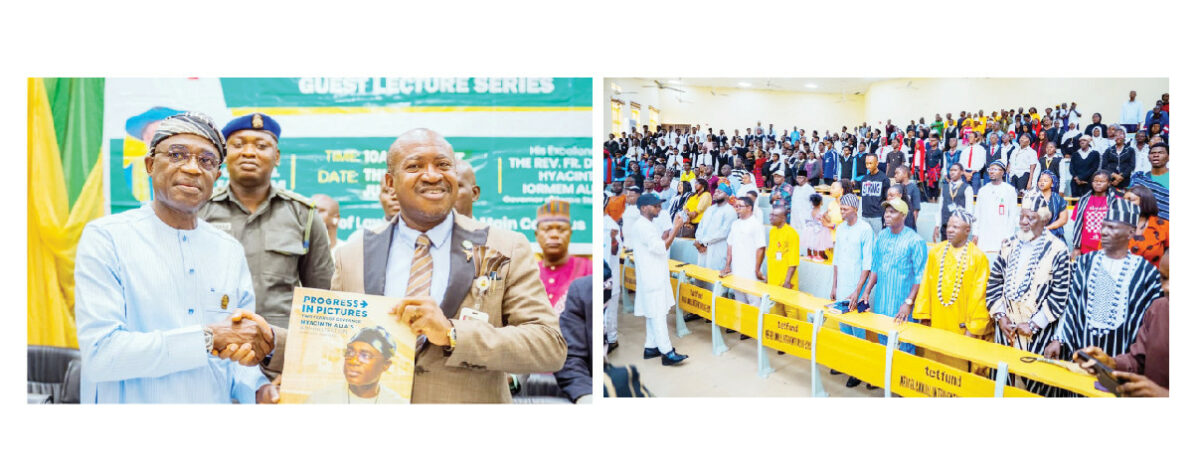
At the inaugural Quarterly Guest Lecture Series of Yakubu Gowon University (formerly the University of Abuja), Benue State Governor, Rev. Fr. Dr. Hyacinth Iormem Alia, advanced a compelling alternative. His lecture, “Insecurity and Education in Nigeria: The Benue Model as a Pathway to National Development,” was not merely an academic discourse. It was a policy proposition that seeks to redefine education as Nigeria’s most enduring instrument for peacebuilding, social stability and national development.
Governor Alia’s intervention arrives at a critical moment in Nigeria’s history. The country continues to grapple with multiple security crises that have displaced millions, disrupted livelihoods and weakened public confidence in state institutions.
Against this backdrop, the Benue experience offers an instructive lesson: while security operations may suppress violence temporarily, only education possesses the transformative capacity to eliminate the social conditions that breed insecurity.
The Governor’s central thesis is both straightforward and profound. Insecurity thrives where poverty, ignorance, unemployment and hopelessness flourish. Consequently, sustainable peace cannot be achieved without investing in human capital through accessible, functional and quality education.
His argument is firmly anchored in contemporary realities. From the Boko Haram insurgency, whose ideological foundation rejects Western education, to the alarming number of out-of-school children across parts of northern Nigeria, the relationship between educational deprivation and violent extremism has become increasingly evident. Communities deprived of learning opportunities often become fertile grounds for criminal recruitment, political manipulation and religious radicalisation.
This diagnosis extends beyond terrorism. Across Nigeria, weak institutions, unemployment, inequality, declining social values and poor governance have collectively created conditions that fuel insecurity. Governor Alia contends that addressing these structural deficiencies requires strengthening public institutions, restoring confidence in governance and repositioning education as the country’s foremost security investment.
The lecture equally highlights the indispensable role of an effective public service. Strong institutions, he argues, remain the foundation of national security. Public servants deliver education, healthcare, infrastructure and justice—the very services that strengthen citizens’ trust in government and reinforce social cohesion. National security, therefore, extends beyond military capability to encompass what scholars describe as “human security”—the freedom from fear and freedom from want.
This philosophy aligns closely with the Sustainable Development Goals (SDGs), particularly Goal Four, which advocates inclusive and equitable quality education. For Governor Alia, the SDGs are not abstract international aspirations but practical instruments for restoring peace, improving livelihoods and promoting human dignity.
Nowhere is this philosophy more visible than in Benue State itself. Few states have suffered the devastating consequences of insecurity as profoundly as Benue. Years of armed herder attacks, banditry, kidnappings and communal violence have claimed thousands of lives, displaced over 1.5 million residents and severely disrupted agricultural production, education and community life. Upon assuming office in 2023, Governor Alia inherited not merely a security crisis but a humanitarian emergency.
Rather than relying exclusively on conventional security responses, his administration introduced an ambitious educational strategy designed to remove vulnerable youths from the streets and redirect them into productive learning environments.
The premise was remarkably simple: an engaged student is less likely to become an idle recruit for criminal networks. This philosophy has translated into measurable investments. Basic education from primary school to Junior Secondary School Three has been made free and compulsory throughout the state, removing one of the biggest barriers to school enrolment.
Beyond expanding access, the administration has embarked on a comprehensive transformation of educational infrastructure. Within three years, more than 422 educational structures have been constructed or renovated, dozens of libraries established, eighty-bed hostels built, over 8,400 whiteboards introduced to replace obsolete chalkboards, and more than 207,000 textbooks distributed to schools. Thousands of classroom furniture units, bookshelves, digital learning facilities and instructional materials have equally been supplied across the state.
The reforms extend beyond infrastructure. Recognising that quality education depends fundamentally on quality teaching, the government has trained over 8,500 teachers while recruiting and deploying approximately 9,700 additional teachers across Benue. Improved welfare, prompt salary payments, pension reforms and the implementation of the ₦75,000 minimum wage have further strengthened the educational workforce.
Collectively, these interventions have significantly increased school enrolment, including among children residing in internally displaced persons’ camps, while simultaneously reducing youth restiveness through constructive engagement.
The educational reforms are themselves situated within the administration’s broader development blueprint known as SACHIIP—an integrated governance framework encompassing Security, Agriculture, Commerce, Human Capital Development, Infrastructure, Information and Communications Technology, and Political and Economic Governance.
This integrated model recognises that education cannot operate in isolation. Security supports education; education strengthens agriculture and commerce; infrastructure enhances learning outcomes; and good governance sustains all the pillars simultaneously.
Perhaps the most visionary component of the Benue strategy lies in its deliberate emphasis on entrepreneurship, technical education and vocational skills. The establishment of the Benue State University of Agriculture, Science and Technology at Ihugh reflects a deliberate effort to prepare young people for productive employment while addressing unemployment—one of the most persistent drivers of insecurity.
Governor Alia argues convincingly that graduates equipped with practical skills are less susceptible to recruitment by criminal gangs, terrorist organisations, political thugs or violent extremist movements. In this regard, education becomes not merely a pathway to certificates but a strategic investment in national security.
Importantly, the Governor does not present education as a standalone solution. While advocating long-term preventive strategies, he equally calls for urgent institutional reforms, particularly the establishment of State Police.
His position reflects growing national conversations regarding the limitations of Nigeria’s highly centralised policing architecture. Community-based policing, he argues, would improve intelligence gathering, enhance operational responsiveness, deepen accountability and foster stronger relationships between security agencies and local communities.
Governor Alia’s longstanding advocacy for State Police, coupled with his commendation of ongoing constitutional reform efforts under President Bola Ahmed Tinubu, underscores his belief that effective security requires both institutional decentralisation and educational transformation.
His recommendations for national policy are equally far-reaching. They include strengthening the Almajiri education system, integrating entrepreneurship into tertiary education, expanding vocational training, introducing compulsory peace-building and conflict-resolution studies, promoting civic and moral education, improving school security infrastructure and ensuring that educational institutions become safe spaces for learning rather than targets of violence.
These proposals collectively reposition education from being merely a social service to becoming a strategic pillar of national security.
Ultimately, the significance of Governor Alia’s lecture extends beyond Benue State. It challenges Nigeria to rethink longstanding assumptions about how peace is built and sustained. While military operations remain indispensable in confronting immediate threats, enduring peace requires transforming the socio-economic conditions that produce violence in the first place.
The Benue Model demonstrates that education is not simply an expenditure within the annual budget; it is an investment in national resilience. Every classroom built, every teacher trained, every child enrolled and every youth equipped with employable skills represents another barrier against insecurity.
Nigeria’s search for lasting peace may therefore depend less on expanding its armouries than on expanding its classrooms.
If replicated nationally with commitment, adequate investment and institutional discipline, the Benue Model could become one of the country’s most enduring contributions to the evolving discourse on security, governance and sustainable development. It offers a simple yet powerful proposition: the safest nation is ultimately the most educated one.
– Donald Kumun, is the Principal Special Assistant to the Benue State Governor on Print Media and writes from Makurdi the State Capital.
We’ve got the edge. Get real-time reports, breaking scoops, and exclusive angles delivered straight to your phone. Don’t settle for stale news. Join LEADERSHIP NEWS on WhatsApp for 24/7 updates →
Join Our WhatsApp Channel