By Bello Adamu | [email protected]
The true measure of governance is rarely found in speeches. It is found in the water that reaches a tap, the flood that does not come, the tree that shades a street and provide an improved air quality, the clean environment devoid of waste. By that standard, Kano State has spent the past three years writing a quieter, sturdier kind of political record, one built less on rhetoric than on boreholes drilled, treatment plants restored, drains dug and seedlings planted.
Under Governor Abba Kabir Yusuf, the Kano State Ministry of Water Resources, Environment and Climate Change has pursued what may be the most ambitious environmental and water-sector transformation programme attempted by any state in northern Nigeria. It has not always made headlines. Infrastructure: roads, bridges, schools, tends to command public attention in a way that borehole construction and rehabilitation, sweeping the roads and streets, drainages and canals construction and distilling and tree nurseries do not. But the investments made here may prove just as consequential to how Kano’s five million metropolitan residents lives happily and healthy, and how the state weathers the decades ahead.
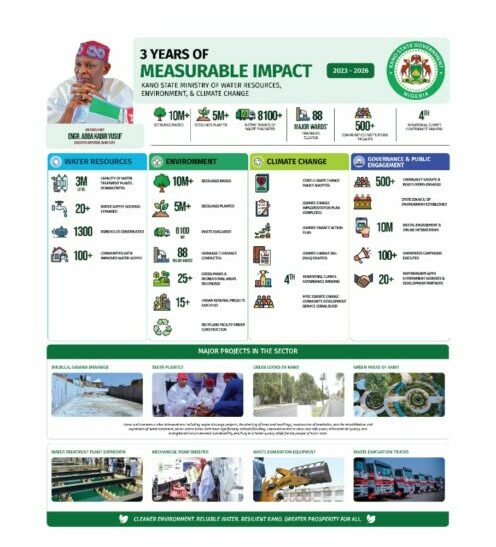
Climate change is no longer an abstraction for policymakers in the Sahel’s shadow. Erratic rainfall, flash flooding, encroaching desertification and rising pressure on water resources are now lived realities across Nigeria’s north. Governments face a choice: manage these crises as they arrive, or build the institutions to anticipate them. Kano has opted for the latter, and has the paperwork to prove it. The state has developed and adopted a Climate Change Policy, validated a Climate Change Implementation Plan and a Climate Finance Reform Action Plan running through 2028, while a Climate Change Bill alongside a companion regulation on environmental pollution and waste, translated into Hausa for wider public reach is now before stakeholders. Institutional reform of this kind rarely draws applause, but it is what allows a state to attract serious climate financing rather than simply react to the next disaster.
It is telling, too, that the Governor chose to merge the portfolios of Water Resources, Environment and Climate Change into a single ministry. Water security, environmental protection and climate resilience are not three separate problems; they are one interconnected challenge, and Kano’s institutional structure now reflects that.
Nowhere is the case for implementation over rhetoric clearer than in water. After years of ageing infrastructure and recurring shortages, the administration has moved on two fronts at once: immediate relief and long-term rebuilding.
The immediate relief has come through the approval of 166 solar-powered boreholes targeted at communities facing acute shortages, expected to yield more than 4.15 million litres of potable water daily and reach an estimated 830,000 residents, powered by renewable energy rather than the diesel generators that typically strain such schemes over time this is in addition to over 1000 hand pump boreholes.
The long-term rebuilding is larger in scale and consequence: multibillion naira is committed to the rehabilitation and upgrading of the Tamburawa and Challawa Water Treatment Plants, along with the restoration of raw water pumping stations and the Goron Dutse Reservoirs. Once complete, this work is expected to materially expand water production capacity to 370 million litters of portable water per day and restore reliable pipe-borne supply across Kano metropolis and its surrounding communities, the kind of unglamorous, capital-intensive project whose value tends to be felt years after the ribbon-cutting, not at it.
Flood control tells a similar story of scale meeting intent. Community-based drainage clearance has reached 88 metropolitan wards. Major channels: Jakara, Kwarin Gogau, Babban Gwari among many have undergone large-scale desilting, backed by new drainage construction targeting the city’s worst flood-prone corridors. No city sitting in Kano’s climate can eliminate flooding outright; what can be achieved, and what appears to be happening, is a measurable reduction in its frequency and severity, along with erosion-control work now extending to priority gully sites state-wide.
The environmental restoration effort runs on a similar logic of scale. Government nurseries have raised roughly 10 million tree seedlings, more than five` million of which have already gone into the ground across the state, complemented by greening along major metropolitan road corridors and public-space planting in schools, markets and religious centres. Waste management has followed a parallel track: over 8,100 metric tonnes evacuated, the Dorayi compost plant recommissioned to convert organic waste into fertiliser, and a waste-to-wealth framework designed to draw private capital into what has traditionally been treated as a purely public burden. None of this is glamorous work. It is, however, the work that determines whether a growing city stays liveable.
The Ministry’s own accounting suggests it understands that environmental and water stewardship cannot be legislated from above alone. Community engagement now spans more than 500 groups and institutions; an NYSC Climate Change Community Development Service has been established to draw young corps members into the work; and a digital public-awareness campaign has taken the ministry’s social media following from zero to over 30,000, generating more than ten million engagements along the way. Whatever one makes of the raw numbers, the underlying strategy, treating residents as participants in environmental and water governance rather than its passive beneficiaries, is the right one, and increasingly rare in African subnational governance.
The clearest external validation of this record is Kano’s climb from 35th to 4th position in national climate governance rankings, a jump that reflects institutional credibility as much as any single project, and one likely to matter more over time as it opens doors to climate finance and technical partnerships that lower-ranked states will struggle to access.
the trajectory is the story here, and it is an encouraging one. What the Kano State Ministry of Water Resources, Environment and Climate Change has demonstrated over three years is that water security and environmental governance, done seriously, are not soft add-ons to development, they are public health policy, economic policy and long-term security policy in one. As states across Nigeria confront the same climate and water pressures with far less institutional groundwork, Kano’s approach merged mandates, integrated policy, sustained investment, and governance treated as a shared civic project, offers a template worth examining, whatever one’s politics.
Governments are usually remembered for what they build. The more durable legacy, often, is what they were disciplined enough to protect.
Editor’s note: Figures cited are drawn from the Kano State Ministry of Water Resources, Environment and Climate Change’s three-year project record (2023–2026).
We’ve got the edge. Get real-time reports, breaking scoops, and exclusive angles delivered straight to your phone. Don’t settle for stale news. Join LEADERSHIP NEWS on WhatsApp for 24/7 updates →
Join Our WhatsApp Channel