
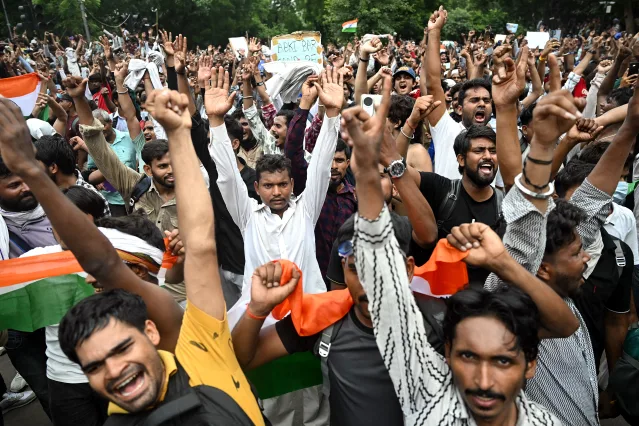
India’s Education Minister, Dharmendra Pradhan bowed to pressure, resigned on Saturday following weeks of youth-led protests over alleged examination leaks and irregularities in some of the country’s most competitive entrance examinations.
Pradhan’s resignation came after thousands of young people took to the streets in New Delhi and other parts of India under the banner of the social media-driven Cockroach Janta Party (CJP), demanding reforms to the education system and his removal from office.
In a statement posted on X, Pradhan said his decision was prompted by concerns over the impact of the protests on students and the country.
“I am pained to see the events of the past 10 days. This is not a matter of personal prestige for me,” Pradhan said.
“I have sent my resignation letter to the prime minister,” he added in a letter written in Hindi.
The CJP, which has led demonstrations centred on the Jantar Mantar protest site in central New Delhi, said following Pradhan’s resignation that its demands had been met and announced the suspension of the protests.
The demonstrations were sparked by allegations of leaks and irregularities involving major examinations, including the National Eligibility cum Entrance Test (NEET), which is crucial for admission into medical schools. The movement subsequently expanded its demands to include broader education reforms, employment opportunities and greater government accountability.
Tensions escalated earlier in the week when police fired tear gas and used batons as protesters attempted to march from Jantar Mantar towards Parliament.
The government held two rounds of talks with CJP representatives on Monday and Friday, but the discussions initially failed to resolve the standoff, with protesters maintaining their demand for Pradhan’s resignation.
The minister announced his decision ahead of a planned third round of talks.
“India’s youth power is the real strength of this nation. My resolve is that we will not let the country’s youth get trapped in a vicious cycle of confusion,” he said.
News of Pradhan’s resignation sparked celebrations among protesters at the demonstration site.
“We have done it,” CJP founder Abhijeet Dipke told hundreds of jubilant protesters, who responded with loud cheers.
The movement has since evolved beyond examination irregularities to encompass concerns about unemployment, opportunities for young people and what critics describe as the increasingly authoritarian style of Prime Minister Narendra Modi’s government.
The protests represented one of the most significant challenges to Modi’s administration since his re-election in 2024.
According to CJP spokesman Ashutosh Ranka, the protesters also demanded compensation for people affected by examination irregularities and the withdrawal of legal cases filed against demonstrators.
India’s opposition leader, Rahul Gandhi, backed the protesters and described Pradhan’s resignation as a “huge step”.
Gandhi called on Modi to “apologize” and respect students and future generations, while also demanding action against those responsible for violence against protesters.
“Action should be taken against those guilty of violence against students,” he said.
A 27-year-old protester identified as Sunil, who visited the demonstration site for the first time on Saturday to “experience the atmosphere”, described the mood following Pradhan’s resignation as “truly electrifying”.
“What the young people did was commendable,” he told AFP.
We’ve got the edge. Get real-time reports, breaking scoops, and exclusive angles delivered straight to your phone. Don’t settle for stale news. Join LEADERSHIP NEWS on WhatsApp for 24/7 updates →
Join Our WhatsApp Channel