
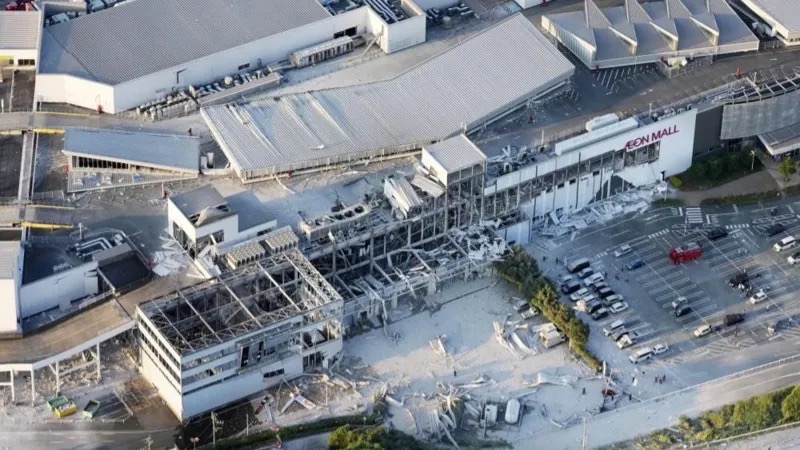
Several people have been trapped after a powerful 7.1-magnitude earthquake struck Japan’s south-western island of Kyushu on Tuesday, causing widespread destruction, partial building collapses, fires and power outages.
According to Japanese authorities, the earthquake struck inland near Kumamoto at about 4:27 p.m. local time (07:27 GMT), prompting evacuation orders for more than 150,000 residents. Although a tsunami warning was initially issued, it was lifted less than an hour later.
Emergency responders said many people were trapped inside an Aeon Mall in Kumamoto after part of the shopping complex collapsed.
The Kumamoto Fire Department said the second floor of the shopping complex in Kashima town collapsed, leaving several people trapped beneath the debris.
Local broadcaster NHK reported that an explosion occurred at the shopping mall following the earthquake, although authorities have yet to confirm the cause. The broadcaster also reported that about 50 people sustained injuries in the incident, while rescue operations were ongoing.
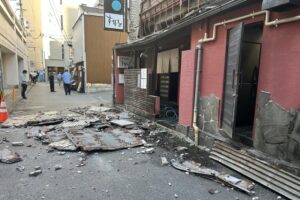
Television footage aired by NHK showed cracked roads, damaged bridges and several buildings engulfed in flames across affected communities.
Japan’s Meteorological Agency warned residents to remain on high alert for strong aftershocks, noting that the earthquake had a shallow depth of about 10 kilometres, increasing the likelihood of further seismic activity.
Prime Minister Sanae Takaichi said officials were still assessing the full extent of the disaster.
“We are still assessing the extent of injuries and property damage, but I have been informed that there have already been several injuries,” Takaichi said.
According to NHK, at least 10 of the injured were residents of an elderly care home, while no fewer than 50 people were receiving treatment in hospitals.
The Prime Minister added that emergency authorities were working to determine the scale of the damage.
“We have already been informed that people have been injured. Power outages and fires have occurred in some areas, and there has also been damage to roads and bridges and the collapse of buildings.”
Train services across parts of Kyushu were suspended following the quake, while thousands of households were left without electricity.
Chief Cabinet Secretary Minoru Kihara said emergency personnel, including members of Japan’s Self-Defence Forces, firefighters and the Coast Guard, had been mobilised to support rescue and relief operations.
“We urge residents in areas where the shaking was particularly severe to pay close attention to evacuation information issued by local authorities via radio, television and the internet, and to act calmly,” Kihara said.
The International Atomic Energy Agency (IAEA) also confirmed that the earthquake caused no damage to the Sendai Nuclear Power Plant, located about 100 kilometres from the epicentre.
In a post on X, the agency said the facility remained operational.
“The earthquake caused no damage or safety issues at the Sendai Nuclear Power Plant… The IAEA will continue to monitor the situation.”
Meanwhile, Taiwan Semiconductor Manufacturing Company (TSMC) evacuated workers from its nearby facility as a precaution, according to a company spokesperson.
Japan is among the world’s most earthquake-prone countries, recording about 1,500 earthquakes annually due to its location along the Pacific “Ring of Fire.”
The latest disaster also revived memories of the devastating 2016 Kumamoto earthquakes, which claimed 275 lives and left more than 2,700 people injured.
We’ve got the edge. Get real-time reports, breaking scoops, and exclusive angles delivered straight to your phone. Don’t settle for stale news. Join LEADERSHIP NEWS on WhatsApp for 24/7 updates →
Join Our WhatsApp Channel