FIFA has unveiled plans to commit more than USD 10 billion to football development over the next four years, subject to approval by a majority of its 211 Member Associations (MAs) and the required approval of the FIFA Council.
Under the ambitious proposal, FIFA intends to significantly increase development funding available to football associations across the world, with each member association set to receive USD 20 million under the FIFA Forward programme for the 2027-2030 cycle, up from the current USD 8 million.
The proposed funding would subsequently rise to USD 22 million per association for 2031-2034 and USD 24 million for 2035-2038.
In addition, every FIFA Member Association would have the option of accessing up to USD j20 million in exceptional one-off funding for special development projects through a proposed FIFA Fast-Forward Programme (FFFP).
FIFA said the additional funding would support areas including football infrastructure, national teams, coaching, competitions, grassroots development and the women’s game.
The proposal is to be implemented through FIFA Forward Enterprise (FFE), a new FIFA-owned and controlled subsidiary that would consolidate the organisation’s commercial and event operations.
Under the proposed structure, FFE would seek to raise up to USD 4.2 billion later this year, based on an initial equity valuation of USD 20 billion, through minority, non-controlling investments from carefully selected long-term investors.
FIFA stressed that it would retain full control of FFE and that outside investors would have no authority over football governance, competitions, the international match calendar or regulatory and sporting decisions.
“All net benefits of FFE will be reinvested back into football worldwide,” FIFA said.
Infantino: ‘This Is About Democratisation of Football’
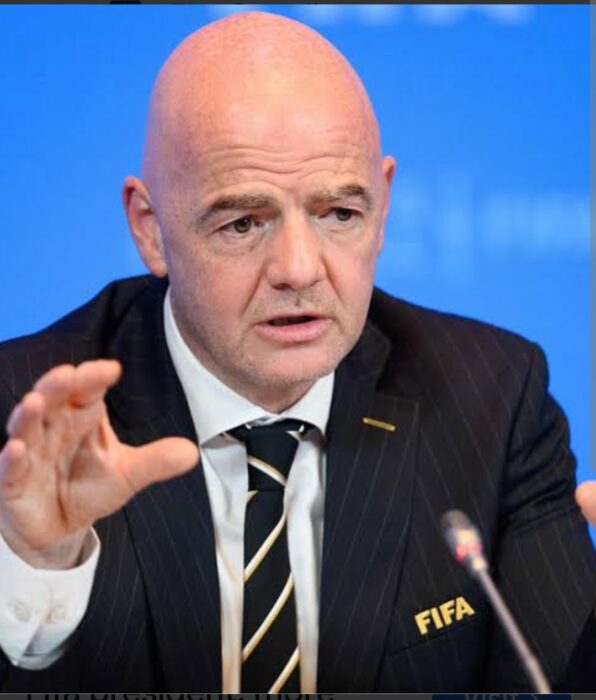
FIFA President Gianni Infantino said the proposal was designed to ensure that the commercial growth of football benefits every part of the game, including countries and regions that have historically received fewer opportunities.
“Football is the world’s most popular sport and an extraordinary engine of human and social development,” Infantino said.
“Our job is to make sure the rest of football grows with it: FIFA exists to support sustainable, inclusive development in every corner of the world.”
Infantino said FIFA’s commercial success should be used to create greater opportunities for its 211 Member Associations.
“Our next stage of growth needs a structure built for it, one where the commercial side of the game operates as a focused, dedicated business, with its value shared more and better all around the world,” he added.
“Every FIFA Member Association should have an opportunity to seek a fair share of the available funding to shape its own future, deciding for itself rather than relying on others. This is about the democratisation of football worldwide.”
The FIFA president also stressed that the proposed investment would not be restricted to the game’s wealthiest or most established nations.
“We intend to invest heavily even in the smallest or most remote parts of the footballing world, places that are too often passed over,” he said.
“Every FIFA Member Association, whatever its size, resources, or geographic location will have a voice and the opportunity to determine its own course.”
Nigeria Among 211 Associations Set to Benefit
If approved, the proposal would have significant implications for the Nigeria Football Federation (NFF), which would be among the 211 associations eligible for the increased FIFA Forward funding.
The proposed rise from USD 8 million to USD 20 million per association for the 2027-2030 cycle would provide a substantial increase in the resources available for football development.
The optional FFFP funding could also provide additional capital for major infrastructure projects, including stadiums and national training centres, which FIFA said could otherwise be difficult for individual associations to finance within a single development cycle.
FIFA said participation in the programme would be entirely voluntary, with each association having the opportunity to access up to USD 20 million in one-off capital.
FIFA Insists Investors Will Not Control Football
The proposed commercial restructuring will bring together FIFA’s commercial rights, including broadcasting, sponsorship, ticketing and licensing, with the operational delivery of its tournaments.
FIFA said the move was designed to unlock the commercial potential of its entire portfolio of men’s, women’s and youth competitions while ensuring that the resulting benefits are channelled back into football development.
Third-party investors would be permitted to acquire minority, non-controlling interests in FFE, but FIFA would retain majority representation on the subsidiary’s board.
The governing body also emphasised that investors would not be buying into FIFA itself.
“They are investing in a subsidiary of FIFA, and not in FIFA itself,” the organisation said, adding: “For FIFA, nothing changes.”
FIFA said prospective investors would be selected based on long-term governance and strategic criteria, with the aim of creating a geographically diversified group reflecting football’s global reach.
The proposed investor group is expected to be led by Thrive Eternal, a permanent capital holding company. Greg Maffei, CEO of BANN Ventures and former President and CEO of Liberty Media during its acquisition and ownership of Formula One, has also been involved as a key commercial adviser.
J.P. Morgan has been engaged to work alongside FIFA, while OpenEconomics is among the other advisers involved in discussions with prospective investors.
Largest Development Commitment by a Sports Organisation
FIFA said the proposed investment, combined with its existing development programmes, could take its total planned football development funding to more than USD 10 billion over the next four years.
The governing body described the proposal as potentially the largest development commitment ever made by a sports organisation.
FIFA pointed to the 2026 World Cup as evidence of the impact of sustained investment in football development, noting the progress of debutants such as Cabo Verde and Curaçao, whose emergence on the global stage followed years of development support.
The organisation said the 2026 World Cup also generated unprecedented global commercial and fan engagement, with almost 16 million people attending matches and fan festivals while billions more watched around the world.
FIFA said the proposed structure would seek to build on that momentum by ensuring that the commercial growth generated by the global game is reinvested across all 211 Member Associations.
However, the plan is not yet final.
FIFA said the launch of FIFA Forward Enterprise and the associated funding mechanisms would require the support of a majority of its Member Associations, alongside the necessary regulatory approvals from the FIFA Council.
If approved, the new funding model would represent a major increase in FIFA’s direct investment in football development worldwide, potentially giving national associations significantly greater resources to develop infrastructure, players, coaches, competitions and grassroots football.
We’ve got the edge. Get real-time reports, breaking scoops, and exclusive angles delivered straight to your phone. Don’t settle for stale news. Join LEADERSHIP NEWS on WhatsApp for 24/7 updates →
Join Our WhatsApp Channel