
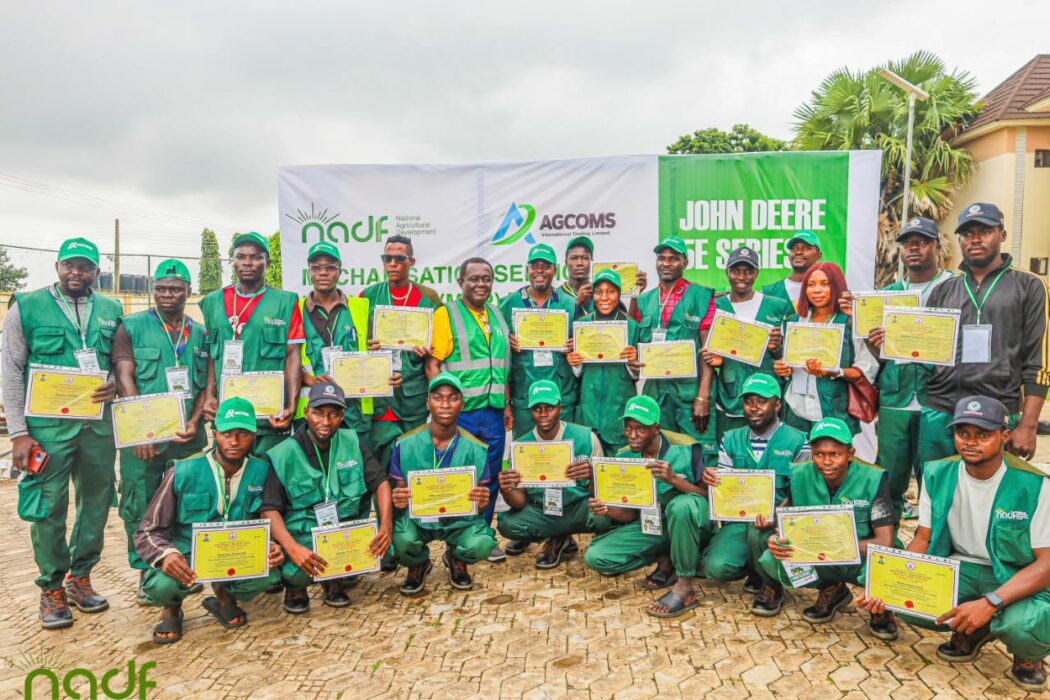
The federal government has graduated the first cohort of 250 participants trained under the National Agricultural Mechanisation Service Providers (NAMSP) Training Programme, aimed at strengthening machinery deployment across Nigeria.
The 10-day programme, organised by the National Agricultural Development Fund (NADF) with the Ministry of Agriculture and Food Security, AGCOMS and partners, focused on mechanisation, machinery management, maintenance, safety and enterprise development.
The initiative targets 4,000 tractor drivers and mechanics with the first 250 drawn from the six geopolitical zones.
Speaking at the closing ceremony, NADF Executive Secretary, Mohammed Ibrahim, represented by general manager, technical, Ernest Ihedigbo, said the graduation marked a milestone in government’s drive to modernise agriculture through mechanisation, innovation and human capital development.
Ibrahim said the programme would build the skills, systems and maintenance culture required to sustain productivity and strengthen food and nutrition security.
He commended President Bola Ahmed Tinubu for making agriculture a driver of food security, diversification and job creation under the Renewed Hope Agenda, and Agriculture Minister Senator Abubakar Kyari for advancing agricultural reforms.
According to a statement, NADF said trainees have received instruction in machinery management, safety, enterprise development, maintenance and environmental sustainability. The trainees will be certified by the Industrial Training Fund (ITF) and included in NADF’s national database of mechanisation service providers.
Ibrahim said the database would support investment in machinery and enable certified providers to manage multimillion-naira assets. He stressed that mechanisation should be judged not by the number of tractors acquired, but by their operational efficiency, productivity and economic viability.
He said past investments had sometimes failed because of inadequate technical capacity, maintenance systems and accountability.
“Beyond technical skills, the programme has strengthened professionalism, enterprise mindset and operational discipline required to sustain an efficient mechanisation ecosystem.
“The future of agricultural mechanisation in Nigeria depends not only on acquiring machines, but on sustaining them through technical competence, accountability, and responsible asset and environmental stewardship.
“Let your work increase productivity, expand access to mechanisation, preserve national investments, and accelerate Nigeria’s agricultural prosperity,” Ibrahim said.
NAMSP, he added, formed part of wider NADF interventions, including the Farm Input Support Programme supporting 109,000 smallholder farmers and the Grassroots Digital Extension Corps, which has trained 1,884 extension agents and food security specialists. NADF is also investing in research laboratories, digital extension, biotechnology, renewable energy and irrigation.
The NADF chief urged mechanisation associations and State Agricultural Development Projects to recruit young people and women, as rural-urban migration and an ageing farming population threaten the workforce. He described the graduates as a new generation capable of reducing downtime, expanding access and protecting assets.
National President of the Tractor Owners and Hiring Facilities Association of Nigeria (TOHFAN), Abdullahi Mohammed, commended NADF for bringing together participants nationwide.
He said continuous training was necessary because manufacturers and vendors could not remain available wherever tractors operate. He called for collaboration among NADF, manufacturers, vendors and service providers, and government support to make machinery affordable.
Director of Training at ITF, Hayatu Tambuwal, said the agency monitored the programme from commencement to completion. He said ITF evaluated the training and provided certification, observing positive attitudes and evidence of learning. He also urged NADF to sustain the partnership and expand the programme, noting that adequate funding would be required.
Representing Women in Mechanised Agriculture (WIMA), beneficiary Akuhwa Sewuese Michelle, said the training provided practical skills in tractor operation, safety, maintenance, servicing, troubleshooting and use of implements.
She said it strengthened women’s confidence and demonstrated their capacity in mechanisation, food security, employment and economic empowerment.
We’ve got the edge. Get real-time reports, breaking scoops, and exclusive angles delivered straight to your phone. Don’t settle for stale news. Join LEADERSHIP NEWS on WhatsApp for 24/7 updates →
Join Our WhatsApp Channel