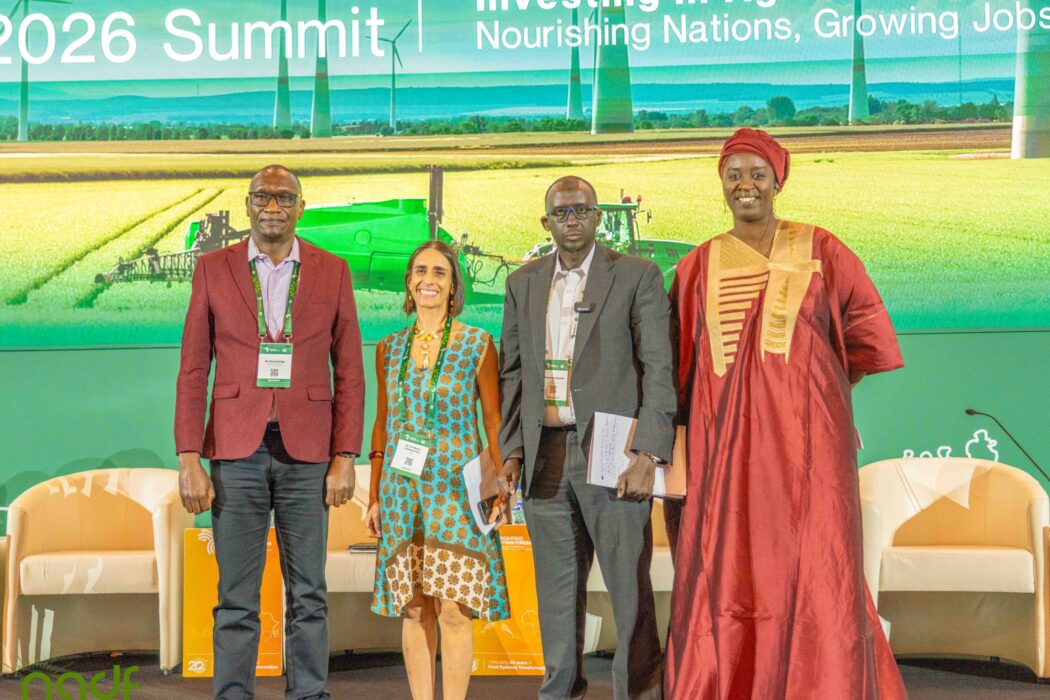
The executive secretary of the National Agricultural Development Fund (NADF), Mohammed Ibrahim, has called for a coordinated financial architecture that brings together public, private and concessional capital to unlock Africa’s agricultural potential and accelerate the transformation of its food systems.
Ibrahim made the call during the Policy and State Capability Thematic Plenary, titled “Aligning Investment to Fast-Track CAADP Objectives,” at the Africa Food Systems Forum (AFSF) in Kigali, Rwanda.
He said African countries must move beyond conventional approaches to financing agricultural programmes by developing structured systems that align investments with national priorities, de-risk projects and attract greater private-sector capital.
Ibrahim said the challenge facing agricultural financing on the continent was not only the availability of capital but also the fragmentation of existing resources and the lack of effective mechanisms to coordinate investments.
In a statement, he explained that NADF’s approach involves identifying national priorities, developing credible investment opportunities and strategically deploying public and concessional resources to catalyse additional financing.
According to him, the fund is also working to de-risk agricultural investments and build credible, bankable project pipelines capable of attracting private-sector financing.
He stressed that public resources should be strategically deployed to attract private investment rather than displace it, noting that the absence of commercially viable projects remained a major constraint to mobilising capital for agriculture.
The NADF executive secretary also called for stronger data systems to guide investment decisions and improved accountability to ensure that agricultural financing produces measurable benefits, particularly for smallholder farmers.
He advocated a shift from measuring agricultural interventions by the amount of money spent to assessing the actual outcomes and changes generated by such investments.
Ibrahim said the impact of agricultural programmes should be assessed not only through increased yields but also by improvements in farmer profitability, participation in value chains, resilience and livelihoods.
He further advocated independent monitoring, evaluation and learning systems to establish what works, identify gaps and generate evidence for scaling up successful interventions.
He said, “We’re continuously trying to move from just funding to a financial architecture.
We want to see that we are coordinating financial capital because there is sometimes a problem of capital availability, but also fragmentation of capital that lack of a structure.”
He asked, “If we do not have credible pipelines or the right projects that would attract private capital, then what do we do?
The first is that we are strengthening data for investment decisions. No investment decision is made without looking at the data and what it shows.
We are pushing for a transition towards accountability for outcomes. So, what has that money changed on the ground?”
Also speaking, Ana Maria Loboguerrero, Director of Adaptive and Equitable Food Systems at the Gates Foundation, said philanthropic capital could serve as a catalyst by providing patient and higher-risk financing for innovative agricultural solutions before commercial investors became involved.
She said such financing could generate evidence, strengthen public-sector capabilities and reduce risks, making agricultural investments more attractive to commercial capital.
Participants agreed that achieving the objectives of the Comprehensive Africa Agriculture Development Programme (CAADP) would require more than increased funding.
We’ve got the edge. Get real-time reports, breaking scoops, and exclusive angles delivered straight to your phone. Don’t settle for stale news. Join LEADERSHIP NEWS on WhatsApp for 24/7 updates →
Join Our WhatsApp Channel