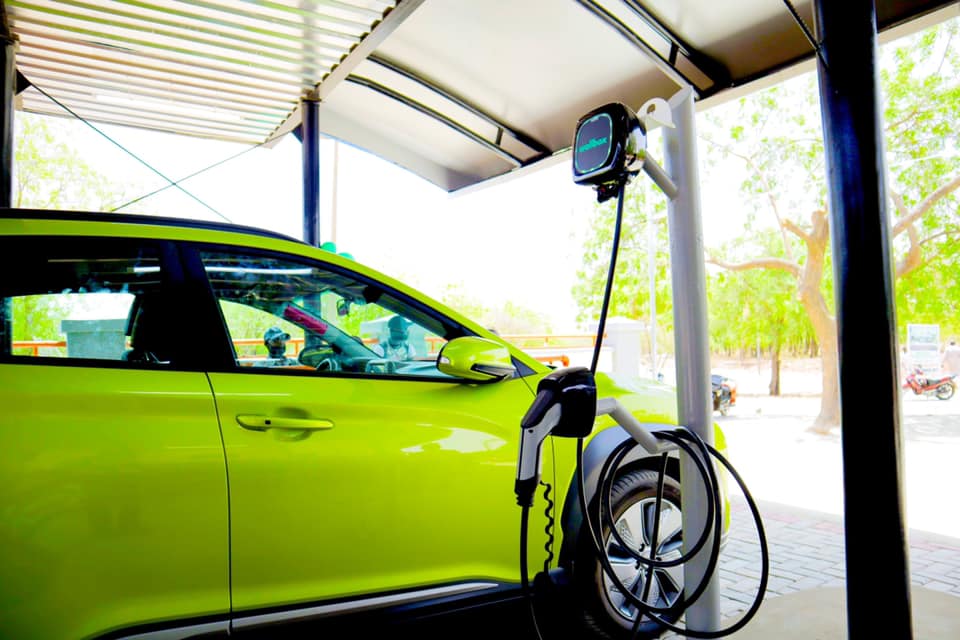
High interest rates, unreliable electricity supply and inadequate charging infrastructure are threatening the adoption of electric vehicles (EVs) in Nigeria, industry experts have warned.
They said although tax incentives introduced by the federal government have helped reduce the initial cost of EVs and increased their visibility on Nigerian roads, expensive financing and the lack of reliable electricity could prevent the country from achieving mass adoption.
The experts also called for affordable green financing, increased investment in renewable energy-powered charging infrastructure and stronger incentives for local EV assembly to accelerate Nigeria’s transition to clean mobility.
Electric vehicle user, Prince Mustapha Audu, said the cost savings associated with EVs become significant when the vehicles are charged with renewable energy.
“I’ve not been to a petrol station for over four years. The car I use is an EV, and when I charge it with the NEPA light, it costs the equivalent of about N8,000 every two weeks.
“However, I have a solar panel in my house, which means I actually use free electricity to charge my vehicle. So I’ve not paid for petrol to move around Abuja or travel to nearby states that I visit.”
While Nigeria is one of Africa’s largest economies, its EV market remains behind countries such as Morocco, South Africa and Egypt.
In the first half of 2026, the federal government approved tax waivers for about 4,000 electric vehicles imported into Nigeria, with import duties reduced to zero under a new clean mobility programme designed to promote EV adoption and local assembly.
Under the Energy Reforms Framework’s fiscal incentives, pure battery-electric vehicles and qualifying extended-range electric vehicles (EREVs) are eligible for duty-free and VAT-free importation, while hybrid vehicles and luxury models valued at $100,000 or more do not qualify for the waivers.
However, EV mobility and fleet economics consultant, Victor Okwudil, said economic pressures and weak infrastructure remained major constraints.
“EVs are becoming more visible on Nigerian roads, but economic pressures and weak infrastructure continue to slow adoption.”
He said the growing visibility of EVs was an indication that Nigerians were gradually becoming more receptive to the technology.
“EV has been welcomed, from how I see it, and being in the auto dealership market, we’ve started seeing more EVs on our streets than we used to see this time last year. Some influential people have started driving EVs, which will flow down.”
Okwudili, however, said the wider automotive market had slowed due to inflation and declining consumer purchasing power.
“People are not buying cars like they used to. But I have not seen anybody that has bought an EV who wouldn’t want to try it again. The point is that there is not much money in circulation, and even with elections around the corner, car sales have dropped.
“In our country, if you look at it, governments are the highest people that purchase brand-new cars. 65 per cent of brand-new cars that are being purchased in this country are bought by government agencies and some big business organisations.”
Despite the economic downturn, he argued that EVs were not necessarily more expensive than internal combustion engine (ICE) vehicles.
“EVs are actually cheaper than ICE vehicles in the real sense.
“According to him, a sound EV can be purchased for around $10,000 (about N15 million), which is about the price of Nigerian-used cars. For average people, one can get used EVs for the equivalent of $6,000. But luxury EVs may cost N100–150 million, but ICE vehicles can go above N700 million, and people are still buying them. The only issue is that people don’t have the finances to buy it.”
Okwudili said the major challenge was therefore not necessarily the price of EVs but access to financing, particularly as high interest rates make it difficult for individuals and businesses to fund vehicle purchases.
He also dismissed some concerns about charging infrastructure, saying most EV users should be able to charge their vehicles at home.
“It’s just like your phone. Your phone is designed to be charged in the wall socket, not constantly with a power bank. In the case of EVs, charging stations are for emergencies. If you want the life of your battery to cross the 8 to 10-year warranty, you are not supposed to constantly use fast chargers,” he said.
A Nigerian automotive industry expert and former Director for Policy and Strategy at the National Automotive Design and Development Council (NADDC), Luqman Mamudu, said the Federal Government’s tax waivers had helped stimulate the market.
“Tax waivers introduced by the federal government have certainly helped. They brought down the initial cost and opened up the market, and we’ve seen a noticeable increase in EVs on Nigerian roads.”
He said, however, that the growth had been concentrated largely in commercial e-mobility rather than private vehicles and ride-hailing passenger cars.
“But the growth has largely been in commercial e-mobility rather than private and ride-hailing passenger cars. With petrol prices rising, companies involved in ride-hailing, logistics, and delivery are finding electric two- and three-wheelers increasingly attractive.
“Local assembly is also beginning to play a role. So, I would say the response has been encouraging, but we are still at the early stages. The tax incentives helped open the door, but we now need policies that can sustain the growth.”
Mamudu identified the high cost of financing as one of the biggest barriers to mass adoption.
“The upfront cost is still one of the biggest barriers. The tax incentives have helped reduce the price, but EVs can still cost more than comparable petrol vehicles.
“So the bigger problem, however, is financing. In countries where EV adoption is growing quickly, people can access affordable loans and green financing.
“In Nigeria, interest rates are high, so many individuals and fleet operators have to find the money upfront. That makes it difficult to achieve mass adoption.”
Beyond financing, Mamudu said unreliable electricity supply posed another major threat to the expansion of EVs.
“Electricity supply is another major issue for adoption. You cannot have large-scale EV adoption without thinking seriously about where the electricity for charging will come from.
“Our power supply is still unreliable, and the public charging network is very limited and concentrated mainly in Lagos and Abuja. Some charging stations have to depend on generators when the grid is unavailable. That creates a strange situation where you are charging a vehicle that is supposed to be cleaner using diesel or petrol.
“It also creates what I call charging anxiety. People want to know, ‘If I travel outside the major cities, where will I charge?’ This is one reason we are likely to see more extended-range EVs and plug-in hybrids in Nigeria, because they provide a backup when charging infrastructure is not available.”
He called for a shift from reliance on import incentives to policies that would make EV ownership more affordable and sustainable.
Mamudu said, “We need to move beyond just giving tax waivers.
“We need affordable green loans for fleet operators, logistics companies, civil servants, and other potential users. If people cannot finance the vehicle, reducing import duty alone will not solve the problem.”
He also advocated stronger incentives for local manufacturing and assembly.
The automotive expert said, “We should give stronger incentives for companies assembling EVs locally, including easier access to SKD and CKD components. The more we assemble locally, the more we can bring down costs, create jobs, and gradually develop the local supply chain.
“So, the opportunity for Nigeria is not simply to become a market for imported EVs. We should use the EV transition to build a local manufacturing and mobility industry around it. That, to me, is where the real long-term value lies,” he said.
Meanwhile, renewable energy expert, Dr Damilola Asaleye, said Nigeria did not have to depend entirely on the national grid to power the country’s growing EV fleet.
She said renewable energy could provide a practical alternative for charging electric cars, tricycles and other e-mobility solutions, particularly in communities where grid electricity remained unreliable.
“We don’t have to wait for the national grid for us to be able to power the electric vehicle. The way to it is to use the existing resources in the country in terms of renewable energy.”
Asaleye said several companies were already developing charging stations powered entirely by solar mini-grids, with electric tricycles deployed in rural communities.
“I’ve seen a lot of electric vehicles that are being charged by renewable energy. In several mini-grids, electric charging stations and tricycles are 100 per cent on solar systems,” she added.
She stressed the need for stronger government support to expand renewable energy access, particularly in last-mile communities with low purchasing power.
According to her, incentives should cover not only financing but also technical equipment and subsidies needed to make renewable energy deployment more affordable.
“Some incentives are already available, but because of technicalities, equipment remains expensive to procure. There is a need for incentives in terms of subsidy, technical equipment, and resources required to deploy renewable energy more affordably,” she said.
We’ve got the edge. Get real-time reports, breaking scoops, and exclusive angles delivered straight to your phone. Don’t settle for stale news. Join LEADERSHIP NEWS on WhatsApp for 24/7 updates →
Join Our WhatsApp Channel