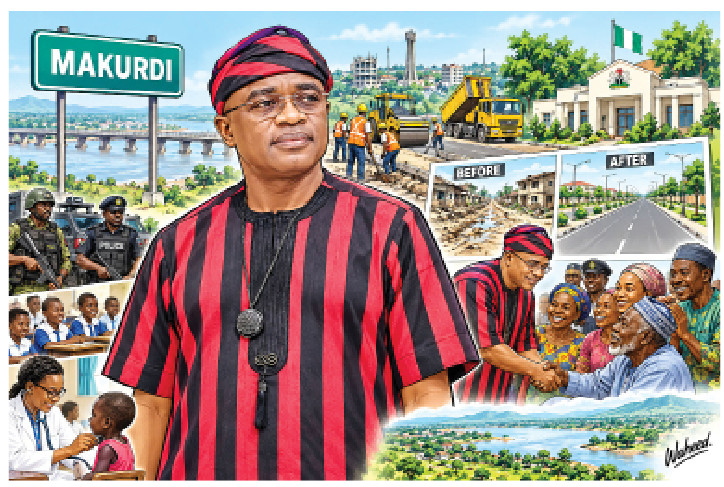
I was in Makurdi recently for the just-concluded North Central Regional Security Summit. I arrived in the city some days ahead as a member of the planning committee to put the final touches on the preparations. I had missed Makurdi, the city where I lived as a young boy in the early ’90s. When our vehicle approached the North Bank bridge, ushering us into Makurdi, something hit me. It wasn’t the atmosphere; it wasn’t the sight of the River Benue. It also wasn’t the thought of the Tiv delicacy of pounded yam and pocho soup that I looked forward to. It was the sight of heavy machinery and human activity scattered across almost every turn and bend. It felt like a city being rebuilt.
We struggled with Google Maps to navigate our way because of the volume of construction work going on in almost every nook and cranny of the city. When Google Maps told us to turn right, the construction workers would tell us to turn left. It was funny at some point, and we enjoyed the ride until we reached our destination, but not without forming an impression in my mind.
The cassock
Rev. Fr. Dr. Hyacinth Iormem Alia is the governor of Benue State, and the only cleric among the present class of governors in this dispensation. He is the second Roman Catholic priest to serve as governor of Benue State. The late Very Rev. Fr. Moses Orshio Adasu was the first in the state between January 1992 and November 1993; he was also the only cleric among the class of ’92 governors in Nigeria. When this piece of history crossed my mind, I smiled and asked myself: there must be something about the cassock, especially in Benue State.
My presence in Makurdi coincided with the conclusion of a statewide tour embarked upon by the governor and his team. With Benue serving as the host state for the North Central Zonal Security Summit, the governor was on the ground and participated fully from preparations to the event proper. Benue was a very good host. I was also privileged to meet Hon. Solomon Iorpev, the State Commissioner for Information and Orientation. I shared my fascination with him, especially the Google Maps episode. He let out a pleasant smile and said they had just returned from a statewide tour where the governor presented his scorecard to the people directly with facts.
He said, “In the space of a single week, the administration of Rev. Fr. Dr. Hyacinth Iormem Alia did something few Benue administrations have attempted with such scale and openness: it took itself, project list in hand, to the people across all three senatorial districts and all eleven federal constituencies of the state.”
He was emphatic in his position. In the midst of interjections from associates at the venue of the security summit, he did not falter in his analysis. He graciously extended an invitation for me to visit his office the next day, and I was there at the agreed time. Amid a marathon of meetings, I finally had my moment. With his usual sense of humour, he pointed to a book on top of a heap of books in the far-right corner of his office and said, “That book is for you. In Benue, we don’t talk; we show evidence.” And we both laughed.
I grabbed the book, assessed the print quality, and flipped through the pages. It is a 248-page publication with a title that captivated me: “Strokes of the Silent Achiever: Rhythms of Two Years in Office of His Excellency, Rev. Fr. Dr. Hyacinth Iormem Alia.” I commended the title because of the “silent achiever” phrase, which is not common in our political vocabulary where phrases like “political bulldozer,” “the project governor,” “the dancing governor,” “the political Maradona,” “Mr. Salary,” “Mr. Governor,” “the servant leader,” “the digital governor,” and others too numerous to mention hold sway.
As I flipped through, the prose and images connected seamlessly—and as they say, a picture is worth a thousand words. The before-and-after imagery provided a clear breakdown of executed projects complete with dates. It was vivid, and I asked myself: Is this what Governor Alia is doing in Benue? My host noticed my keen interest in the book, and he jokingly offered a price tag before I could have it. It was hilarious. But what ran through my mind was the instrumentality of philosophy and logic in governance.
Logic and governance
In 2019, I attended a course in philosophy and logic at the Centre for Critical Thinking, Research and Learning at the Nigerian Defence Academy. It was then that I realised the intersection of logic and governance is a tight one. It is a function of choices—public or personal. Those who implement personal choices are popular only among a select few. But those who implement public choices are popular among the people. What is governance without impact on the lives of the people, and what is governance when patronage serves the interest of only a select few? Numerous examples abound in our political culture across various levels of governance in the country.
To fly high in politics is often misconstrued as the ability to manipulate the system. Logic in governance is that moment of deep reflection when political actors realise that a thin line separates where we are from where we ought to be. Governor Alia, by reasonable measure, stood out. The best word to describe the Alia administration in Benue State is intentionality—the quality of doing something on purpose.
My takeaway from Makurdi was that Governor Alia is intentional about the social contract he has with the Benue people. I don’t say this for the fun of it. Anyone who understands the dynamics of intentionality in governance, especially at the grassroots level, would agree with my position.
As I departed Makurdi, I took a deep look out of the window and said to myself, “I will be back,” because beyond the documentation in “Strokes of the Silent Achiever: Rhythms of Two Years in Office of His Excellency, Rev. Fr. Dr. Hyacinth Iormem Alia,” there are deeper lessons in governance worth highlighting at a micro level.
The objective is to come up with an analysis of the drivers of sustainable growth and development in Nigeria, with Benue State as a case study. The decision to zero in on Benue is not far-fetched because of what Governor Alia is doing in the state. They are simply uncommon and worthy of academic research.
In my opinion, what is on ground in the state is a researcher’s delight. What is worth highlighting is the governance model deployed by Governor Alia. Beyond my personal experience, the takeaways from the security summit are not lost on me. I was also impressed with the presentations by stakeholders in the North Central with regard to the security measures deployed to address the perennial conflict in the region. I look forward to the outcome of my research work which I have titled “The Tricks and Bricks of Governance in Nigeria: A Case Study of Benue State, 2023–2027.”
– Dr. Joshua Ocheja, a dual-PhD holder in Military History and Leadership and Public Policy, specialises in the security-development nexus in the Sahel and Nigeria.
We’ve got the edge. Get real-time reports, breaking scoops, and exclusive angles delivered straight to your phone. Don’t settle for stale news. Join LEADERSHIP NEWS on WhatsApp for 24/7 updates →
Join Our WhatsApp Channel