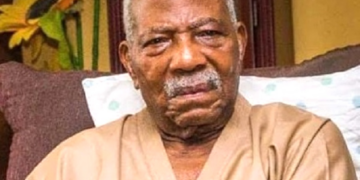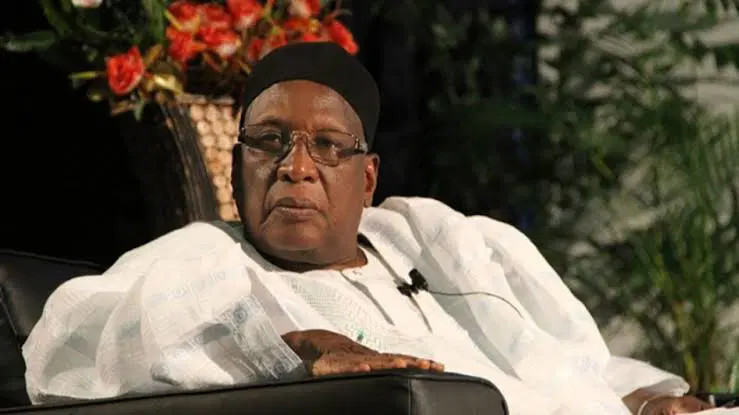
Alhaji Bamanga Tukur died in Abuja on Saturday, three days short of his 91st birthday, having lived through nearly every era of Nigeria’s post-independence public life without ever quite settling into one lane. He ran the country’s ports, governed a state, built an industrial empire, chased the presidency, sat in a military head of state’s cabinet, and eventually chaired the party that dominated Nigerian politics for 16 years.
Few Nigerians of his generation touched as many of the country’s defining institutions, and fewer still left each one with as complicated a legacy as he did. He was, by turns, a technocrat, a governor removed by a coup, a continental businessman, a presidential aspirant, a federal minister and a party chairman brought down by the very organisation he was meant to lead, and few obituaries in recent Nigerian memory have had to reconcile that many chapters into a single life.
His most durable achievement may be the one Nigerians think about least. As general manager and chief executive of the Nigerian Ports Authority from 1975 to 1982, Tukur modernised an institution central to Nigeria’s trade and revenue at a time when the country’s maritime infrastructure badly needed competent management rather than political patronage. That reputation as a serious administrator carried him into politics, where he won the governorship of the old Gongola State in 1983 on the platform of the National Party of Nigeria, only to watch the Second Republic collapse under a military coup on New Year’s Eve that same year, ending a tenure that had barely begun. It was not the last time Tukur’s political ambitions would be overtaken by forces larger than any single career, a pattern that would recur, in different form, three decades later.
Between those two political chapters sat the business career that gave Tukur his continental profile. Through BHI Holdings, also known as the DADDO Group, he built interests spanning manufacturing, agriculture, logistics and trade, and he carried that commercial credibility into pan-African economic diplomacy as Executive President of the Africa Business Roundtable and later Chairman of the NEPAD Business Group, where he became one of the more persistent voices arguing that Africa’s development depended on private enterprise and intra-African trade rather than aid alone.
He returned briefly to national politics during the aborted Third Republic, contesting the National Republican Convention’s presidential nomination in 1992 before that transition collapsed entirely in the annulment of the June 12, 1993 election, and he served as Minister of Industries under General Sani Abacha from 1993 to 1995, adding a federal cabinet post to a résumé that already spanned public administration and private enterprise in equal measure.
It was Tukur’s chairmanship of the Peoples Democratic Party, from March 2012 to January 2014, that produced both his highest formal political office and his most public defeat. Installed with the backing of President Goodluck Jonathan, Tukur inherited a party already straining under disputes over succession and direction, and his tenure became the flashpoint rather than the resolution.
In 2013, former Vice President Atiku Abubakar, joined by several sitting governors and lawmakers, broke away to form the faction that became known as the New PDP, an internal rebellion serious enough to weaken the party heading into the 2015 general election, which the PDP went on to lose for the first time since Nigeria’s return to democracy in 1999. There is a particular irony buried in that fight worth noting: Atiku had been part of the political campaign that first put Tukur in the Gongola State governorship in 1983. Three decades on, the two men found themselves on opposite sides of a battle for control of the same party, a reminder of how fluid Nigerian political alliances remain across a career long enough to contain multitudes.
That episode deserves more attention from Nigerians reflecting on Tukur’s life than a passing mention, because it is not only a footnote in one man’s career. It is a recognisable pattern this newspaper has pointed to elsewhere in Nigerian institutional life, most recently in the governance disputes that have shaken the Nigerian Bar Association’s electoral process and the Nigeria Football Federation’s leadership. When Nigerian institutions, political parties very much included, hit a genuine crisis over succession or direction, the response is rarely an internal process strong enough to absorb the disagreement. It is a faction, a walkout, a rival structure built outside the institution rather than a reform pursued inside it. The PDP’s 2013 rebellion foreshadowed exactly the kind of institutional fragility Nigeria continues to grapple with today, in bodies far removed from party politics, and Tukur’s chairmanship is a useful, if uncomfortable, case study in how quickly an institution can fracture when its internal mechanisms are not trusted to settle a dispute of this size.
None of that erases what he built elsewhere. President Bola Tinubu, in a statement mourning his passing, called him “urbane, generous and deeply rooted in the values of integrity and service,” and former President Goodluck Jonathan praised his contributions to Nigeria’s political development and democratic consolidation. That two presidents from opposing political traditions, along with former Senate President David Mark and the Northern Nigeria Governors’ Forum, all found genuine cause to mourn him says something about the breadth of the respect he commanded even from those who stood against him at various points in his long public life.
Bamanga Tukur’s career touched the ports, the governor’s office, the boardroom, the presidential race, the federal cabinet and the chairmanship of Nigeria’s most powerful party, and each chapter left something durable behind it, alongside the contradictions and unfinished battles that came with operating at that level for six decades. Nigeria has lost a genuine builder of institutions. It has not yet learned the lesson his own party’s internal collapse under his leadership was trying to teach it.
We’ve got the edge. Get real-time reports, breaking scoops, and exclusive angles delivered straight to your phone. Don’t settle for stale news. Join LEADERSHIP NEWS on WhatsApp for 24/7 updates →
Join Our WhatsApp Channel